
 Apple Podcasts
 Spotify
 iHeartRadio
 Audible
 YouTube
 RSS Feed
 Defy Organizational Gravity with Synthetic Personas - with Dr. Matt Wilkinson
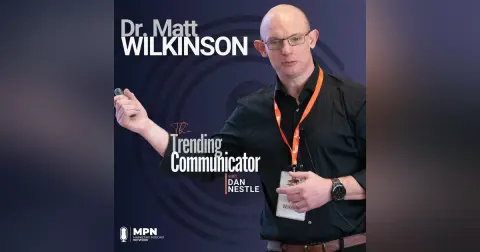
Customer research goes in full of real language and emotion, but by the time brand, legal, and executive reviewers are done with it, the message that reaches the market has gone flat. Dr. Matt Wilkinson, founder and CEO of Strivenn and author of The Buyer in the Loop, calls that force "organizational gravity" and explains how grounded synthetic customers built from a company's own research keep the buyer's voice in the work from brief to launch, along with where those synthetic customers fall short.
Key Takeaways
- Synthetic customers are grounded AI representations built from a company's own CRM data, sales transcripts, interviews, and social listening to keep customer insights intact from inception to launch.
- Organizational gravity dilutes customer emotion and intent during review cycles, making gut feelings hard to defend compared to evidence-backed synthetic personas.
- Generic 'act as' AI prompts fall short because true synthetic personas require proprietary data grounding, creating a defensible moat for your organization.
- Synthetic panels can effectively test creative assets like book covers alongside real-world polling, but they still struggle with deep emotional nuances like pricing and temporal drift.
- Communicators can expand synthetic modeling beyond buyers to map out investors, stakeholders, and opposition lobby groups before a message goes live.
What happens to a customer's words between the research readout and the campaign launch? Usually they survive in meaning and die in language. Every review cycle sands off a little more of the emotion that made the insight worth having, until the market no longer recognizes itself in what comes back.
In this episode of The Trending Communicator, Dan Nestle welcomes back Dr. Matt Wilkinson, founder and CEO of Strivenn and author of The Buyer in the Loop. Matt's answer is the grounded synthetic customer: an AI representation built from a company's own interviews, CRM data, sales transcripts, and social listening that stays with the work from inception to launch and can trace every recommendation back to the evidence behind it.
From there, the conversation turns to why an "act as" prompt can't stand in for real customer knowledge, and to the book cover Matt tested on a synthetic panel and on LinkedIn at the same time. Matt is candid about where synthetic customers stumble, with a Montblanc pen and New Coke along the way, and he closes with how communicators can build personas for investors and even the lobby groups working against them. He also makes the case that all of this should send teams back to their real customers more often.
Listen in and hear about...
- Why organizational gravity can't be fixed one department at a time
- The difference between a one-page persona, an "act as" prompt, and a grounded synthetic customer
- How a synthetic panel and a LinkedIn poll split the same way on three book covers, then agreed on a fourth
- Why the half-life of customer research is shrinking in the era of zero-click search
- Where synthetic customers break down, from temporal drift to pricing and emotion
- How communicators can model investors, stakeholders, and opposition groups before a message goes out
Notable Quotes from Matt
"The ability to create stuff, everybody has it now, but the ability to understand your customer is one of the few things that really sets us apart." - Dr. Matt Wilkinson [06:05 → 06:54]
"Does the customer really care that you've been in business 20 years? Yes, they want a reliable partner to work with, but actually they probably want to know, what have you actually done for the industry? What have you changed? What problems have you solved?" - Dr. Matt Wilkinson [13:20 → 13:52]
"The thing about the grounding is it's twofold. One, that it is grounded in evidence, but secondly, it's grounded in your evidence. And that's where the real moat comes in." - Dr. Matt Wilkinson [29:53 → 30:33]
"It gives marketers the ability to start pointing at evidence rather than their gut feelings, because gut feelings are really hard to defend." - Dr. Matt Wilkinson [31:22 → 32:03]
"Why would you spend five, six, seven figures on customer insight when all you're going to do is turn it into a report, share it, have a couple of meetings about it and then forget it?" - Dr. Matt Wilkinson [44:05 → 44:24]
"People spend hundreds of dollars on buying a Montblanc pen. It performs the same service as a Bic Biro that maybe costs a dollar... The difference is how it makes you feel and how other people might perceive you using it." - Dr. Matt Wilkinson [47:39 → 49:27]
Resources and Links
Dr. Matt Wilkinson
- Strivenn
- drmattwilkinson.ai
- The Buyer in the Loop: How Synthetic Customers Stop Your Buyer Disappearing Between Research and Market
Mentioned in this episode
- You're the Top of the AI Sandwich - with Brian Piper and Matt Wilkinson
- Jim MacLeod, designer of the book cover
Timestamps
[00:00] Why many hands make flat work in comms and marketing
[02:54] Matt returns to the show
[04:24] The fireworks lecture that doubled undergraduate chemistry recruitment
[06:05] When anyone can create, understanding the customer is the edge
[07:18] Research-backed messaging that falls flat in the market
[09:13] Organizational gravity as a force of nature, not a department problem
[10:20] Naming the problem, and why good strategy stalls inside the organization
[10:58] Building synthetic customers from everything you know about your buyers
[12:20] Carrying the customer from inception to launch, and weighing legal's edits
[13:20] The heritage line: what customers actually want to hear about longevity
[17:27] Why "act as" prompts fall short
[18:56] The persona spectrum, from one-page profiles to grounded synthetic customers
[20:35] The persona workshop flip charts nobody ever sees again
[22:24] Using AI to build customer archetypes from data
[25:46] Backing up messaging decisions with 30 qualitative interviews
[28:34] What "grounded" means, and why it's a moat
[32:30] Testing the book cover on a synthetic panel and on LinkedIn
[39:48] Organizational gravity as Steven Pressfield's resistance
[40:49] Grounding as onboarding for AI models
[43:13] Zero-click search and the shrinking half-life of customer research
[46:15] Where synthetic customers break: temporal drift and knowledge gaps
[47:39] Why synthetic customers struggle with pricing
[52:28] Can synthetic personas model emotion? New Coke and asking the wrong questions
[57:02] Where communicators start: investors, stakeholders, and lobby groups as personas
[59:00] Wrap-up
About The Trending Communicator
The Trending Communicator is a podcast about the future of communications and marketing, hosted by Dan Nestle. Each episode is a conversation with a communicator, marketer, author, or technologist about how the work is changing and what that means for the people doing it. The show launched in 2020 as The Dan Nestle Show and has published more than 150 episodes.
About the Host
Dan Nestle (Daniel Nestle) is a communications strategist with more than 25 years of experience, including 16 years in Japan. He is co-founder and Chief Product & Intelligence Officer of Lilypath, the company behind the patent-pending Authority Intelligence™ platform, and founder and Chief Curiosity Officer of Inquisitive Communications, a strategic advisory practice. He received the 2022 Arthur W. Page Society Page Up Innovation Award, was named a PRWeek Dashboard 25 AI Pioneer in 2023 and 2024, and was named one of Propel's 100 Most Influential PR Tech Leaders Worldwide in 2025.
Connect with Dan
The Trending Communicator: https://trendingcommunicator.com
Substack: https://trendingcommunicator.substack.com
LinkedIn: https://linkedin.com/in/nestle
Lilypath: https://lilypath.com
Inquisitive Communications: https://be-inquisitive.com
Instagram: https://instagram.com/trendingcommunicator
Show notes for The Trending Communicator are co-created by Human Dan, Claude, and Fireflies.
Hosted by Simplecast, an AdsWizz company. See pcm.adswizz.com for information about our collection and use of personal data for advertising.
Frequently Asked Questions
What is a synthetic customer in communications and marketing?
A synthetic customer is an AI-powered representation built from a company's actual interviews, CRM data, and sales transcripts that stays with a project from inception to launch, ensuring customer insights don't get lost in review cycles.
How do grounded synthetic customers differ from generic AI prompts?
While an 'act as' prompt uses generalized AI training data, a grounded synthetic customer is built using a company's proprietary evidence and data, providing specific, defensible insights unique to that organization.
Where do synthetic customer models struggle or break down?
Synthetic customers can struggle with temporal drift, deep emotional contexts like luxury pricing strategies, and nuanced human reactions, meaning they should complement rather than entirely replace real customer interactions.
How can communicators use synthetic personas beyond buyers?
Communicators can leverage synthetic personas to model investors, key stakeholders, and even opposition lobby groups, allowing teams to test messaging strategies against diverse perspectives before launching campaigns.