
 Apple Podcasts
 Spotify
 iHeartRadio
 Audible
 YouTube
 RSS Feed
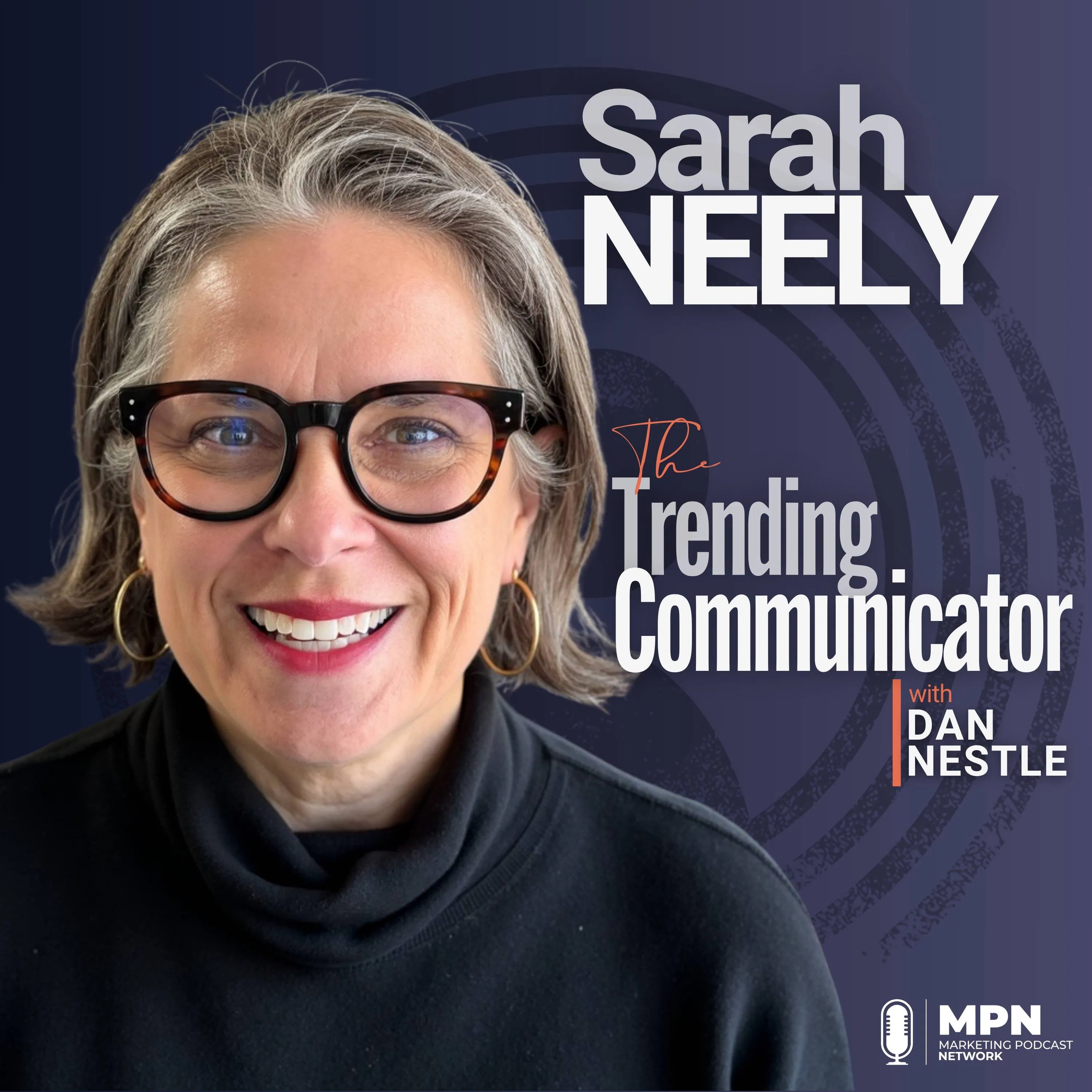
 Why Human Conversation is the OS for AI - with Sarah Neely
Can you build word of mouth on purpose?
Few people are better equipped to answer it than Sarah Neely. She's spent two decades engineering the conversations most brands just hope will happen by accident, and she's now the founder of SignalSwell, built to make human word of mouth "audible" to AI. She also leads client strategy at Fizz, one of the few agencies built entirely around getting people to talk. Her premise runs against everything a virality-obsessed business wants to believe: advocates are a personality type you can plan for, and the right story dropped in the right place does the rest.
In this episode of The Trending Communicator, host Dan Nestle and Sarah dig into what "story" actually means at the level of a single human conversation, the shorthand one person uses to describe you to someone else. They get into why a cactus at a wedding travels further than a logo, how Red Bull carries the same story from an F1 helmet to a truck stop, and the SHARE framework Sarah uses to build experiences worth repeating.
Then the conversation turns to AI. If the machines increasingly decide which conversations get surfaced, communicators have to make human word of mouth visible to them, on the channels that actually feed the models. It's a practical problem with a strange philosophical center. Maybe human conversation isn't competing with AI at all. Maybe it's the operating system AI runs on.
Listen in and hear about...
- Why word of mouth can be engineered on purpose, and why "organic" is a misleading word for it
- The SHARE framework for creating experiences worth talking about
- What "story" means at the level of a single human conversation, versus a mission statement or value prop
- Making human conversations discoverable to AI, and which channels actually feed the LLMs
- Why human conversation may be the operating system AI depends on to stay relevant
Notable Quotes from Sarah Neely
"The story is that sort of shorthand way that one person would describe a product, a brand, an experience to another person." - Sarah Neely
"If you take all the colors that are in your paint kit, you're going to make something that's brown or gray. It has nothing interesting to look at. And that's what chat is doing." - Sarah Neely
"You need to create signals for humans and AI, and then you need to swell that footprint through human conversation at scale." - Sarah Neely
"The purpose is to remind me to ask more questions, remind me to explore on my own, and remind me to bring it up in a human conversation if it feels relevant." - Sarah Neely
Resources and Links
Dan Nestle
- Lilypath | Website
- The Trending Communicator | Website
- Communications Trends from Trending Communicators | Dan Nestle's Substack
- Dan Nestle | LinkedIn
Sarah Neely
Timestamps
[00:00 - 03:00] Introduction to Word of Mouth Marketing
[03:00 - 09:32] Community and AI Curiosity
[09:32 - 15:58] Word of Mouth as Wedding Planning
[15:58 - 19:49] Defining the Story in Word of Mouth
[19:49 - 24:30] Value Proposition vs Conversational Story
[24:30 - 28:35] SHARE Framework for Story Moments
[28:35 - 30:07] Marketing and PR Collaboration
[30:07 - 35:15] Red Bull Case Study
[35:15 - 43:20] AI Visibility of Human Conversations
[43:20 - 50:22] Social Media vs Word of Mouth Marketing
[50:22 - 53:44] Key Channels for AI Discovery
[53:44 - 56:46] Owned Content Importance
[56:46 - 01:02:24] Human Conversation as AI Foundation
[01:02:24 - 01:04:07] Introduction to Signal Swell
[01:04:07 - 01:10:58] Holistic Approach: The Five C's
[01:10:58 - 01:13:04] Closing Recommendations
(Notes co-created by Human Dan, Claude, Fireflies, and Riverside)
Learn more about your ad choices. Visit megaphone.fm/adchoices
00:00
Daniel Nestle
Welcome or welcome back to the trending Communicator. I'm your host, Dan Nestle. We treat word of mouth like the weather. It's something that just happens to you. You know, you build a decent product, you cross your fingers and maybe if the marketing gods are feeling generous, people start talking about it. We even have a word for it. Organic. As if the best thing that can happen to your brand is the one thing that you have the least control over. I've never really bought that. And I think the brands that get talked about are usually the ones that gave people something worth talking about on purpose. Which is why the phrase word of mouth marketing has always kind of bugged me.
00:48
Daniel Nestle
I mean, it makes a multidisciplinary craft, part marketing, part communications, part pr sound like a lucky accident or a line item on a budget. And then AI walked in and changed where those conversations even live. Well, for two decades, my guest has been the person brands call when they want to be talked about and won't leave it to chance. Red Bull and its early US growth years, then Chipotle, JetBlue, Polaris. She's trained hundreds of people to think like word of mouth marketers, engineering the moments that get a story moving and keep it moving. Her premise is almost heretical in a business that worships virality. The advocate isn't a stroke of luck. It's a personality type. And the right story dropped in the right place does the rest. She's been doing this since before it had a name.
01:38
Daniel Nestle
From the floor of the world of Coca Cola to a decade building Red Bull to running strategy at one of the few agencies built entirely around word of mouth, where she still leads client work today. And out of her own curiosity about where AI is taking all of this, she's built something new on top of it. Today we get into the thing I keep snagging on. Can you actually build word of mouth or is it just luck you dress up after the fact? And what happens to all of it now that AI decides which conversations get heard? She's the founder of Signal Swell. She's been a friend of mine for years and I have a feeling she's about to make me rethink everything I or you listeners out there have ever filed under the term organic.
02:20
Daniel Nestle
Please welcome to the show, my good friend and co ticket holder, golden ticket holder for the uprising, Sarah Neely. Sarah, it is great to see you.
02:31
Sarah Neely
Great to see you. How you doing? Thanks so much for that awesome introduction and yes, I am proud to be tied with you for the most Uprisings attended.
02:43
Daniel Nestle
That's right. Are we.
02:44
Sarah Neely
I don't know, as you know, where we really have dug in with AI, where my interest in AI and how it was starting to show up was really sparked back with Matt Sweezy.
03:00
Daniel Nestle
Yeah.
03:01
Sarah Neely
So really appreciate that community as it's allowed me to build this curiosity, understand how things are shaping up in the AI world and then to have this brainwave of how I could connect what I know how to do and make folks have conversations. And then how does that impact what AI is recommending and talking about?
03:32
Daniel Nestle
You know, that kind of dots that are. They're almost like stepping stones or dots that just happen over time. And it's interesting that, whether I don't know what the right metaphor is, but people keep talking about the uprising and the Rise community. My last episode was with Matt and Brian and we talked about what we did at the last uprising. And I go on and on all the time about, were it not for the uprising, were it not for Rise, were it not for Mark Schaefer, would I be here today? The answer is I would not be here today were it not for those things. We would not be here today were it not for those. Those pivotal events and those dots that you're talking about, starting with Matt Sweezy, you know, or even before that, but starting with his great discussion on.
04:19
Daniel Nestle
I believe it was like Web three that scared the bejesus out of all of us into immediate action. I mean, all of these things kind of are those. Those connecting points, those nodes, those. I don't know if we're going to talk, like I said. What's the metaphor? I don't know. Is it. Are these the. The stones or the lily pads in a pond that, you know, that only we have had access to or something else? I can't quite figure it out. But all I know is it's a convening of people who I want to be convened with. And we always make really interesting connections. And I mean, not just of people. I mean, of ideas. We connect ideas. We connect what we're doing with each other, what we're doing for our own businesses. And, you know, just, I don't know, magic kind of happens.
05:14
Daniel Nestle
It's. It's. It's really cool. It's kind of like a little, I don't know, sort of word of mouth marketing conclave in a way. Right. It really leans into what you do. And I mean, I'm. I feel I'm the better for it, but I know that you and I are talking about, you know, we're talking about word of mouth marketing today, but we talk about it in different ways in how it connects to, you know, my business, how it connects to the what other folks in the Uprising are doing. And it just seems like you're kind of in every conversation these days. We gotta talk to Sarah. You gotta talk to Sarah.
05:55
Sarah Neely
Oh, I like hearing that. I agree. I think actually that the Uprising is a really great example of a community where word of mouth happens about ideas, about products, and that's what you're looking for when you think about, you know, you mentioned, is word of mouth, just luck dressed up. I think that's a funny way of thinking about something that you can in fact plan for and for the Uprising and the Rise community. We are a group of people who are connected by marketing and innovation. And so if you have something that's relevant to that community, it's going to be shared amongst this community. And then we take that information and we share it out in the places that it's relevant outside of those worlds.
06:53
Sarah Neely
And if you think about the filters that we use to bring information into our community of marketers and entrepreneurs, there's lots of stories or brands or products that I could talk about when I'm sitting down to chat with you or Brian, but I'm going to filter those into what is relevant and likely to be interesting to you. So that's something that is a uniquely or especially human skill. And we're able to do that in each of the communities that we're part of. And that's what helps make the stories that advocates share travel even further. Because we're very specific with who and where we're sharing something that is relevant so that it continues to move forward. Just stop. Because I'm not gonna talk to you about, you know, baby diapers or something like that. That has no implication in your life whatsoever.
08:02
Daniel Nestle
Well, not anymore, thankfully. Same case, you know, but you have to be sensitive to where people are in their lives and exactly. Well, you know, like what you're saying. Of course, it makes perfect sense to me because I've known you for a long time and heard about word of mouth and started to think about it really as a, you know, as a real, not just a tactic, as a strategy for various companies I've been involved with and for my own company even. Right. And I think you've sort of answered some of this. But I want to really start by asking you to kind of address the skeptic, right? Like you have spent a career proving basically that word of mouth isn't something that just happens. And even though we just said, like, it's not that the uprising is a place where it happens. Right.
08:54
Sarah Neely
But.
08:57
Daniel Nestle
It's not a magical thing. There are reasons why it happens. And how do you explain to a skeptic that it can be really built on purpose? Purposefully?
09:06
Sarah Neely
Well, I started my marketing and events career as a wedding planner, which is probably a weird segue into AI expertise. But as a wedding planner, you ask a ton of questions because you need to understand the vision that's gonna make the wedding couple feel excited, feel happy, feel like it's authentic to themselves. That's a process that requires a lot of planning and a lot of detail. But when you arrive at the wedding as a guest or as a participant, it shouldn't feel like a strategy or a plan. It should feel like it represents the story of the folks who are getting married. And I think you can kind of take that analogy into a word of mouth or conversation at scale strategy, because you want to figure out, you want to ask those questions, who's going to care about what we're talking about?
10:11
Sarah Neely
Who cares about it the most? What do they already like to do when they're spending time together with people who have similar interests? Now let's go to them and bring them an experience that's worth sharing and worth talking about and feels relevant and authentic to that community. You're still making a plan. You're still asking the questions about who's going to care the most and figuring out where you can meet them, where they already spend their time. And then you're bringing the story to them in a way that gets them excited and lets them have a new story to share. The weddings that you talk about are the ones where you encounter something new or interesting or so perfect for the couple.
11:02
Sarah Neely
That's the piece that makes it worth talking about the wedding the next week or the next time you are having dinner with someone who's newly engaged. Right. So the same is true for brands or services. Ideas. Bring it to the people who are going to find it interesting and exciting and relevant to themselves and their other communities and circles that they're in. They pick it up and they share it for you. So it can be both planned and organic.
11:39
Daniel Nestle
I was just thinking about this whole idea of carrying the story along from the wedding. Yeah. And naturally I thought of my own wedding, you know, almost 25 years ago.
11:50
Sarah Neely
25. Congratulations.
11:52
Daniel Nestle
Thank you. You know, I got married in Japan, and the Japanese approach To weddings is spectacular and exhausting and also kind of. It sounds like it's almost built for what you're talking about. You know, it's like it's not necessarily that you're trying to outdo all the folks whose weddings you've been to because, you know, everybody has that period of time where everybody's getting married and you're going to weddings all the time. And you know, Japane have a term for this is kekon bimbo. It's the poverty that is brought on by having to go too many weddings and give all these gifts, right?
12:27
Sarah Neely
Oh, yeah, I like it. I like it. That's a great, that's a great word to have in a vocabulary.
12:32
Daniel Nestle
I love it. I haven't used that word in 20 years. But the, the thing that like about Japanese weddings is that people bring cash. Like, so you're bring. You're not giving gifts, you're giving cash in exchange for that. I guess you expect to walk away from a wedding with a bag full of stuff like swag, almost. Wow. And the wedding swag is good. I mean, it's ridiculously expensive and good things usually. So when people talk about my wedding, even now, sometimes they talk about the cactus that we gave them. We gave people a cactus, Little planted cactus, right? And this big, like a little tiny for those who are listening, about an inch and a half, you know, maybe three inches high. And some people still have it 20 years later, 25 years later. That's like. It's a giant thing.
13:31
Daniel Nestle
And they're in a big sandy pot, Right. Ours died within months, our own one, because we lived in a. In a dark first floor apartment. And I think we didn't really do anything with it, but so we gave cactus. We also gave these plates, these dishes that we had custom made, as one does for a wedding in Japan. There are these little kind of, you know, small serving plates that had a design of Mount Fuji. And I think it was like a wisteria flowers with our names like written in to the. I forget what the word is. Is it cloisonne, the style?
14:17
Sarah Neely
That is a thing. Yeah. So it's designed into the pattern.
14:20
Daniel Nestle
Yeah. We'll have to ask Chelsea about this. But the whole thing, right, it winds around and around, so it looks like a beautiful pattern. But you get close and it just says Dan and you go 20, you know, whatever, and the date. And anyway, people like this. We had all these unique things. And then you go to another wedding and people give you Wedgwood Stuff, and it's crazy. Right, but you're right. Sorry. Sorry for the kind of diversion there. But the point is that these are items that people talk about after the wedding. And had we thought about engineering this as a word of mouth exercise, and I think we succeeded in that respect. Right. But taking it forward, right. To real. What marketers and communicators are thinking about today. Is it about you talk about the story.
15:14
Daniel Nestle
So is it all about the story? Are the, I guess, paid items, let's call them the swag, the ads, whatever it is. And there's not a lot of advertising involved with this necessarily. You know, the things that people get to remember the story, all of this together. Right. What is the. I think what I'm trying to figure out is this whole idea of story. It's so common to all the disciplines. Right. And I think people just don't kind of get that. They hear story and they kind of tune out or they think, okay, that's pr.
15:58
Sarah Neely
Right.
15:58
Daniel Nestle
So. So is this part of the pushback you get, or is this part of the whole big picture of how to get word of mouth generated and going?
16:09
Sarah Neely
Well, that is a lot of questions. And why.
16:10
Daniel Nestle
I'm sorry. Yeah, that's what I get.
16:12
Sarah Neely
So let me start with story, because I know you just had Jason Dressel on. Mutual friend Jason Dressel on. And he talks about story a lot. He and I talk about it a little bit differently. And one of the things that I like to do whenever I'm leaving a conversation about word of mouth is that I want to define what I mean when I say story. And mine is very focused on human conversation. So what does one person say to another person about that brand, the wedding, the experience? It's not a mission statement. It's not your values and vision. It's not your founder's story. All of those things are important, and they help to make the story true, and they help to make the story lasting.
17:11
Sarah Neely
But the story is that sort of shorthand way that one person would describe a product, a brand, an experience to another person. And you need clarity on that. And that's a really challenging thing for a lot of organizations is to get clarity on what it is that their customers care about, why they choose the product over other products. And once you have clarity on that story, it then leads into the swag, the ads, the things that you're spending money on, because they should remind your customers of the experience that they had, the thing that makes your company special. So if it's just, you know, logo slapping Right. Then that isn't helping them to remember that story. And when they pick up that thing with the logo on it, there's no unlock in their brains about, oh, remember that time?
18:18
Sarah Neely
And that's what we want the swag and the ads to do.
18:22
Daniel Nestle
Well, how does the story then differ from like a value proposition?
18:27
Sarah Neely
Right. And so, yeah, go ahead, throw one at me and I'll see if I can. That will give me a good example to work from.
18:39
Daniel Nestle
You know, I didn't think about making one up, but let's just think like, okay, for, let's say for Lilypath.
18:44
Sarah Neely
Right.
18:45
Daniel Nestle
So this is my company now, Lilypath.
18:46
Sarah Neely
Yes.
18:47
Daniel Nestle
And we've got a lot of different.
18:48
Sarah Neely
I admire what you're doing very much.
18:50
Daniel Nestle
Thank you. Yeah, I've got a lot of different customers and you know, the UVPs vary, I think, a little bit per customer audience, but just to throw like one of the more generic things out there, it's, you know, let's say we and this. I'm sorry, I'm going to do a terrible job at this. But only we can, only we can give you the tools that you need to have AI interpret you as a professional, as an individual, effectively and accurately from LinkedIn all the way across the LLMs, which means that you can manage your reputation, you can increase your visibility and get discovered and get found. So that's sort of a uvp, right? Yeah, it's not my best effort, but there you go, there's one.
19:56
Sarah Neely
Yeah. All of the things that you said are true, relevant to executives. Really important right now. Something that folks are really struggling with is this idea of building their online reputation. And I would say that the best way to translate that value proposition into a story is to think about what one of your customers would say to an someone that they want, that they think could use Lilypath. So when I talk about it, I say things like, you know, holy moly, because that's how I talk. But I'll say things like, wow, you won't believe the great advice that they're going to give you, how well they're going to understand what you need to accomplish. And the Lilypath makes it super easy. It gives you even the directions on how to click around on your LinkedIn page.
21:04
Sarah Neely
And once it's done, you will see that you are being found the way you want to be found online. Google yourself. Right, so just a little bit more conversational, a little more direct and a little bit more of the why in there. Because as you said, you have lots of different customers. The why for a recent grad is going to be different than for a senior executive who's looking for speaking opportunity. But they're both going to value that. It makes it simple, that it reflects who they truly are and what they truly want and that it's going to achieve whatever that result is that they're looking for, help them achieve that result.
21:55
Daniel Nestle
You know, it's funny because I know all this in my head and it's hard to put yourself in the shoes of the people who can become your advocates or who should be your advocates like you. I mean and I should say full transparency to our listeners and our viewers that, you know, I've known Sarah for a long time and clearly Lillipath would be a foolish organization. Did it not work with Sarah on some word of mouth stuff?
22:21
Sarah Neely
I got, you got to be a beta tester too, which was very exciting.
22:25
Daniel Nestle
Beta tester and you know, is going to be helping us out a little bit with some of our story later on maybe certainly around the time that this thing, this episode airs. I mean maybe we'll see some of it in market. But regardless of all those things, I, you know, I see that the kind of that journey from the UVP to what the customer needs to say, what that's so that story migration maybe is what it is or a story of evolution. Like there's a core story and not that the UVP is a story. The UVP is part of a story or it's, it should, you know, like I know that, you know that Park Howell was probably like that The UVP isn't a story. You have to have a beginning, a middle and end.
23:17
Daniel Nestle
And you need to have a, a conflict and a resolution. You know, you need to have your.
23:21
Sarah Neely
End, not therefore that kind of story. Right.
23:23
Daniel Nestle
So it's not that kind of story. Right. So you know, there's a lot of ways people approach story and I think I'd like to understand more about. Number one, is there a framework that can help people to understand what that word of mouth story should be? And you know, this is the trending communicator after all. That doesn't mean it's not for marketers. And I've been on the record about saying how I don't really believe in the distinction between comms and marketing so much anymore. But think about it from a PR communicator standpoint. They're thinking about this. They're going, yeah, of course. Stories. Stories. We get stories. We do stories. Right. So, so yeah, like that going from the UVP to the story. Like what's a framework that can help everyone?
24:16
Daniel Nestle
And then let's kind of figure out how communicators really can adopt this in a big way.
24:24
Sarah Neely
So I'll say that I think even in this conversation we're using story in multiple different ways. And because of your long background in sort of the public relations and PR and comms world, what I hear, when I hear you say story is something that I'm going to pitch to a news organization. And when I say story, I'm thinking about what's the heart of that activity. What do you want someone to take away from the event or occasion that you're writing a story about? So the organization's story has already been decided in my terms, in my language. And that is the thing that the event or activity is bringing to life. So when I think of swag, an ad, an event, a public speaking occasion for, you know, my CEO, I want that moment to have five things.
25:40
Sarah Neely
One, it needs to, and I like to use an acronym, share. It needs to be a little bit surprising. It needs to. Now we're not talking about, you know, lasers and drones kind of surprising or jumping out of space like Red Bull doesn't need to meet that level of surprising, but it should be unexpected in some way. Then it helps if it's helpful. If you're sharing something that is helpful, good advice that helps it to get picked up and remembered because people like to share helpful things with each other. You want it to be authentic.
26:22
Sarah Neely
So if you are talking about an organization like Patagonia that's known for sustainability, if you give me a new activity or ad that doesn't align with what I already know or what kind of feels right in the gut, then it's not going to hit that authentic level that's going to make me hold on to that information and share it because it just doesn't get filed correctly. Right. It needs to be relevant, needs to be something that I care about, that my community cares about. And that way I am interested in seeking out more information. I'm probably going to come and ask questions. I know that when I pick up this story and I leave this event or this speech, I have a circle waiting that's also going to find this information relevant. And so it's all about the experience.
27:28
Sarah Neely
That's E in the share framework, that whatever that touch point is between you and your customer, it could Be your call center. It could be a Facebook ad. It could be that piece of swag that we talked about. It should share all of those qualities of bringing to mind your organization story and underlining what feels relevant and interesting about that product or service that you're sharing.
27:59
Daniel Nestle
It feels like a couple clicks removed from the corporate story or from the brand story.
28:05
Sarah Neely
Right.
28:06
Daniel Nestle
But the brand story has to sit under it. Like, it has to be like the authenticity has to connect it. And there can't be any doubt that this is coming from a particular brand or a particular person, you know, so, you know, this applies to any story that. That is either that's aiming to go for the word of mouth, to get that word of mouth, I guess, benefit or to be used as a word of mouth story. Right, Absolutely. Yeah. What I was thinking about though is that the, so the authenticity part and all of that, I mean, what you're saying here sounds a lot like in a different way format, I suppose, but it does sound a lot like what comms people are doing, you know, day to day. And I, you're right about. Okay. We're creating stories.
28:58
Daniel Nestle
A story that is going to be pitched, that is for a PR function. You know, like their function is to go get coverage. Earned media. Right. But I think this whole thing is like an earned,.
29:11
Sarah Neely
Earned conversation.
29:12
Daniel Nestle
Yeah, yeah. And as earned, the argument can be made that of course this comm should be in charge of this. Why are we calling it word of mouth marketing? It should be called WOMC Word of mouth communications.
29:25
Sarah Neely
Well, it doesn't flow quite as easily. I do agree. I think that the practice of creating conversations at scale, I don't think that it should be siloed into just marketing or just comms. I think those two functions need to be working together very closely. There's a lot of overlap. And the idea that the brand story, I think is really close to how I talk about story. And you use the phrase, you know, only we can. Only I can uniquely.
30:06
Daniel Nestle
Yeah, I wonder where I got that one from.
30:07
Sarah Neely
Yeah, yeah, that's definitely part of the process. It's also listening to your customers. What are they telling you when they ask, you know, what are your FAQs like? What are. Where people always want to know about the product or service? What do they write in the reviews? Those are the things that, you know, let's say the brand stories here and then you have your customer conversation happening. What are those common elements that are showing up there? And then it's going to be A combination platter, right?
30:39
Daniel Nestle
Yeah.
30:39
Sarah Neely
Here's what the brand is all about. Here's what's important to your customers, and that combination is probably uniquely yours. And then you take that and you say, all right, marketing is going to bring that story to life in these ways. You know, we're going to have. I'm going to go back to a Red Bull example, actually. So Formula one, amazing Formula one team drivers, a incredible amount of brand visibility around Formula one. Those guys are also using Red Bull as a functional product. Those drivers, and they're the leaders of the teams, right? It's improving reaction speed, it's increasing endurance, all that science stuff, and that's a really great reason to put Red Bull on your helmet, is that you can actually use the product as a driver.
31:43
Sarah Neely
However, those guys, as handsome as they are not typically running into the convenience store and pulling a lot of Red Bull off the shelf. So who is also going to find that story relevant? We would see anybody that's. That's on the road, over the road. Drivers, truckers, delivery drivers. So if as a brand, Red Bull says, all right, let's take this. This combination of ideas. You know, we've got the visibility of the F1 team and drivers, but let's go find folks who care about those same things at truck stops, at way stations, bring them the product, bring them cold product where they're already gathering, where the benefits are going to be immediately accessible and experienced. And it's kind of surprising to have a little car with a giant can on top show up at a truck stop. Right.
32:45
Sarah Neely
And offer ice cold cans of Red Bull. So it has all of those share elements. It's helpful, right. It's in the right moment. So we're taking that story, we're shifting it to another community that's going to care about the same story. And then, ideally, especially now, in the age of AI, we need to make those human experiences and conversations show up in a way that's visible to AI. And in my opinion, that's a really important reason that marketing function should be working closely with comms and pr. Because we've got the structure in place to make sure that the F1 team is getting coverage. But if we can make sure that we're creating opportunities for our human conversations at the truck stop to show up in a way that's visible to AI, then that adds so much credibility, it adds so much relevance.
33:47
Sarah Neely
And that's another framework that I like to talk about in figuring out, how are you going to take. Now you've made lots of human conversations happen and be memorable and shareable. And now how do we make sure that they're leaving the digital footprint that AI is going to pull up and say, oh yes, this is current information, this is a clear story across all the ways that it shows up. It is credible because I'm hearing it from a lot of different sources, including earned media sources that AI trusts. And then, you know, that role of ensuring that a wider audience is hearing those interesting experiences is really key to getting the most conversations to happen and making sure that they are showing up in a way that AI can gather that information.
34:49
Daniel Nestle
Yeah, yeah. You know, it may surprise our listeners here that I want to really dive into this AI stuff now, because I do. And you know, it's a training communicator. We talk about AI. I'm really partly intrigued, but also already on the train in some ways for what you're talking about. See, like, because certainly a lilypath. And even before that, going through the kind of growth periods that we had from working with AI and understanding how the LLMs are looking at information, how the LLMs are serving up information, there's still so much out there that people simply do not understand or that very few people understand. And even they understand it to a, I don't know, 70 to 90% standpoint, but I don't think anybody gets it 100%, really, to be frank with you.
35:50
Daniel Nestle
Some people might disagree, but there's this whole thing about discoverability and lillipath. We're focusing a lot on just making sure that the source of truth is right, because the citations have to be right. And we're looking at LinkedIn as a really important source of truth for individuals because that's what the LLMs are indexing. Right. That's what the LLMs are citing. There's a lot of other sources that they cite for sure. But the thing is, right, that you want to have the LLMs citing the right information and the citations are kind of where it all starts, or it's kind of. Or maybe the citations are where it all ends. That's the best way to say, because they're looking.
36:37
Daniel Nestle
LLNs, of course, have their own training data which may or may not be accurate, but then they're going to look at citations, they're going to look at their sources and then they're going to decide what information to serve up, whether it's if it's a query, they're going to answer the query. If it's an agentic activity that's happening on the back end that you never see, they're going to make a decision, they're going to choose somebody or something without you even ever being involved. And there's I guess, a spectrum or a range of those kinds of activities from you going to ChatGPT and saying, oh gosh, I really need somebody to help me with word of mouth marketing. Who's that going to be? Right. Oh, but I happen to, I live in the, in the southeastern United States.
37:23
Daniel Nestle
You know, you would hope that the name Sarah Neely would rise up even if even before I get to the southern southeastern United States. But as I get my queries, you know, that's one way, but the other way is, you know, these searches and these kind of the way that you're being tapped by the AI without you ever knowing it. Not a direct, not a direct thing. When somebody's doing just general research, for example, about word of mouth marketing. Right. I want to know what this thing's all about. You know, you want the name Sarah Neely to appear in the citations and that's critically important. So what I'm trying to get to is, you know, word of mouth happens. It's not going to be a Forbes article. Right. It's not going to be a, you know, it could be a LinkedIn post. Right.
38:15
Daniel Nestle
LinkedIn post could be a word of mouth kind of agitator, as we. As it were. But where's. What's the, what's the throughput. What's the through line from word of mouth to LLM Discovery? Because it's different than, you know, your personal brand or your corporate brand through line.
38:33
Sarah Neely
Yeah, well, I mean, one, as you said, you're building a reputation as a leader. So if you were to have a query about a word of mouth in the US or most places in the world, you're probably going to land on Fizz and Ted Wright because our agency has built that reputation and part of it comes through writing a book, speaking on stages about the same topics over an extended period of time. What is going to land as a Forbes article is a word of mouth activity, a word of mouth marketing activity. Something that is intentionally built like were talking about the weddings or the truck stop visits to create conversation. So where the word of mouth marketing, the wom instead of the Wombsky Womp, where that comes in is that or Wamper.
39:34
Daniel Nestle
Wamper's word of mouthpiece.
39:36
Sarah Neely
Oh, now that Wamper is kind of.
39:37
Daniel Nestle
Actually, yeah, let's kind of put a note in that let's invent it today. Whomper.
39:42
Sarah Neely
Okay, got it.
39:43
Daniel Nestle
Word of mouth pr.
39:44
Sarah Neely
So those activities are the things that come from understanding your story and your customers and where they're spending their time. When you find that activity that's going to bring the story to life in the places where they're spending time virtually or IRL in real life, then you're creating something that is worthy of earned media, worthy of being shared from a stage. You're talking about something that was created as part of a strategy to give room for conversations to happen at scale. You're looking at the results of that activity and you're saying, hey, this worked. This is worth talking about from the front of the room. This is worth an article in Forbes because you were able to achieve a result for your client based on those word of mouth engagements, the human conversations that are showing up.
40:50
Sarah Neely
And that used to be sort of the end of the path, right? You come up with the ideas, it creates the conversations, it moves the needle for the brand or the product. Then you get to talk about it on a stage and you've earned some media that then turns into work. More word of mouth for the company and more word of mouth for the marketer. Now, we want to make sure that we're layering in. How is that activity visible to AI? Are you integrating ways for people to use their human language to write reviews? Are you making sure that it's really easy and simple for them to do that? Are you integrating your happy clients quotes into a format that's readable by AI on your own websites?
41:49
Sarah Neely
So there's lots of different, you know, earned media, making sure that, you know that speaking at the front of the stage, you're capturing that transcript and making that again in a format that's visible to AI. So there's lots of ways to layer that in, but what you have to start with is the raw material, which is the thing that something somebody cares about. You can't just be saying, just do it. You have to have a really interesting innovation from Nike or a really interesting athlete achievement to go along with it. Just do it.
42:31
Daniel Nestle
Yeah, it's okay. So let me try to kind of. There's something's floating up the, bubbling up here. Okay, we've got the idea that, okay, you want to have advocates, people telling stories for human conversations happening about your brand, your product, you, whatever the subject is for the word of mouth, what has to be mouthed by words out there. And that's, you have to make some strategic Choices about that. Right. Once that sort of mouth happens, you know, the words are floating out there. Conversations. Yes. So those conversations, you know, few years ago, not that many years ago, were talking about this as, oh, that's what social media is for. Right? That's what social media might as well be called. Word of mouth media. Right.
43:25
Sarah Neely
You know.
43:26
Daniel Nestle
Yeah, okay, I know that. I, I agree with your face on this. I, I just, you just hear it like, you hear like, oh, but that's influence. Yeah, you just post it and it'll go viral. The viral post. And that's like your word of mouth. And now what I'm hearing, when I think about getting things to be AI discoverable and readable. Right. I mean, it's not so much social media as it is the community, the communities that are readable for AI. And that would be places like Reddit, you know, or like Reddit and perhaps Reddit. Right. Might be good places for like word of mouth campaigns to kind of catch fire. The. But you know, where, like, where do these digital conversations have to happen is kind of what I'm wondering now.
44:15
Daniel Nestle
And is it different than, and how is it different than the kind of tendency for social media marketing? Like, what is, where do you draw those lines?
44:29
Sarah Neely
Well, I'll first say I am not a social media marketer, so I don't want to claim expertise on what works and what doesn't work. You. I'm not someone who works with influencers in a traditional way. We could call our mutual friend Sarah Stahl, if we want to talk about someone who is successful in working with social media and influencers in a way that is authentic and drives conversation. What I would say about social media as a tool for both driving conversation and for AI visibility, we have a lot of conversations over social media. So having someone post an image, post a product review, it's going to be a different experience. If I've formed enough of a connection with that influencer that those parasocial connections, that, and I feel that they are a reliable source of information.
45:38
Sarah Neely
So if they're talking about a different product every day of the week, I might not have as much put as much credibility in their voice. And if a brand is talking about themselves, I may put again, less credibility in their own in that what they're sharing on social media, if what they're doing is sharing something that feels relevant, interesting, Surprising, right? It still has that share framework. And then that's when I say, oh, here's a new source of information. I'm still most likely going to take that information to a human conversation in that way. You can describe social media as a broadcast channel. Right. The purpose is to remind me to ask more questions, remind me to explore on my own and remind me to bring it up in a human conversation if it feels relevant.
46:42
Sarah Neely
And that in that way, social media can be really effective because it's. You've got a way to reach communities that have things in common. You've got a way to be surprising and interesting on a budget and reach a lot of people. That's where this sort of viral, I think wishing and hoping comes in, is that if you think that if you as a brand think you're gonna get conversations started by being wild and crazy on social media, in order to meet that interesting and surprising bit, you might go to really great lengths to do that. And it's kind of easy to do because you know that millions of eyeballs are going to see it. What's overlooked there to me very often is the story piece, what's relevant, what am my customers actually care about.
47:44
Sarah Neely
So what's going to make them not just laugh at that Instagram reel, but save it, share it, bring it up in conversation?
47:56
Daniel Nestle
Yeah.
47:58
Sarah Neely
And because it's so much more difficult to create an in real life experience, it just takes more planning. That to me forces a lot of folks to put more effort into what are we trying to accomplish here. And sometimes that step seems skipped in social media.
48:19
Daniel Nestle
I'm not, and I certainly don't want to downplay the value of social for any of these things. And of course I agree with you, it's a broadcast channel for the most part. And Sarah's fantastic. Sarah Stahl is fantastic at this. And we know quite a few people who've come up as social media marketers or who jumped on that train 25 years ago. 20Ish years ago. Right. That's changed a lot. But to me right now, when we talk about the power of. A post that is going to or of content that is going to create or encourage conversation, the channels are okay. I mean, socials, different channels do different things. There's different, of course, users in each one. You know, I always think LinkedIn is the one for business.
49:18
Daniel Nestle
And those conversations that happen, the conversation itself might not be the one that AI indexes, but the big posts that get a lot of conversation behind them are seen as more credible by the AI. So, you know, there's a connection, there's. In other words, there's a. I see why you'd want to do that. If you're on Instagram and you're a product person and you're just showing off these really great things and you get a lot of play, that's not going to be seen by the AI. Like, AI doesn't read Instagram. Yep. So how does one move the conversation from the, like, the viral place into the AI place? How does that happen?
50:13
Sarah Neely
Well, I have answer. I have some answers. Yeah. And I think part of it is we don't, we're not sure. So we can only go with what we know is true today. And you're absolutely right. LinkedIn is a heavyweight in what AI is reading for credibility, current information, clarity around a brand's or an individual story. You mentioned Reddit, Right. Also a great reference point for a lot of the LLMs. It has its weight has for Reddit has shifted over the last year. Still very valuable and also one that we know is worthwhile while there's some that we're not sure about. So we should continue to make sure that we're being part of the conversation in Reddit for the other social media channels. You're absolutely right. There's not content that is coming from Instagram or Facebook directly into an LLM's. Training data exceptions. YouTube. Right.
51:21
Sarah Neely
If we make sure that our YouTube channel, we have transcripts, we have accessible language for AI to find that's helpful. And the other role that Facebook and Instagram and X TikTok play is that they are the broadcast channel that people are tuned into right now. So that's bringing human conversation in front of my eyeballs. And then maybe my next step if I hear about a new product or an event, is to go to Reddit and find out more, to go to the company's own webpage and check out the FAQs. So those channels are still serving a relevant purpose, just not necessarily something that's findable to AI. If you're a talented communications leader such as yourself, you're always also thinking about how can I repurpose all of these things?
52:27
Sarah Neely
So if your executive that is building their clarity of their profile and visibility on LinkedIn, you're going to be recommending to them to create certain types of content. Your main platform for them is going to be LinkedIn, but you're going to have other suggestions about how they should use that content, right? That's right. So thinking about the other social media channels, maybe not as the primary audience that they were in the past, but as a way to get more human eyes on whatever that raw material is that you're starting with.
53:08
Daniel Nestle
Yeah, I mean, that raw material that owned content. Right. Is the most critical piece in this whole puzzle from the start, at least for the digital. For your digital life.
53:20
Sarah Neely
Right.
53:20
Daniel Nestle
Like it's. You need to have. If you don't have your own domain, if you're a brand, you have a. You have your own domain. You have. Hopefully you'd have a blog page or you'd have somewhere where you'd have this kind of owned content living on your owned property. If you're not a brand, maybe your own content is an article that's on a post on LinkedIn or a newsletter or something like this. Right. And you want social as an incredibly. It's an incredibly important channel to drive eyes to those pieces, you know, and to continue conversations about those things wherever your people live. So, yeah, I definitely am not gonna poo social at all. I just, I think that we all, we have to, though, now make strategic choices about where we are investing our time.
54:12
Sarah Neely
Yeah.
54:13
Daniel Nestle
Right. And especially with word of mouth, because something you say, you've said a few times, and I think it's just a continuous drumbeat is human conversation. So the socials, are they human conversations sometimes? I mean, like, I would argue that a conversation on LinkedIn that I'm having with people is human, but it's not the same thing as an IRL conversation. We know that. Right. And when you're on some of the other socials, you don't know whether it's a bot or it's really. Or it's a real person. But still, you know, conversations can happen, but things move so fast. You know, they're more like fast moments in time. You know, they're not super focused on, hey, let's settle down here for a minute and find out what everybody thinks. I mean, LinkedIn can be like that sometimes.
55:06
Daniel Nestle
If you're one of the fortunate few who gets shown a piece of content that you want to see, that you want to. But, you know, other platforms aren't necessarily like that. That's why the Reddits and the Discords and the, you know, the mighty and the Circle and, you know, these community platforms are thriving, I think, because that's where people are having real deep conversations.
55:32
Sarah Neely
Yep.
55:32
Daniel Nestle
And expressing opinions and, you know, YouTube as well. I mean, it happens there. The conversation is actually happening right in front of you in the video and in the comments. Right. But these are all important, I think, distinctions that we need to make between the channel and where you're going to be, I think focusing your time. So what we're saying is there's this through line, there is this idea of human conversation. And could we be looking at the AI saying, not wrong, but maybe from a. Slightly, from a, from an angle that we, that could be a. Maybe there's a better angle to look at stuff. Because we're always talking about how AI can't replace the human ingenuity or the human connection.
56:26
Sarah Neely
Right.
56:27
Daniel Nestle
AI is just a soulless machine. And that's fine if you think about it from the AI side, but what if human connection or human conversation is more than that? What if human conversation is actually the operating system?
56:46
Sarah Neely
Yes.
56:46
Daniel Nestle
What do you think of that?
56:50
Sarah Neely
I love it. I think it's terrifying, but also feels very accurate that all of the LLMs have been built on human created materials. And I actually gave my daughter this example the other day. We were talking about using ChatGPT to write something. And I said, you know how if you take all the colors that are in your paint kit, you're going to make something that's brown or gray. It has nothing interesting to look at. And that's what Chat, I mean, sorry, chat is doing. Right? It's taking everything in human existence and mushing it together. And if you ask a question, it will say, here is the average of all of those, that information. And a lot of times it's like, so by continuing to pull in human voices in human creativity and human conversation, that's the way that AI can maintain any relevance.
58:02
Sarah Neely
Because maybe not any relevance. I'm not a data scientist. I'm sure there's all kinds of exciting things that you can do with AI that aren't in my brain. As a marketer, but as a marketer, AI needs my ideas, my perspective, my discernment in order to my experience, in order to continue to develop interesting answers to questions. Interesting, relevant, correct answers to our human questions. So I think we will, when we're using AI as a partner, a sparring partner, a second brain, we are helping to hone our own skills, but we're also delivering content to the AI that it needs in order to evolve.
59:04
Daniel Nestle
Yeah, I suppose if you let it, you know, you're saying, hey, use my conversation. It's, it's interesting because, you know, you planted that idea in my mind. That wasn't my original idea about human conversation being the os. That was a Sarah. There was a Sarah. Neely maybe said it in a different way. But that's your thinking there. And I just kind of repurposed, I did an AI thing on you. I did what AI does. I switched it around. But I think, you know, I think that the AI or the way that you use AI is going to be really limited and walled off if you're not involving the things that you are learning in conversations or what you're hearing in conversations, because conversations. And I'm using that in a very broad, brushy type of a way.
59:55
Daniel Nestle
But conversations are where new ideas evolve and develop and where you're connecting dots that nobody else connects and blah, blah, so on. Right. That's where the quote unquote magic happens. It's not happening when you're looking at a LLM that's been trained on a certain amount of data. And yeah, sure, it can go and look for new stuff, but is it going to process the information and the insights in a way that you can only get from human conversations? Not in my experience so far. It does come up with interesting ways to analyze and synthesize and connect things when you tell it to. But that connection in the first place, is it always going to be made by AI? I think the humans have them beat. They need us. They need us. We're needed.
01:00:45
Sarah Neely
Fingers crossed. They need us. I agree. I think the creative energy that happens between human collaborators is very different than the energy that happens when you're collaborating with your AI, no matter what, how well it knows you. And we are bringing those human sparks, the dots that we're connecting, we're bringing that into the AI conversation. And then we're able to use our experience and discernment just to reference your conversation with.
01:01:23
Daniel Nestle
Brian Piper.
01:01:24
Sarah Neely
With Brian Piper and Matt Wilkinson. We're bringing our discernment to understand the output that we're getting. Is it good? Does it make sense? Is it relevant? Is it creative? Is it moving the activity forward in a way that is going to feel relevant and authentic to a human audience? And that's something that is. A challenge to plan for the future when folks have less real experience to lean on and more AI interaction to lean on in their discernment.
01:02:12
Daniel Nestle
Yeah, well said. You know, I mean, I want to dig in more, but you know what? We've been on for an hour. Can you believe it?
01:02:20
Sarah Neely
Yes. Love it. So we could definitely keep talking.
01:02:24
Daniel Nestle
I know we could keep talking, but for the last few minutes here, what I want to do is ask you actually about what you're building. I mean, signal. Swell. First of all, can you come up. Is there a better way to talk about, to encapsulate what you want to happen in word of mouth marketing or word of mouth wamper, whatever we're calling it, does it want to. There's a signal and you want it to swell and grow and get to the right people. I love it. Signal swell. Thank you. You're building new and you're at the same time working with and through and from the knowledge of great word of mouth legends. I mean, Fizz Ted Wright, you've got Ed Keller in your DNA here a little bit the granddaddy or the father of word of mouth in some ways. Right.
01:03:25
Sarah Neely
Speaking of advocates, for sure.
01:03:27
Daniel Nestle
Right. So tell us a little bit about signal swell and what's coming. What is the thing, what is the thing that signal swell is going to do for everybody out there who's going to immediately call you and say I need help.
01:03:42
Sarah Neely
Well, thank you for asking and the compliments. I do feel really proud of that name because it sort of combines this idea of you need to create signals for humans and AI and then you need to swell that footprint through human conversation at scale and by making that visible to AI. I have had such a phenomenal career in experiential and word of mouth and building community. And the, you know, just starting my career at Red Bull and being able to take the time to build relationships, share relevant stories and let that grow over time was such a luxury that I don't think brands have today.
01:04:36
Sarah Neely
But then taking that and in my time at Fizz, being able to work with clients across so many different industries and worlds that it forced me to be able to think really clearly about what are the things that are going to help a story get shared. And then as we talked about being part of this very innovative and collaborative marketing community where we had really early conversations about AI and what it means for us, even being able to be part of Mark Shafer's how AI changes your customers. And being part of that conversation and being quoted in that book is mind boggling to me.
01:05:24
Sarah Neely
And that I have been able to take what I've learned over the years of working in this world and connect the dots to making those human conversations purposefully also create a digital footprint that's visible to AI so that any brand, any service or customer, once they have, and I referenced this earlier, but I call it the five C's right? They need to have clarity on their story. They need to have earned credibility that's visible to AI and in human conversation, it needs to Be current, make sure that the AI knows this is still the right story about this organization. You need all that good technical stuff that the composition, I call it, or construction and all of that. There's this thread of human conversation. So when you have those elements, you are sharing information that is relevant, it's helpful, it's authentic. It's surprising.
01:06:36
Sarah Neely
Humans are sharing the story in their communities and when they go to AI and ask what they have the query, they have the question that they're asking, AI understands what the answer should be. And so I see my role in SignalsWell is helping to advise organizations on getting that clarity on their story. Understanding what's going to bring that story to life, where and how, that it's going to be remarkable and be picked up by humans. And then building the process that's going to make sure that those interesting, relevant experiences are going to come to life in a way that is visible to AI. And that part is understanding where AI is getting its information and putting processes in place. You don't need to add a whole new team or department. You need to add a layer of communications and PR and digital sharing. That's.
01:07:43
Sarah Neely
They're all working, it's all working from the same raw material.
01:07:48
Daniel Nestle
There's, you know, I think people, a lot of companies miss that point. Like it's not about, like you have the resources, you have the people there.
01:07:57
Sarah Neely
Yeah.
01:07:58
Daniel Nestle
Things need to be rethought in a certain way. Like there's there need, there's a lot of reorienting is if that's the right way to call it. Like what it means to, to get your brand, your conversation, your product, your POV successfully absorbed or successfully consumed by the population. Because now AI is part of that is an audience. Right? AI is now an audience. It's some, I've seen arguments that it's not really a stakeholder, but I think it's a stakeholder.
01:08:38
Sarah Neely
It's a very important audience. We can agree with that for sure. Yeah.
01:08:41
Daniel Nestle
And you know, it's important, I think when you're doing the work that you do, Sarah, like how could you possibly want to do a, a communications campaign, a marketing campaign, a word of mouth driven activity or campaign without considering AI? It doesn't make sense. Right, Absolutely. So thank you for making sense of this and I think it's gonna be a tremendous success. Of course. And I have faith because I want to work with you a lot. And look, we're at the end of the hour. Ish here. So I think let's just, I'll just wrap it up by saying, look, everybody out there, you've heard a lot in here about word of mouth, marketing, community, pr, but word of mouth and the importance of story here, story means different things, but still we're still talking about the same elements.
01:09:41
Daniel Nestle
We're talking about what drives humans to be interested in something and then say something back to you. It's a very simple kind of ask and that's the core, I think, of everything that we do. So look, everybody takes at least that much away. But remember, you can find Sarah and you can find the Cher framework and her five Cs in various different places. But definitely look for Sarah on LinkedIn and her name's gonna be spelled properly in the episode title. I always add an extra E somewhere and I shouldn't do that. So just let's be aware where. But Sarah Neely, you can go to SignalsWell AI. It's coming soon. I know that's SignalsWell AI. It's a new, it's a new thing, but a foundational element, I think, of anyone's word of mouth strategy should be. It should be.
01:10:40
Daniel Nestle
Anyway, so look for SignalsWell AI anywhere else, Sarah, that people can find you.
01:10:46
Sarah Neely
Yeah, I'm active on LinkedIn and we are both active in the Rise community. That's another place to find me on Discord. And I'll be speaking and sharing some of those conversations on LinkedIn and on SignalsWell AI. And of course, I'm still leading client strategy at Fizz, so if you need to find me there as well. We have some really great projects going on now and I'm lucky to have the opportunity to work on really interesting projects and continue to pursue this curiosity and passion around digital footprint and AI visibility with SignalsWell.
01:11:35
Daniel Nestle
Well, there you heard it, folks. SignalsWell aifiz.com fizz.com and LinkedIn, of course, where you'll often see Sarah commenting on my stuff and me commenting on her. So like, you know, just follow both of us. Just, just, you know, just make it happen. And other than that, thank you so much for joining me today, Sarah. This has been long coming. We've known each other for years. I've always wanted you on the show. I think that this is, I mean, I'm pleased as punch or like a Georgia peach. I don't know.
01:12:07
Sarah Neely
Thanks. Oh, I like the. Right, I like the reference.
01:12:10
Daniel Nestle
It is, it is peach season. But thank you so much for coming on the show.
01:12:16
Sarah Neely
Thank you very much for having me. Dan Nestle thanks for taking the time.
01:12:20
Daniel Nestle
To listen in on today's conversation. If you enjoyed it, please be sure to subscribe through the podcast player of your choice. Share with your friends and colleagues and leave me a review. Five stars would be preferred. It's your call. Have ideas for future guests Want to be on the show? Let me know you if@dantrendingcommunicator.com thanks again for listening to the trending Communicator.