
 Apple Podcasts
 Spotify
 iHeartRadio
 Audible
 YouTube
 RSS Feed
 Open your AI Authenticity Loop - with Allison Shapira
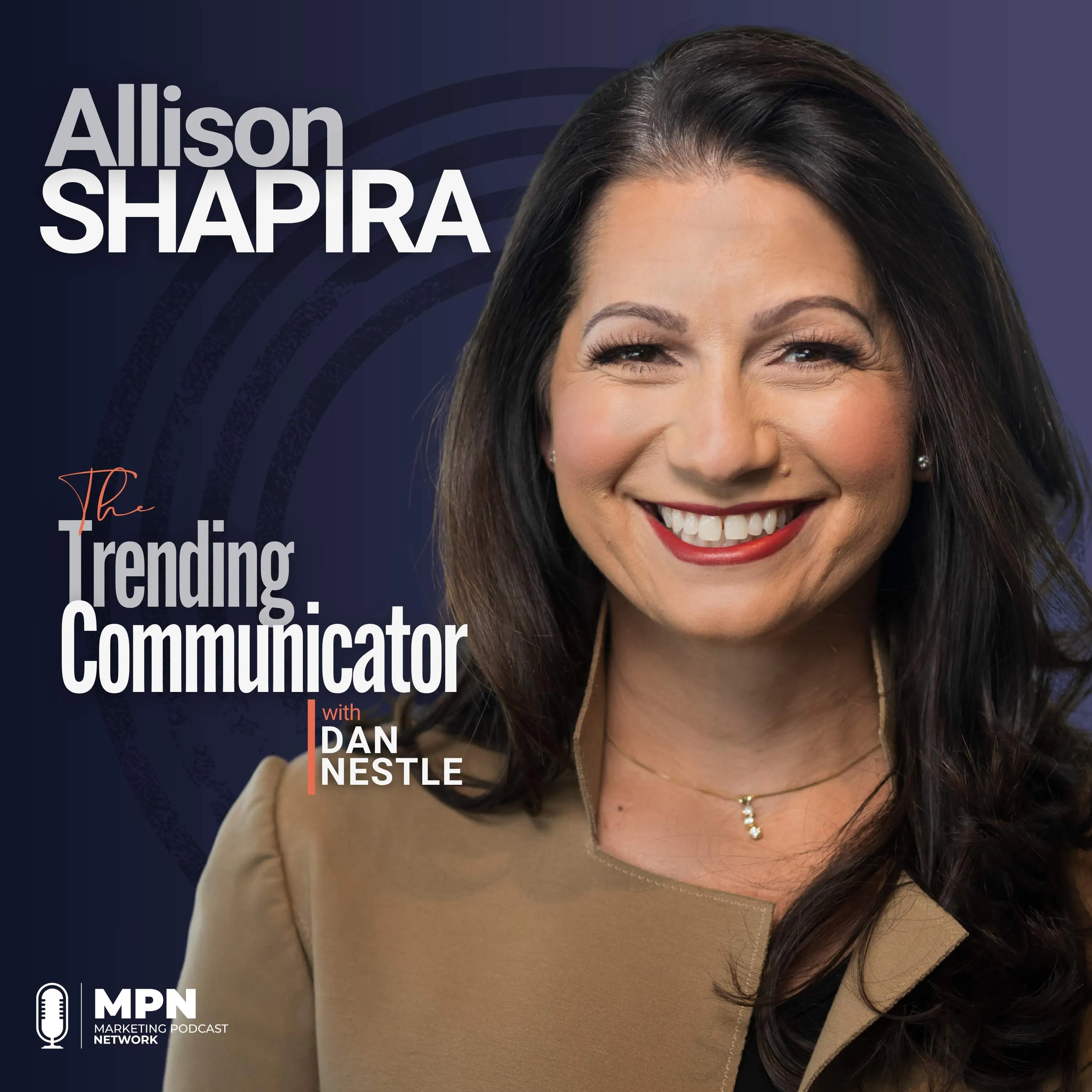
Authenticity might be the most abused word in business today. Every AI tool promises to preserve it. Every leadership guru sells it as a brand pillar. And the more it gets thrown around, the less it actually means.
In this episode of The Trending Communicator, host Dan Nestle sits down with Allison Shapira — founder and CEO of Global Public Speaking, Harvard Kennedy School lecturer, regular HBR contributor, and author of AI for the Authentic Leader: How to Communicate More Effectively Without Losing Your Humanity. Allison went from the opera stage to the corridors of diplomacy, eventually building a global communication training company that now coaches prime ministers, cabinet members, and Fortune 100 executives in their highest-stakes moments.
Allison and Dan dig into what authenticity actually means when AI can draft your speech in seconds, why generic AI output is quietly eroding trust between leaders and the teams they lead, and how the AI Authenticity Loop gives communicators a practical way to use these tools without flattening their voice. Along the way, they explore why live speaking might be the last place left to be certain a human is being human — and why the choices we make about AI in the next three years will determine whether it brings us together or pulls us apart.
Listen in and hear about...
- Strategic authenticity, and why "rolling out of bed without brushing your teeth" doesn't count
- The ACE model — authenticity, clarity, and energy — as the foundation of leadership voice
- What new research reveals about how AI overuse erodes trust between leaders and teams
- The five-step AI Authenticity Loop and what "starts with you" actually means
- Behavioral training, not technical training, as the real key to AI adoption
- Why leaders need to be vulnerable about their AI use before their teams will trust them
Notable Quotes from Allison Shapira
"This is not about keeping the human in the loop. As I say in my book, the human IS the loop."
"It would be rude to ask a human for feedback when you haven't asked an AI first because it would be a waste of the human's time."
"The decisions we make in the next three years will determine where AI goes. Whether it brings us together, builds trust, whether it pushes us apart and isolates us even further."
Resources and Links
Dan Nestle
- Lilypath | Website
- Inquisitive Communications | Website
- The Trending Communicator | Website
- Communications Trends from Trending Communicators | Dan Nestle's Substack
- Dan Nestle | LinkedIn
Allison Shapira
Timestamps
0:00:00 Introduction: Authenticity, leadership, and guest Allison Shapira
0:06:18 Allison Shapira’s journey: From opera to diplomacy and communication
0:12:29 Defining effective leadership communication and the ACE model
0:18:20 AI's impact on human connection and the risks to authentic communication
0:24:01 Strategic authenticity: Aligning personal and organizational values
0:31:07 How AI undermines trust when misused in corporate messaging
0:37:21 Human vs. AI knowledge: Authenticity and lived experience
0:43:50 Dangers of outsourcing critical thinking to AI and accountability
0:50:01 The AI Authenticity Loop: Five-step framework explained
0:57:25 Importance of feedback and critical engagement with AI tools
1:01:49 Final thoughts: Shaping the future of AI, authenticity, and leadership
(Notes co-created by Human Dan, Claude, and Castmagic)
Learn more about your ad choices. Visit megaphone.fm/adchoices
00:00
Daniel Nestle
Welcome or welcome back to the trending Communicator. I'm your host, Dan Nestle. You know, authentic might be the most abused word in business right now. Every AI tool promises to preserve your authentic voice. And every leadership guru peddles authenticity as a brand pillar. And the more people say it, the less it means. I mean, it's become a buzzword pretending to be a virtue. And we can talk about that at another time. But I think authenticity needs to be re examined. But what would it mean if someone actually understood voice as a physical instrument, not a metaphor? Trained over years to project truth into a room of 35,000 people without a microphone? Well, my guest today made that exact pivot. From the opera stage to the boardrooms and government chambers were communication failures, creator careers, and derail policy.
01:01
Daniel Nestle
She built a global communication training company, ran it for two decades, then deliberately downsized to work exclusively with senior leaders in their highest stakes moments. Prime ministers, cabinet members, Fortune 100 executives, all learning what it takes to build trust through how you speak. Her first book became a Washington Post bestseller. And she'd been studying technology and communication for eight years before Generative AI even made the headlines. Not as what she calls the AI nouveau riche, jumping on the bandwagon. She wrote the book on using AI without losing yourself. And she wrote it because none of her clients were asking about it, and she knew that was a problem.
01:41
Daniel Nestle
Well, we're going to dig deep into what authentic leadership communication looks like when AI can draft your speech in seconds, and why Live Speaking might be the last place we know of for certain that a human can actually be human. She's the founder and CEO of Global Public Speaking, a Harvard Kennedy School lecturer for over a decade, a regular HBR contributor, and author of AI for the authentic how to communicate more effectively without losing your humanity. She's also trained women leaders across two dozen countries through Vital Voices, which tells you something about how seriously she takes the idea that voice is power. I have a feeling she might just convince this skeptic that authenticity still actually means something. So please welcome, for the first time on the trending Communicator, Allison Shapiro. Allison, how you doing? It's good to see you.
02:34
Allison Shapira
It's so great to be with you. Thanks, Dan. Thanks for having me.
02:37
Daniel Nestle
Oh, no, it's good to be here. And, you know, like, sometimes, you know, I meet people in the craziest of places and have them on the show or, you know, people reach out to me, but rarely do I work with. Work with agencies who send me pitches and pitches all the time. But when I saw your name come through and I saw the information, like who you were and what you do, I said, this has to be on the trending communicator. And I'm really glad for that. So folks out there, do not give up on podcast pitching. It works. It works. And Allison is. Is absolute proof of that. But I'm so glad that were connected, and I'm glad that we had time to talk, you know, a while ago.
03:23
Daniel Nestle
So I got to know you, and I'm really excited about talking with you about this corner of communications that, you know, we often don't get to. On the show. We, we did on the very first episode of the Training Communicator with Matt Abrams, when we talked about, you know, verbal communication, we talked about speaking, we talked about impromptu speaking, especially, but you have a very different or more nuanced approach. And especially now in the age of AI, I want to hear more about what it means to be an effective verbal communicator in this crazy time when AI is, as I said, writing our speeches deep, faking your faces, and who knows where it's going to be tomorrow or the next week. So that's enough of preamble. Welcome to the show. And I really want to hear more about.
04:16
Daniel Nestle
Hear all about you first, and then we can get into it. So how did you get here? What was that opera to PR to communication expert? How was that journey? And it's just fascinating to me.
04:34
Allison Shapira
Growing up, all I wanted to do was be an opera singer. I performed in high school. I studied abroad in Italy, and I remember when I was applying for college, I was applying to be a vocal performance major. And I remember my father saying, don't you want to study something practical like economics or business as a minor? And I thought, no, I just want to be an opera singer. And then when I got into the field seriously, I realized how political it was and how in order to get ahead, it really depends not on your. Anything you can control. It depends on how somebody else likes your voice. And I didn't want to be in a field where I couldn't use my brains and my work ethic to get ahead. I had to rely on others.
05:20
Allison Shapira
So I wound up leaving opera, and my first job outside of the field of opera was in diplomacy, where I had to write and deliver speeches on international policy. I was in my early 20s. I'd never given a speech before. I had no idea what speaking was. So I went toastmasters. And actually, through learning through toastmasters I realized I already knew public speaking because opera singers learn how to calm their nerves, project their voice, and how to connect emotionally with their audience. Now they don't know how to craft a persuasive message because opera singers don't write and deliver their own material. So that was a bit of a learning curve. But I made that switch. I actually realized I had exactly the skills that I needed to be not just a powerful speaker myself, but a powerful guide of other communicators.
06:17
Allison Shapira
And that's how I launched my business.
06:18
Daniel Nestle
That's incredible. And in fact, the one thing that sticks in my mind about this is, I mean, the one thing, for crying out loud, we're going opera to diplomacy. But you landed a role like writing for essentially pr, you know, doing speech writing from a vocal background. Vocal music background. What was it in your interview, in your job interview at that time, or in the resume that you had that got you that role? Because, I mean, that's a secret. I think everybody needs to know.
06:50
Allison Shapira
That's right. Certainly now, as a lot of people are looking for jobs, a lot of liberal arts majors looking for jobs, it's really tough out there. Even if you don't have a liberal arts major for an engineering major, it's tough. And so I've always been interested in foreign languages and foreign cultures. And so in college, I actually interned at a number of different diplomatic missions in Boston. And so I was already in that environment. And one of them happened to be hiring for. It was. It wasn't public relations. We call it public diplomacy.
07:23
Daniel Nestle
Sure.
07:24
Allison Shapira
In the diplomatic world. And so one of them was hiring for that role. I interviewed and I sent a photo of myself at the annual party with the rest of the team. And it turns out the consul general, the head diplomat, actually had that same photo on his desk. So I was already in his office when I interviewed. And that turned out to be very helpful because he already knew me.
07:50
Daniel Nestle
That's a great thing. People struggling with applicant tracking systems these days are. Don't have a hope in hell of that happening with. With them, you know, but that's why you have to maintain your network, make sure that you're, you know, you look at all of the skills and all the things you've done in the past if you're early job seeing. But this is not a job seeking podcast. This is about communications. Sorry. It's really, it's really fascinating that is not a unique. That is not a common journey, I think by any stretch. But you got into diplomacy, you know, and started the public speaking business, started your own business shortly thereafter. And from there, like, how did you build your ip?
08:29
Daniel Nestle
Like, how did you kind of come to this idea that, you know, well, people needed a framework and they needed to have, like, proper training? And. And what about your diplomatic communications work made that clear to you?
08:47
Allison Shapira
My diplomatic communications work taught me a lot about, first of all, what not to do, because I made a lot of mistakes, and also how to keep your cool under fire, because in diplomacy, you're talking to audiences, some of whom agree with you, some of whom don't, some of whom are protesting outside of the event you're speaking at. So it was a very contentious field in which to be speaking, and also at a very young age. So I learned how to address a hostile audience, how to prepare for tough questions, how to handle those tough questions when they came in. And so I was learning those skills. I didn't have a framework, though.
09:27
Allison Shapira
It wasn't until years later, and I'll never forget, I was doing a training for the American Chamber of Commerce in Israel, and I was leading a training, and a friend of mine was in the training. And afterwards, she said to me, you know, Alison, you need to give us a methodology. Like, what are the three things to do before you write a speech? And what are the three things you should do during the speech itself? And she really said it in kind of an offhand tone. And I thought, well, that's a great idea. What are the three things you should do before a speech? Okay. And I came up with that. And then, what should you do during the speech? And I just used that as my framework.
10:05
Allison Shapira
And for many years, my frame was the three questions to write, and then the three movements that you make every time you deliver a speech. And it took something as simple as one confused friend who was willing to give me feedback that helped me understand that I needed to build out a methodology. And now I have dozens of frameworks and many different tools that comprise my own methodology. And every time I talk to a client or I'm debriefing an event, my mind is still creating new frameworks and new tools as I continually think of new ways to do more and to better.
10:45
Daniel Nestle
Which of your frameworks would you pick to, say, have really stood the test of time? I actually want to know what the three questions to write are and what the three movements are myself.
10:55
Allison Shapira
Okay, first, the three questions are, who's your audience? What's your goal? Which, as you know, are very obvious in our field. But the third question is why you? Which doesn't mean why are you qualified or where did you go to school? Why you means why do you care about the work you do and the people you represent? And when was a moment in your life that made you care? And that two part question is what I ask in order to help people uncover their authentic voice that may have been hidden by their circumstances or by their upbringing or by the environment in which they work. So those are the three questions everyone should ask before they craft a message. Three movements being with your eyes, your body and with your tone of voice. So that's one methodology.
11:43
Allison Shapira
What has really stood the test of time, which is not to say that one has not. What I'll tell you what I'm teaching the most now is my ACE model of leadership communication. Recognizing that after 24 years of teaching leaders how to build trust and influence through their communication, I keep coming back to authenticity, clarity and energy as three core competencies. Every leader needs to be effective when they build trust using their voice. And it doesn't matter what level they're at, what industry or what country they live in, because I've trained this methodology all around the world in different languages. And we keep coming back to those three competencies.
12:29
Daniel Nestle
It doesn't even matter if you're talking about public speaking at that point. Right? There's, you need to be authentic and you need to be clear. And people can sense energy even in writing. Like they can sense, of course, bad juju. When bad juju happens, they get it. And they know when you're off your base or when you're trying to hide something based a lot on your energy.
12:51
Allison Shapira
That's right. Which is why it's so important to pick up the phone every time you get a difficult email, as opposed to just going back and forth where the energy can get out of hand. And let's jump on the phone, let's use some breathing techniques in order to ensure our voice de escalates the situation. So the energy in our voice is crucial. And I define public speaking as anytime you speak with one person or more. So it's really how do leaders communicate in every situation? Meetings, pitches, presentations, and certainly more formal speeches. But every day they're using their voice in the act of leadership.
13:27
Daniel Nestle
I feel like the idea of picking up the phone after an email or text nowadays is completely lost on most of us. And you know, this is one of those cobbler's shoes moments where, you know, I always say you should just pick up the phone if you have, if you're feeling Emotional, especially to pick up phone. But I rarely do go right back on the email. But I've learned to pause. I had a wonderful psychiatrist and even several podcast guests. I've even said that their secret to really taking stock of the moment and communicating well is to not let your mouth outpace your brain and take a pause. Just chill. Speak what your teachers used to say. Speak before you think, Nestle. Like that kind of thing.
14:22
Allison Shapira
Or think before you speak, or think before you speak.
14:24
Daniel Nestle
See, I did it right there, which.
14:26
Allison Shapira
Was probably the opposite, was the problem.
14:28
Daniel Nestle
Was the problem, you know, because we do in our worlds, especially when you have so many things. And when I say our world, I mean our communications and marketing world, where various problems, crises, tasks are just thrown at you because you're not. And with no disrespect at all to accountants, you know, if you have a finance problem, you go to the accountant. It's a fairly defined realm. You know, you have a legal problem, you go to the lawyer. But the marketer and the communicator tend to have these kind of fluffy borders around the things that they do. They tend to have. Some people blame them for being siloed, but it's anything but. I think they're in a very osmotic membrane around them where just things keep kind of flowing back and forth. So you're catching all these things.
15:22
Daniel Nestle
When do you have time to pause your brain? Like, what is it that we can do to just really breathe and pause? We forget all the time and might be even worse when you're on stage in front of people or have that nervousness going.
15:38
Allison Shapira
It certainly is. And people think that they can't pause when they're in the moment in a tough situation. And we call that the negotiator's pause before you agree to terms or before you say that statement that you're thinking but not sure you should say out loud, or that you're thinking but you don't know if you should say it out loud. Pause and breathe is the term that I use with my clients again and again. Pause and breathe so that the filler words like and don't come out, so that you don't react with emotion, so that you don't say the wrong thing. That then becomes what's reported in the press because every word is now under the microscope. So it's something that we have to build this muscle that we have to build, and that's as leaders, how do we lead ourselves?
16:26
Allison Shapira
How do we self regulate? Pause and breathe is one of the ways in which we do it. And I will say I'm not always the best at it either. I struggle with it myself. I get impulsive in how I want to act, and I need to remind myself. And my mother will often remind me. I'm in my 40s. She'll still remind me. Alison, pause and breathe. And so I still have her voice in my head.
16:50
Daniel Nestle
I'm just laughing because I think we have. Well, we don't have the same mother, but I find myself saying that to my mom all the time. Mom. Pause.
17:01
Allison Shapira
That's interesting.
17:01
Daniel Nestle
Pause.
17:03
Allison Shapira
Relax.
17:06
Daniel Nestle
And. And, you know, now that we are. That I'm working by myself most of the time, you know, since I went out on my own, I find myself, like, I certainly am lonely sometimes. I don't have people around, and I feel I miss camaraderie and I miss discussion, but I feel like it's had a little bit of an effect. When I do get myself into social situations. I've forgotten how to. How to pause. I'm so excited to be there, you know, that I've lost some of the. I wouldn't call them niceties because I'm still nice and wonderful to people, but I. But really it's more about, like, manners and etiquette. That kind of start, I think started to, I don't know, get. People talk about. About cognitive loss or cognitive delegation when you.
17:58
Daniel Nestle
When you're talking about AI, but I think we forget about behavioral. Behavioral loss, behavioral delegation. And I feel like we need to have frameworks like yours, books like yours. We need to be listening to people like you to just remember, okay, we have to actually talk to people. We have to actually be in front of people.
18:20
Allison Shapira
We should talk to people. We don't always think that we have to talk to people because as AI becomes easier and easier to talk to and more patient and more empathetic and always available, it starts to undermine the human connection that we relied on. So that's. I mean, you know, I'm a huge proponent of the. The power of AI to. To amplify our authenticity. There's also great risk in destroying human connection at the same time, for sure.
18:51
Daniel Nestle
Which. Which now, like, kind of, let's. Let's talk about authenticity because, you know, I made so much of it in the intro and be meaning to get there. I've had my doubts about authenticity because I think it means different things to different people. And I had a guest a long time ago on the previous iteration of the show who talked about the difference between authenticity and sincerity. And the importance of being genuine versus being authentic, these things.
19:24
Allison Shapira
And how do you define that?
19:25
Daniel Nestle
Yeah, and that's what I was thinking, this is a strange thing, or I've never heard this before. And I believe it was more about like, sincerity is deed based, and authenticity tends to be more belief based or verbal. I don't know if this is, you know, this is his framework, not mine. But again, it's another indication that we're talking. We might be using the same words, but we're speaking different languages. So what is authenticity? Let's start there. Tell us about authenticity, what it means to you and how you're defining it in your book. And then we'll get into, well, what does that mean when it comes to AI?
20:14
Allison Shapira
Everyone has a different definition of authenticity, which is why people love to hate it as a buzzword, because they interpret it through their own lens of how they see the world. And when people tell you to be authentic, sometimes they think, well, not that kind of authenticity. Like you can be authentically lazy or authentically unprepared. And I like to joke in my keynote speeches, I'm authentically an assertive driver. And that doesn't mean that's an effective leadership quality when I get impatient with my team or with partners. So I define, I talk about authenticity in a few ways. First of all, I talk about strategic authenticity.
20:54
Allison Shapira
So if you think about a Venn diagram in one circle and you have what's authentic to you in the other circle, you have what's effective in any given situation, what's effective with a particular client, what's effective in a particular country or industry. And your job is to find that overlap between what is authentic to you. You're not making it up, you're not faking it. You're simply strategically choosing the parts of you that are authentic which you believe will make you effective in this situation. So that's how I look at that. Strategic authenticity. How do I define authenticity? I define it as speaking and acting in alignment with your values and beliefs. So it's not just rolling out of bed, not brushing your teeth, and that's authentic to you. That does not fall into the strategic authenticity overlap.
21:51
Allison Shapira
It's what are your values and beliefs and in which ways are you living and speaking those values and beliefs in any given situation.
22:01
Daniel Nestle
And, you know, people aren't stupid. Like we have this innate sense of when that's not in alignment. You know, you can call it a bullshit detector, you can call whatever you want, but we have as People, as humans, when we may have, you know, there's another thing AI might be taking away from us. We're losing this sense of reading body language, reading faces, understanding the aura in a way to know when somebody's not being true to themselves. It's interesting because I appreciate the idea and I'm going to actually think about this more of strategic authenticity. I mean, for business. And that makes sense. And I just. And look, it's a Venn diagram. I get it.
22:51
Daniel Nestle
I get the sense also that a lot of leaders and a lot of people who are in the public eye might have a little different definition of what strategic even means when it comes to strategic authenticity. Right. It's what is right in the moment, what they can say in the moment that sounds like they're being real and true to satisfy others, which is the opposite of authenticity. Correct. And. And, you know, it's easy to kind of get caught up in this when you're two steps removed or one step removed even from where those values are coming from. And what I mean by that is put yourself in the role. And you've been. You are in this role and you've been in this role where you're counseling people who are spokespersons, executives, et cetera for a company.
23:41
Daniel Nestle
And the company has values, the company has ethics. We hope, we hope you share those. The company has values and it has. It has its own, you know, mores. And a lot of Japanese companies I've worked for have creeds. They have a 150-year-old creed that hangs on the wall, and they've updated them to be values and vision and stuff. But same thing, let's just say, for argument's sake. But what if that's not you? Right? What if that is not your, like, inner. Inner compass points in a different direction? Communicators, I find either you're sacrificing or dampening your own moral or let's say authentic kind of thoughts in favor of a company or in favor of the person in order to serve. And their leader may be rudderless because they're not anchored to a set of values that they actually believe in.
24:49
Daniel Nestle
So how do we work in that?
24:54
Allison Shapira
It's an interesting question to raise because there are a few options. When I work with investment bankers, for instance, I used to start by saying, what are you passionate about? And the investment bankers would look at me and they'd be like, are you kidding? We're not passionate about investment banking. We're proud of what we do. We love solving Problems for our clients. We like putting the puzzle pieces together, but I wouldn't say we're passionate about it. So I had to learn what language would resonate with them and when. We can't talk about in what ways are you living your sense of purpose. Let's talk about what are you proud of in the work that you do? So maybe you don't share the exact values of the organization, but you need the job. Let's talk about what makes you proud.
25:43
Allison Shapira
Is it the impact that you have on your team, how you live your values for your team or for your clients? That can make it a lot easier for some leaders. Once they realize their values are not in alignment with the values of their organization, they leave.
25:59
Daniel Nestle
Yeah, for sure.
26:00
Allison Shapira
Because it's holding them back. It's making them unhappy. And as a result, an unhappy leader is not going to treat their team well, which is going to affect morale and retention and productivity. So it may become a mismatch if the leader lets themselves find that discrepancy. So it really depends on which values we're talking about and how far away the leader is from the values of their organization.
26:25
Daniel Nestle
Yeah, just.
26:26
Allison Shapira
You always.
26:27
Daniel Nestle
You get the sense in the. In this. Where things are fluid. So fluid these days. I mean, and when I say these days, I don't mean right now. I mean, let's say the last five years or 10 years. It's this volatility where societal issues demand responses or they feel like they demand responses, but they don't always demand responses. You know, it's tempting to move the goalposts a little bit about where your values are so that you can kind of take advantage of or at least defend against what's happening in the moment. And if we would. If you could find that one piece that you can anchor yourself to in a situation, it's hard to do. Right. I mean, it's just. It's very difficult. And I think a lot of folks don't understand how.
27:22
Daniel Nestle
How much of a. I think not only burden, but responsibility that is for the person who is counseling for the. For the communicator or the marketer saying, hey, we can't say that, or we can say that, or, you know, look, you don't. When you get up in front of these people, you have to blah, blah. You know, it's hard.
27:45
Allison Shapira
It is hard for the communication professional to do that. It's also up to the communication professional to help bridge the gap between the leader and the message that needs to be delivered. So meeting with the principal, meeting with the leader they're supporting to get a better sense of that person's values. So then the communication professional can go ahead and craft messages that bridge the leaders values and stories with the values of the organization. And a lot of times when I'm working with senior executives who have communication teams writing for them, what I tell them is you have to give the comms team your time if you want them to write something you'll actually like. Yeah. You can't just expect them to get it right without ever having spoken to you.
28:32
Allison Shapira
So there's a responsibility the leader has in order to give the comms people that time. And then on the comms side they have a responsibility to help bridge the gap. Otherwise the communication is going to be ineffective and inauthentic for sure.
28:47
Daniel Nestle
And we see it all the time, you know, and now especially that people can just create messaging and keynote keywords. Sorry like key messages and Q and A and speeches and everything with pick your poison, pick your tool, pick. Your friend of mine just called it, called them teammates. She likes to call AI agents teammates. Pick your teammate. If there is an authenticity gap in what somebody is saying and what the company is all about, AI can really either fill that gap or exacerbate it. So digging into your fundamental ideas about what we need to watch out for and how AI can either enhance or really destroy authenticity. I don't even know where to start. How do you recommend that we work with AI to kind of keep authenticity right in the front?
29:54
Allison Shapira
Let's start with what's not working. Because the reason I teach authenticity and or teach leaders how to bring out their authenticity is because I believe authenticity builds trust and trust leads to results. So that's why I focus on authenticity, recognizing it as a driver of trust. What's not working right now is that leaders are using generative AI in ways that reduce trust. They're using AI to craft a message and then sending that message without oversight or review. And then their employees are getting this message thinking, you didn't write this. My performance review has never looked like this. Do you really believe it? And we're seeing new research come out now because this is not like Aristotle's three modes of persuasion that we have time tested for 2,000 years. We have two to three years of uses to test.
30:46
Allison Shapira
And so we're writing the new rules of communication right now. And what we're seeing as we do research is, and there was a fascinating study last year that when supervisors over relied on AI for routine communication, their subordinates viewed them as less caring, less knowledgeable, less sincere.
31:08
Daniel Nestle
Surprise.
31:08
Allison Shapira
And if and if that's what they're thinking, they're not going to trust their supervisors. And also those subordinates, they judge their supervisors more harshly for the same AI use. It also means we're seeing a double standard in how we use AI and how we acknowledge the validity of others use of it. And at the same time, we're mistrusting it when we can see the AI. Now I will tell you, I believe that's a temporary phenomenon. In two years, nobody's going to ask if you used AI to write a message because of course you did. But it will be a better AI tool. It will be more customized to you. It will be more effective. Just like we all use spell check. Because it would be rude not to use spell check.
31:58
Allison Shapira
It would be rude to ask a human for feedback when you haven't asked an AI first because it would be a waste of the human's time.
32:06
Daniel Nestle
Interesting.
32:07
Allison Shapira
Now that's forward thinking in terms of communication. Right now, what I'm advising leaders and communicators in every field to do, to make sure that when they use AI, the first draft starts with you. You're not outsourcing the first draft. It comes from your brain. And then you bring in the AI as a brainstorm partner, as a feedback partner, if you use the voice mode to role play. But you come back in throughout that process and I call it the AI Authenticity loop, so that you're using AI in ways that bring out your authentic voice, teaching the AI your values so that it can reflect them back to you or show you where they're lacking in your messages. This is not about keeping the human in the loop. As I say in my book, the human is the loop.
32:56
Daniel Nestle
That's. I want to get you speaking with Ethan Malik because you're. You're both right.
33:01
Allison Shapira
I would love that. I've reached out to him. He doesn't respond.
33:05
Daniel Nestle
Same, same. He's a busy guy, you know, but you've got HBR and Harvard under your belt and you know, you figured he would, he would say hi, but you figure, Ethan, if you happen to hear this, you know where I live, call me. But no, seriously, the whole, his whole idea of like, even though it's not necessarily he didn't. I don't know if he originated or coined it, and he may have, but, you know, keeping the human in loop is common sense. When you're dealing with something that is, you know, you're staking your reputation on, or you're staking your company's brand on, or even your even a simple message, you'd think it's common sense. Yeah.
33:47
Daniel Nestle
And yet people do pass things off with through sheer laziness or because they trust the AI to know more than they do, in which case they're not in the right business. But the whole idea of being the human is the loop. I've been doing more and more work with helping leaders to write authentically and to maintain their real true DNA, let's say their brand DNA and their voice DNA in their writing with AI. And just to get to the point where you're able to do that is a lot of work. And folks don't understand like they think, well, I thought AI was supposed to make this easier. I thought I could just go on there and make stuff happen. Well, that's why we get slopped. That's why we get the stuff that's not authentic.
34:51
Daniel Nestle
Believe it or not, you said the human is the loop. I would add that the human is loop. The human knowledge is what the loop goes around. It's fueling the movement around the loop. The knowledge that you have, the things that you've done, the things that you've said are yours. They're 100% yours. What's more authentic than something you've already done and already said?
35:17
Allison Shapira
Well, I'll push back on that. Are they yours or are they ideas that you picked up from others along the way?
35:24
Daniel Nestle
Well, we're talking about an ethical problem now. Yeah. You know, for sure.
35:27
Allison Shapira
But what are humans? What is our knowledge if not the sum total of what we've ingested through reading, learning and studying? Isn't that what AI has done? It's ingested, it's learned, it's studied, and now it's generating text based on its training data. Our training data is our entire lives. How are we different?
35:53
Daniel Nestle
True, true. Maybe the difference is in the. Is in the system prompt, so to speak. You know, when AI is interpreting or going whatever the lens is that AI is using to interpret or to provide the answers that you're seeking. Whether that's, whether it's a simple answer or whether it's, you know, a 2000 word HBR piece. It. It's going through its own training, its own. What's it called for people? It's, it's your behavioral system, your. Oh gosh, the term just fled my mind. It was right there on the tip of my tongue. But essentially you're programming. Right. And yeah, you're raised with your own biases and you're raised with your own thoughts about the world. And they have to, and they do unbidden come out into your writing and into your communication. But that's kind of the spice that makes things authentically you.
37:04
Daniel Nestle
You know, you have to be able to identify those things and you have to be able to like, understand when you're right and wrong and when there's ethics and you know, when you're being ethical. But we're count with AI, you're counting on somebody else's under, like, idea of what that system behavior, that behavioral system is.
37:21
Allison Shapira
That's right. That's right. You're relying on somebody else deciding which values to align the AI system with.
37:31
Daniel Nestle
That's right.
37:32
Allison Shapira
Whereas you've already had the priming of your family influences which determine whom, determine your values or your life experiences that determine your values. So I would say you have more ownership of the programming process than an AI tool would have. Now you don't have full ownership because you don't get to choose your parents and you don't choose your relatives or your life experiences to a certain extent. But there's more of a sense of agency, see, when it comes to human communication, connection, authenticity than there is in an AI system. So I wanted to push back, to play devil's advocate on that thought. I still see the value, of course, in the, in human wisdom, the wisdom of lived experience over the sum total of the combination of human knowledge.
38:28
Daniel Nestle
Yeah, that's the next part. Right. Is okay, you have all of this stuff, you have all of the stuff of your life. I mean, if you're a professional and you're a domain expert and you've established your expertise, you've got a lot of stuff out there. You've got your, you know, you've got your body of work. That's a fairly safe place to be drawing, to be sending your AI to pull out things that are more likely to be authentically you. As long as you're aware of everything you've done and you look at it and say, wait, that's an idea that I had 15 years ago and it's no longer valid.
39:07
Daniel Nestle
You have to still be on it, you still have to watch it, be careful with it, and how it chooses and how it decides what parts of your past or what ideas of yours or what writing of yours to bring into a specific communication. That's all up to how you set the system prompts and how you program it. Right. But to see it really get to the point where it's enhancing authenticity, you need to add a good, healthy dollop of wisdom and experience. And that's where I think we're 100% on the same page. In your case, when you're talking with your clients and you're speaking with leaders, where is the enhancement part? How do you say that AI can enhance your authenticity?
40:02
Allison Shapira
I created an authenticity GPT and it's actually something that your viewers and listeners can download at my website@alison shapira.com AI there's a resource guide that accompanies the book that has an author authenticity GPT. And I created this actually based on the concept of why you, which we talked about earlier. Why you as a question which brings out your authentic voice. So I created a custom chatbot trained on the why you or grounded in the concept of why you where leaders can have a chat with that chatbot and it prompts them to go deeper into their experience and helps them generate a why you statement. So that's an example where leaders can use a chatbot to bring out their authentic voice. Now, is it better than the process they would go through with me personally? No.
40:59
Allison Shapira
But is it available at 2 in the morning when they can't sleep and I'm asleep and the leader wants to work on their authentic voice or they're traveling in Malaysia and there's a time difference? That's when it's really effective so we can have these experiences. And when a human is not available, Ethan Malik talks about the best available human. And so if the best available human is not available, then an AI tool is very helpful when it prompts you to bring out your own voice. And those are some of the ways in which I think about using AI in a responsible, ethical way that's related to authenticity is by being intentional about the way in which we're using it to ensure it brings out us at our best, as opposed to flattens our voice and makes us sound like everyone else.
41:55
Daniel Nestle
There's a. I love that when there's no human around, you got to go to the best source you have. And I'll just go, I need to think. I need to talk to somebody. There's a whole. I think there's a. There's a lot to be said for the power of AI. You know, when you're comfortable and when you get to the point where you're beyond that simple Google like prompt and like when you really understand that AI is an iterative and iterative and interrogatory interrogative experience. You know, there's that point where you, you get into self reflection like where AI can send you in these deeper. To think more deeply about the things that you know, you didn't. May not have considered.
42:54
Daniel Nestle
And that will result in a much, you know, more well thought out, fill in the blank, you know, well thought out statement, a well thought out idea, whatever it may be. It could also go in wrong, in the wrong direction. Like it could take, it could ask you the wrong questions. Which is I think why I totally agree with you that it's better to talk to Allison than it is to talk to ChatGPT, you know, or somebody who knows you or somebody who's a professional in this kind of thing. However, lacking that the power of, of a. I want, I almost wanted to say a relationship with AI, but I hate saying that. Like I think it's just how do you, how do you define yourself with respect to your AI?
43:42
Daniel Nestle
And then, you know, how does, how do you let it govern your behavior or how do you govern your behavior with regards to. It is a real question a lot of people have. Yeah.
43:51
Allison Shapira
And the challenges that people are outsourcing their critical thinking to AI. They're trusting AI in the way they might blindly trust a human who sounds convincing. And what they're doing is they're removing their own agency and they're getting themselves into trouble because they don't Fact check the AI's work or they don't push back on what the AI is recommending. And we know at this point in time it still hallucinates, it still makes up information. So the challenge is not the AI itself. The challenge is lazy humans and their misuse of AI. And we've always had lazy humans. Now it's easier than ever to be lazy. And that's why we need to instill this sense of accountability and responsibility in ourselves.
44:43
Allison Shapira
Because ultimately we're responsible for the words that come out of our mouth or out of our email address or with our name on them, especially communicators who are putting words in the mouth of their organization. We're responsible for what we share and what gets distributed. So that responsibility or that accountability for what we say and what we get from AI is critical.
45:07
Daniel Nestle
We have to think like we're, like we have a fiduciary responsibility. Like we words are, can really damage A company, a brand, a person, more so now than ever before. So, you know, use it at your own risk. But at the same time you're getting, there's these mixed messages. People are receiving mixed messages about, you know, they should have to be using AI. You need to be using AI, Go use AI. But they're not really understanding the purpose of why they're using AI or, you know, the rationale for why they would use AI to do something that they can do just as easily.
45:45
Daniel Nestle
And you get disenchanted, or they fail to adopt, or they just don't go anywhere because they're either possibly getting the wrong advice, they're on they're following the wrong strategy, or maybe, just maybe, they simply don't like it and they're not going to use it. Right. Which is, which is fine too. A lot of people are like that. And that's their issue.
46:08
Allison Shapira
Well, they're also afraid that it's going to take their job and that their employer is asking them to use AI so that AI can learn what they do and so then they can be fired.
46:18
Daniel Nestle
Yeah.
46:18
Allison Shapira
So there's. It comes back to trust. How are leaders communicating about AI in a way that makes people trust the leader's intention and makes them want to try AI and what kind of training, what kind of access are we giving to AI? And what I'm finding is a lot of organizations are rolling out AI with technical training as opposed to behavioral training, and that's leading to the misuse of AI, which is eroding trust.
46:47
Daniel Nestle
Yeah, there was a stat recently that saw that something like 95% or 90 something percent of CEOs had said, yeah, we rolled out AI in our organization and looking at the performance data, we. There was mild or moderate performance gains in certain departments for three weeks. But then after three weeks, everybody, with the exception of maybe 10 or 20% of the employee population, so let's say 80% of the employees are like, to hell with this, I'm not doing this anymore. Right. I'm not, I'm not in. It's not, it's not doing it for me. It doesn't help my productivity. It's not doing the things that I wanted to do. And yeah, a lot of it's behavioral. A lot of it is trust in where the company wants you to go with this. I think a lot of it has to do with comfort as well.
47:46
Daniel Nestle
And that's behavioral. Right. You need training folks to really become, to get comfortable with their chosen AI teammate. As, as Sandy Carter says, how are you going to do work with a teammate that you don't like or that's uncomfortable or that you don't like being around? You know, so there's got to be a comfort level and it's going to vary person to person, you know, But I think authenticity might be at the core of this because if you see there's a sort of lead by example thing. If you see people who are using this and still remaining authentic and, you know, they get the gist, then you're more likely to say, maybe I can do that too.
48:30
Allison Shapira
It also has to do with the leaders being willing to be vulnerable in how they're using AI because right now there's a hesitation to share that we're using AI at all because we think people will judge us and they are judging us. So it's not false, but it creates an environment where people are afraid to share their AI use, which means no one talks about it, which means no one learns from one another. And we need to normalize AI use in the office by having open conversations about how we're using it so that we can hear from others if it's working or not. And that's a conversation I think especially communications professionals need to have because there's a sense of shame around using AI in terms of, well, wait, aren't you good enough by yourself without needing AI?
49:18
Allison Shapira
Well, but what if AI could make us better? Let's talk about it. And so that's a challenge of human behavior that I think we need to address.
49:27
Daniel Nestle
There's a flip side of that too, which is that the people who are using AI well, don't want to tell people that they're using AI. Well, right. It is making them better. It is helping them to enhance what they're doing, but they're afraid to share. What if the secret gets out? That's a product of the culture that they're in. It's a product of their, you know, of their. Of their work environment, the values of their. Of their work life, of their company, you know, in the book. And by the way, everybody, the book AI for the Authentic Leader. You can see it here. I hope it's not reversed on the screen when it actually.
49:59
Allison Shapira
No, it's perfect. Thank you for showing it, you know,.
50:01
Daniel Nestle
How to communicate more effectively without losing your humanity. You know, we're kind of scratching the surface of this, but we've been talking about authenticity. We've been talking about how, you know, and I don't Think that there's a. There's necessarily a straight answer to, to why and how organizations are failing with AI or to, you know, how they should move forward. Although I have, you know, you have, I, we all have some ideas about this, but it varies organization to organization, culture to culture, leader to leader. But you've created something in here called the AI Authenticity Loop.
50:38
Daniel Nestle
And I was hoping that you could kind of walk us through this because this is the kind of framework that I think if we have in our minds and if we kind of keep it in the forefront, we can prevent a lot of these issues we're talking about and actually use AI to enhance. Yeah.
50:58
Allison Shapira
The AI Authenticity Loop is a framework I created when writing the book to give people a tool, a practical guide to using AI in a way that didn't undermine their authenticity. So it has five steps. The first step is it starts with you. You come up with the idea, you identify a need of that you need to communicate, and you write the first draft. Again, it has to come from your brain so that you can process it and go through the strategic process of deciding what to say as opposed to letting AI put the words in your mouth.
51:32
Daniel Nestle
Sorry, can I.
51:33
Allison Shapira
So it starts with you.
51:34
Daniel Nestle
Can I ask a question at that point?
51:35
Allison Shapira
Because. Sure.
51:37
Daniel Nestle
There are varying ideas about what starts with you means. Right. Or what that draft means.
51:43
Allison Shapira
Okay.
51:43
Daniel Nestle
A writer will tell you, or like somebody who's drafting something, like we often do that. No, it means sitting down with the blank paper and writing. Writing it. Just write. No help from anything whatsoever. But some folks are saying, isn't a draft an organization of your ideas? So what if you provide all of your ideas, everything that you want the piece to say, and you have a good vision, like, here's my point of view. Here are the, Here are the supporting points. Here is, here's what I want to convince audiences of. And you know, here's the context. Right. If you write that or kind of jot that into a very extensive prompt, does that count as a draft or not? Like, how does that, how do you, how does that fit?
52:39
Allison Shapira
It depends. I like the idea of coming up with a bullet pointed list of what you want to say. Your ultimate goal, maybe answering the three questions and then a rough outline that under my definition counts, starts with you. I do think it's best if you write out the first draft as opposed to just the bullet points. Because what I find is when I give those bullet points to AI and ask it to now write this article or this speech based on those Bullet points. It starts to additional context. It uses language or phrases that don't resonate with me, that I don't mean. And then I spend more time reinterpreting the AI's results. And we see this now with all of the data on time saved because of AI use.
53:28
Allison Shapira
There was an interesting workday study from either earlier this year or late last year that said something like 40% of the time saved with AI goes back to reworking the errors and challenges that the AI had produced.
53:43
Daniel Nestle
Oh yeah, yeah.
53:46
Allison Shapira
So that's why I recommend it starts with you. Yes. It can be the outline as opposed to the language itself. Then you can ask AI for feedback or ideas of how to strengthen the argument. You can ask it to do research on key topics. And then of course, you have to double check the research that it's responding with. And then the third step is when you look at what the AI has come back with and you evaluate it for authenticity, does it sound like you evaluate it for accuracy. Is it right or is it wrong? So again, you have to, once you use AI, you have to come back in and apply human judgment. Then the fourth step is using AI for feedback on that message.
54:28
Allison Shapira
And if you're actually delivering a presentation, I like to use the Voice mode of ChatGPT to role play difficult conversations, to role play speeches. I use a tool called yoodli Y O O D L I where you can record a speech and get AI driven feedback. And my version of yoodli I've trained on my materials, I've grounded it in my books so my clients can get feedback based on my books. I can provide feedback on an idea, a speech, a message, especially if you give it characteristics of your target audience. Then the fifth and final step is about you again delivering your message. It's you in person, it's you virtually, it's you by email. But the message comes from a human and to another human and then they come up with their own ideas. And the AI authenticity loop starts again.
55:25
Daniel Nestle
Yeah, there's, I think like going back to the idea of comfort. You know, when you're comfortable with AI. I don't mean in the sense of, hey, I'm comfortable using Word, you know, like I can use Microsoft Word. I'm comfortable with it. I think when you have that degree of hey, like, okay, I'm speaking its language now, like I have no problem it to me, opening up Claude and just starting to go is as natural as getting my morning cup of coffee. And that is, that says either great or terrible things about me. However, it's just my work day. Like, I, I, I have really changed everything about the way that I work and the way that I work through ideas and the stretch, the realm of the possible. Because I feel comfortable with Claude. Right.
56:16
Daniel Nestle
And I feel comfortable to a degree with the other, with other platforms as well. And I use different tools for different reasons, but, you know, Claude's my go to. That said, you know, when you're talking about this, the loop, the AI, the authenticity loop, it just makes perfect sense from a, from the point of view of somebody who's totally used to use an AI. Of course I'm going to start with my own thoughts, and then I want to brainstorm. You know, it just feels right. Right. But I'm gonna be in there and like, no, don't do that. You should be doing this. That's not right. We need to rewrite this sentence. Nope, you got it wrong. Here, this. Okay, let's take a look.
56:58
Daniel Nestle
Like the whole critical back and forth period, that's where the core of, I think the value of your work comes from. Right. I think a lot of people do miss how, like, even experienced folks miss that fourth step, asking for criticism, Asking AI to then evaluate your work. It's so good at doing that, especially when it has enough context and understands you.
57:24
Allison Shapira
Right.
57:25
Daniel Nestle
I can't push that enough. Have you seen this? Have you seen this in action? Have you seen some great success stories with people who've gone through the loop?
57:37
Allison Shapira
No, that's why I wrote the book, because they weren't using it. People ask me, what are the best uses you've seen? I'm like, I wrote the book because I didn't see any best use cases. I am seeing people use it and say that they appreciate having that framework. I'll give you an example of that. Not in action. I was coaching a very senior leader on her communication before an important event. And I always walk them through the three questions. And I sat down with her and she said, hey, I already came up with the first draft. I'm like, great, let me see it. And I looked through it, and it was abundantly clear that it had been written by AI because of the use of the counter arguments.
58:22
Allison Shapira
Or there's a certain contrast rhythm that AI really likes to use that now I can't use anymore because it feels like AI has ruined it.
58:31
Daniel Nestle
For me all the time.
58:32
Allison Shapira
But it was full of these AI tells. And she admitted when I asked her that she'd used AI And I said, let's put this aside, and I'm going to ask you three questions. And what we came up with, those three questions brought forth rich, authentic language that we then turned into a very powerful speech. What AI wrote her was generic and banal, and that wasn't going to build trust. The authenticity that we brought out through our process builds trust. And that's why I wrote the book, because not enough leaders were using those tools in an appropriate way that would bring out their authentic voice.
59:15
Daniel Nestle
I think too many people still see it as a robot assistant that just does things. And maybe in November of 2022, that would have been a nice thing to do and to have, and it was a good party trick. But we're far beyond. What is it? We're not in Kansas anymore. This is a whole different world. I mean, if you spend 15 minutes with cowork or with. With NotebookLM or one of these really advanced, amazing platforms that do so many different things, if it doesn't dawn on you that, wait, this isn't just answer engine, and it gets more powerful with the more stuff I give it, then you need to spend a little more time with it. This has been amazing, Alison. I am. I find myself thinking more about authenticity, and I try to. You can never guarantee that AI Is.
01:00:17
Daniel Nestle
You can never say this will be authentic. I guarantee it. Never that. You need that authenticity loop that you've pointed out. But I try to gear it everything in the upfront as much as possible, so that whatever output we get is going to be really close, like ghostwriter close. You want to build your AI so that it functions as well as a great freelancer or ghostwriter. Even with a great freelancer or ghostwriter, what do you need to do? You need to get in there. You need to see the drafts. You need to, like, really, like, rip it apart if it doesn't feel right to you. So that's how I always advise people to kind of think about this, you know, in their writing.
01:01:05
Allison Shapira
That's right. It's got to start with you before you bring in someone else to help you. And the litmus test for me is always, would I engage the help of another human for this step? And if I would engage the help of a human, I have no problem engaging the help of an A.I.
01:01:20
Daniel Nestle
Yeah, I'm with you on that. And I also think you need to be radically transparent about when you're using it and when you're not using it these days. But I also agree that a couple years from now, it's not even going to be a question. Alison, any final words of wisdom for our audience before we send them away and tell them to immediately run to Amazon, get your book. Where are your Any last words of wisdom? Last words of wisdom for everybody?
01:01:49
Allison Shapira
I want to impress upon those who are watching and listening that the decisions we make in the next three years will determine where AI goes. Whether it brings us together, builds trust, whether it pushes us apart and isolates us even further. And we are writing the new rules of communication, of leadership, of human connection right now. And I don't want to let someone building an AI system decide what my future values are. I want to play an active role in deciding my values and how I interact with others. And it's critically important that everyone watching and listening realize that they have the opportunity to build the kind of future they'd like to see. Because if you don't get involved in that, someone else is going to build your future. And it may not look the way you want it to look.
01:02:42
Allison Shapira
Which is why I wrote the book, which is why I'm advising leaders, speaking to leadership teams, and going to Davos and other venues to talk about these issues. Because I believe that our world is changing and we have an active role to play to make sure it changes for the better. That's why I wrote the book. And I encourage anyone to reach out to me through my website@alison shapira.com AI and they can download the resource guide from the book and to please connect with me on LinkedIn. It's a great place to follow my work and also reach out for the messages because I'd love to hear from them.
01:03:19
Daniel Nestle
Well, I love what you're saying there. We absolutely are building this plane as we're flying it, but everybody is their own pilot. And whether it crashes or burns, it's kind of in your hands, people. I mean, you have the tools in front of you. You can take advantage of it, but do it authentically and do it with intentionally. And don't lose your critical thinking skills, everybody. Allison Shapira.com is the website LinkedIn. Of course. Find her Alison Shapira and her name will be spelled properly in the episode title when we release it. YouTube Alison Shapira. Imagine that. And Instagram Alison Shapira. And that's it. Twixter Alison Shapira and the book, Sorry, it is AI for the authentic leader Alison Shapira. Grab it on Amazon. Grab it. Wherever you get books, get the audiobook. Do you read the audiobook, by the way?
01:04:12
Allison Shapira
Is it you the audiobook. Yes I do. It is coming out. By the time this episode comes out, the audiobook will be out and it is my voice.
01:04:21
Daniel Nestle
Sweet. So you can listen to Alison's mellifluous tunes voice as we as you hear all about AI for the authentic leader. Alison, thank you very much. I hope you come back sometime. It's been a real pleasure.
01:04:34
Allison Shapira
Pleasure talking to you. Thanks for having me. Dan.
01:04:43
Daniel Nestle
Thanks for taking the time to listen in on today's conversation. If you enjoyed it, please be sure to subscribe through the podcast player of your choice. Share with your friends and colleagues and leave me a review. Five stars would be preferred. It's your call. Have ideas for future guests Want to be on the show? Let me know@dandingcommunicator.com thanks again for listening to the trending Communicator.