
 Apple Podcasts
 Spotify
 iHeartRadio
 Audible
 YouTube
 RSS Feed
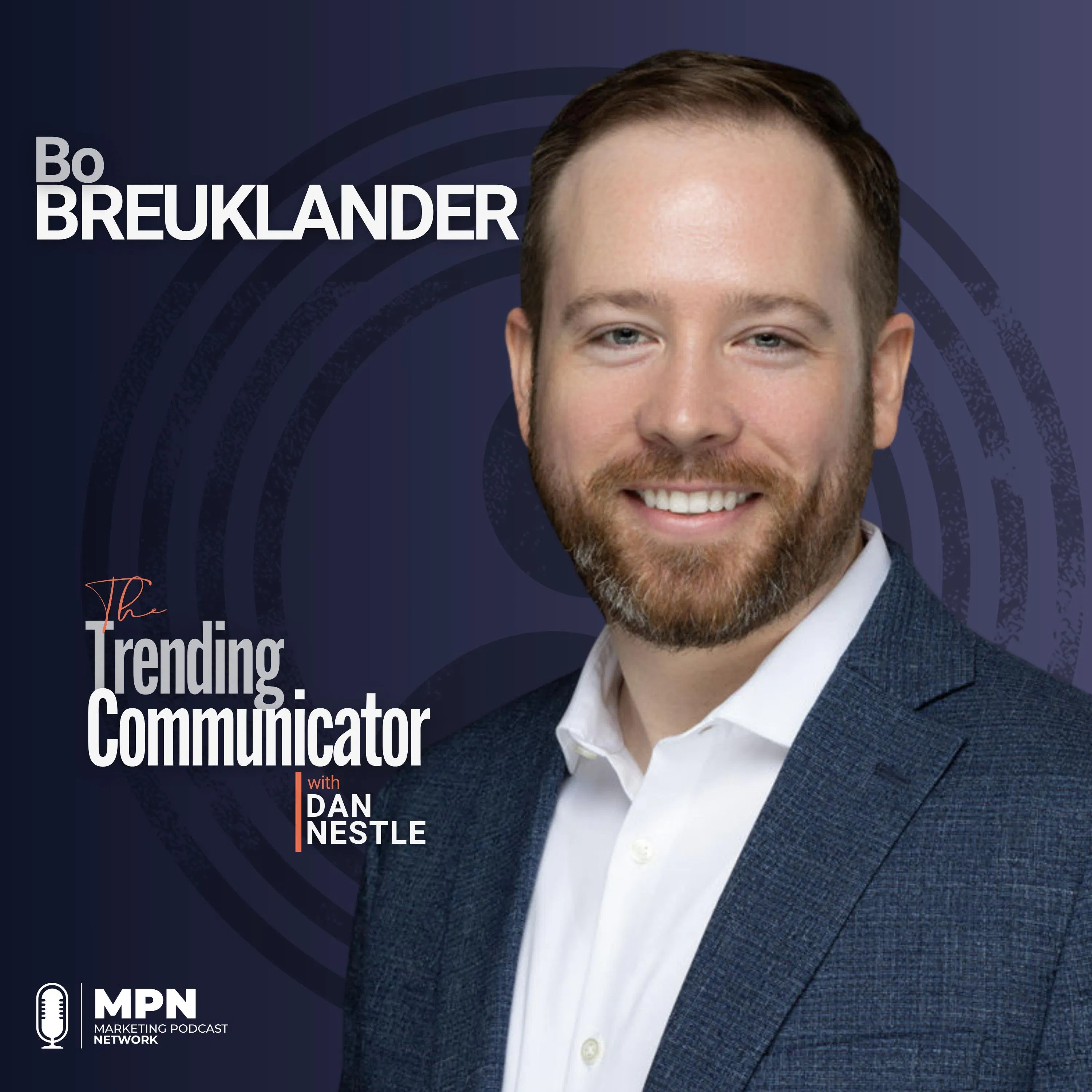
 Judgment Is the New Advantage - with Bo Breuklander
AI transformation isn't a strategy problem. It's a leadership problem. And until CEOs and boards stop asking for an AI strategy and start asking for a change management strategy, most organizations are going to keep spinning their wheels.
In this episode of The Trending Communicator, host Dan Nestle sits down with Bo Breuklander, founder of Breuklander Communications, ProSci-certified change practitioner, and professor of PR and media writing at the University of Tampa. Bo spent 16 years in corporate communications, led digital communications at Jabil, moved into VP-level transformation work, and now runs People First AI workshops that document 100% confidence increases among participants.
Dan and Bo get into why the comfortability gap matters more than the skills gap, what happens when people in the room are too afraid to admit they're already using AI, and why communicators are uniquely positioned to lead organizational AI transformation rather than waiting for IT to hand them a playbook.
Listen in and hear about...
- Why random acts of AI are the new random acts of content and equally ineffective
- The explainability problem and why it connects directly to critical thinking in the classroom
- How to find your AI champions and ambassadors inside existing teams
- What entrepreneurial thinking actually looks like as a survival strategy for knowledge workers
- Why $20 a month might be the most important career investment a communicator can make right now
Notable Quotes from Bo Breuklander
"You have to ask people how they feel about it. And you have to listen to what they tell you."
"Your job is not necessarily your value. I think it's really important for students to hear that, for younger professionals, for older professionals, for all of us."
"Slow down enough to get the functional and the foundations right. Clarity is going to beat speed. Judgment is the new advantage."
Resources and Links
Dan Nestle
- Lilypath | Website
- The Trending Communicator | Website
- Communications Trends from Trending Communicators | Dan Nestle's Substack
- Dan Nestle | LinkedIn
Bo Breuklander
Timestamps
0:00:00 Introduction: AI Transformation & Leadership Challenges
0:05:48 [Speaker B]'s AI Journey & Focus at Brooklander Communications
0:11:22 Addressing Human Factors in AI Workshops
0:17:22 Individualized Nature of AI Adoption
0:21:22 Students, Employees, and the Hidden Use of AI
0:27:01 Are “AI Natives” Ready? Skills vs. Comfort
0:34:11 Explainability, Critical Thinking, and Fact-Checking in AI Use
0:42:08 Navigating Job Disruption and Entrepreneurial Mindset
0:47:42 Practical Steps for Comms Pros: Quick Wins & Automation
0:53:57 Using Prompting Frameworks and Moving to Advanced AI Use
1:00:16 Investing in AI Learning—No Room for Victimhood
1:07:22 Closing Advice: Slow Down, Clarity and Judgment as Advantages
(Notes co-created by Human Dan, Claude, and Castmagic)
Learn more about your ad choices. Visit megaphone.fm/adchoices
00:00
Daniel Nestle
Welcome or welcome back to the trending Communicator. I'm your host, Dan Nestle. You know, there's a road that we've been down maybe a few times, maybe more than a few times. And I have to tell you, dear listeners, that we're going there again. And I'm talking about AI transformation. And it seems to be that no matter how far we travel, we are no closer to our destination. And unlike those family road trips that can get a little tense after a few hours on this ride, we can't silence the infuriating are we there yet? Because it's not coming from the kids. It's hitting us from all directions. So when someone steps up and says, no, hey, I really want to drive, I want to be your navigator, we should be grateful. I mean, skeptical maybe, but grateful at the same time.
00:55
Daniel Nestle
I mean, I get it. I'm one of those gluttons for punishment myself, after all. I actually love the challenge of mapping out this territory. And I also realize that we'd make a lot more progress if CEOs and boards out there would take a beat, stop saying they need an AI strategy and start saying we need a change management strategy. AI transformation isn't a strategy problem. It's a leadership problem. Which brings me today's guest. He implemented AI workflows at a Fortune 120 manufacturer with 260,000 employees across 30 countries. He's teaching communicators at the University of Tampa while running People First AI workshops that achieve 100% confidence increases documented. He calls out Random Acts of AI and I love that expression. We say random acts of content. Anything associated with random acts. I'm partial too, but in this case, random acts of AI.
01:51
Daniel Nestle
People dabbling without strategy, hoping prompts alone will deliver transformation. He led digital communications at Jabil, moved into VP level transformation work, then launched Brooklander Communications. He's ProSci certified change practitioner. Look, we're going to dig into what responsible AI implementation looks like and whether communicators can actually lead this transformation. Making his debut on the trending Communicator. Founder of Brooklander Communications, teaching implementation over hype. Beau Brooklander, my friend Beau. How are you?
02:25
Bo Breuklander
I'm good. Thank you for that intro, Dan. We should end right here. Okay, Dan, we're done the bar and we'll talk later.
02:31
Daniel Nestle
Good to see you.
02:32
Bo Breuklander
Good to see you too. Yeah, it's great to be.
02:34
Daniel Nestle
Best wishes.
02:35
Bo Breuklander
Yeah, thank you. I got to tell you that just listening to the last few podcasts or sessions that you've released like, I, I, I find myself clapping and standing up and then I realize I'm by myself. But I think it was Anne Green that you.
02:53
Daniel Nestle
Yeah. Just today. Yeah. Shared on the as of this recording, Ann Green was released today.
02:57
Bo Breuklander
Yes, absolutely. Absolutely. So I'm going to finish that after this. And then I listened to Chris G. Prior to that. Was it last week?
03:04
Daniel Nestle
But I mean, heavy hitters, one after another. Here you are.
03:07
Bo Breuklander
I know, I sorry to disappoint you with this week, but tell you, like, I just keep, continue to agree with a lot of the things that, well, not 100%, but I think that's, that's part of the discussion today is like, you know, there's things that you can learn, things you could do differently, things you have to know about yourself and individuals on your teams within an organization. Again, that's about leadership, too. But I've just learned a lot about myself and about the things that I'm doing and adjustments that I can make and the conversation that I'm having with the guests that you've had. So thank you for presenting information the way that you do.
03:44
Daniel Nestle
Oh, man, you're very welcome. I mean, and if nature and the vagaries of time and utilities departments would have been more favorable to us, we would have done this a couple months ago. But we kept getting waylaid by a storm and by a power outage and by this and that. It's just, it's crazy sometimes the things that happen when you do all of this from home and, you know, many of you out there are working at home all the time anyway, so you get it, you know, this little storm and you're like, okay, got the day off, right? But, but we've got, you know, we've been trying to do this for a while. Beau and I met through comms consultants, I think, but there's so many organizations, great organizations out there that we're both a part of.
04:32
Daniel Nestle
But we, you know, we gravitated towards one another with our friend Natalie Moran, who was also on the show a while back to do some workshops and webinars through to communicators through that org. And from the first time we connected, Beau, it's like we're sympathetic. We've got very similar views on what's happening with AI. But I like your approach to this. There's no hype, real AI for teams and for people. And plus, you're also teaching and, you know, you Bring a very refreshing perspective. So let's kind of start there or, you know, learn a little bit more about, you know, BO and Brooklander Communications. Just before we got on, were talking about, you know, how the entrepreneurial journey is a little. Is a little bit crazy.
05:25
Daniel Nestle
And with AI, though, we're enabled to do so many different things, and it's hard to choose which things to do. So that. That challenge of focus is magnified, I think. What, in our age now? But how have you found it so far? And like, how did you get here? What is your. What is your main thing right at the moment? Give us a little bit of. Of who Beau is.
05:48
Bo Breuklander
Yeah, well, right now I'm leaning heavily into my 2026 planning, which involves taking a few extra steps into the. The advisory offerings. Right. For leadership, as it pertains to AI and enabling their teams and offering up some decision intelligence. I keep hearing that phrase come up here and again. But helping them kind of decipher all the water that's coming through the fire hose. It's hard to drink from a fire hose. You've heard the saying, but try to make some sense out of it because there is a lot of noise. I've heard you talk about AI slut. I talk about random acts of AI. It's kind of in the same vein. There's a lot of parallels there. And we're human, right? We get emotional, we see things that trigger us. The word of the year, rage, bait.
06:46
Bo Breuklander
And so you've got things that trigger us emotionally on a human level. Leaders are human. Sometimes it's important for you to remember that you got to take time for yourself and pause and think. I know that a lot of you probably do build that in and you're conscious of that and make that a priority. But what that means is that also applies to the people around your teams and who you work with and for and your leadership. And people are seeing and reading different things about AI. And AI is such a broad topic. And so I try to be one of the sense makers. Certainly I'm not alone. There's a lot of them. There's a lot of good ones. But I try to be that calm voice. I don't push one tool over another.
07:38
Bo Breuklander
There's tools that I don't use right now that I want to use. I want to test them out. You know, for example, I mean, I subscribe to Google Workspace, and I have not leaned into the creating gyms and integrating that into the work that I do. And that, to me, is an opportunity, and I'm going to try to leverage that. And that's, you know, a lot of the clients I talk to are Microsoft shops, right? They're Microsoft houses. And you know, as a solo, you know, I don't have the same Microsoft tools, so I've got to find a way to experience that another way through other partnerships and clients and things like that. So it's a real different learning journey that I've experienced these last couple of years.
08:25
Bo Breuklander
And I still lean into my corporate comms experience of 16 years prior to this, which has served me really well. But I just think this is such a moving target.
08:43
Daniel Nestle
You're kidding. No kidding.
08:44
Bo Breuklander
That we just have to realize that empty still matters. All of those, the basic blocking and tackling. This all still matters. This is just a new technology that is far more transformative than what we may have experienced previously. But all the basics, you know, those matter. They'll always matter.
09:04
Daniel Nestle
And I think we can hear from partly, well, from the way you're talking, everybody gets the sense of the calm, I hope, and anybody who sees this on video will certainly see that. So that calmness, that calm approach that you've picked up over the years and this idea that, you know, you keep talking about the people about like the teams and you got to remember the leaders are people too. And every. This is, it's that. That people first AI, that you're, you're obviously walking the walk of what you. Of you're talking. And I don't know if enough, enough practitioners out there really get that like, okay, everybody pays lip service to it when it comes down to it. You get an engagement. We want to learn the tools. We want to learn the AI. We want to learn how to prompt. Sorry.
10:03
Daniel Nestle
We want to learn how to prompt. We want to learn how to clear our throats. You know, we want to learn how to, how to build a, a GPT or a GEM or whatever it is that's going to like make it just 25% easier for me to get through my day. They don't realize that by doing that, they're not actually going to free up 25% of their time. They're going to fill that 25% with 40 more work. That's kind of the math of this whole thing. But we talk about these things, the benefits, the features and benefits. We don't talk about as much as we should. The humans, the people and the change management, like you said. So are you spending a lot of Your time, like in your workshops, the way that you deliver, I guess, AI enablement and AI literacy.
10:53
Daniel Nestle
How are you working the human into this?
10:56
Bo Breuklander
That's a great question because I leaning into the cliche, hey, everybody's different, everybody learns differently, everybody's at a different stage, everybody's at a different spot in their journey. Organizations have different maturity levels. So it's probably the hardest thing I do, and it's going to be really difficult for a lot of people unless you have an idea of where people are before going into this workshop.
11:22
Daniel Nestle
Right.
11:23
Bo Breuklander
So I do my best to try to assess people at an individual level in their stage and their confidence. You know, that is one of my metrics that I try to come away with each time is does their confidence level increase? Because that a lot of factors into that. Do they know enough? Right. You think about change, right? Do they know enough. If they know enough about something, do they know the tools they need to use to overcome the challenge? Do they know what to measure? Do they know what it's going to look like in six months? Do they know what it's going to look like in 12 months? All that stuff goes in. And, you know, I don't shy away from asking people how they feel about certain things. So it's not just about the quantitative metrics. Right.
12:03
Bo Breuklander
You have to ask people how they feel about it.
12:05
Daniel Nestle
Yeah.
12:05
Bo Breuklander
And you have to listen to what they tell you. And just recently, you know, we did a portion. Even after I did an assessment,.
12:14
Daniel Nestle
There.
12:14
Bo Breuklander
Was a room of about 15 or 16 global comms team members from a global B2B organization. And we still went around the room, first thing we did, and they had meetings prior to this and they'd already done the icebreakers. They were tired. This wasn't the first session they had. This was kind of the second half of their day and a day full of meetings. So I just wanted to ask them how they felt about it and what they were excited. And a few of them actually said they weren't excited. Right. They were, they were fearful. And these things come up and you have to ask these questions. You have to gauge how people perceive it on your team as individuals. So, you know, you try to bring them together to achieve something and form a system. Right. What are you building as a team?
13:02
Bo Breuklander
What is your goal? What is your North Star? But you have to get to know them as individuals and where they are. So, you know, you can't ask someone to think about what agent they want to build if they're not if they're only restricted to using a free version of Copilot, for example. And they don't really use that maybe once a week to summarize something. And they don't have that inspiration beyond their own usage of that. And so it's kind of all over the map. You know, some more organizations have lots of quality training. Some of them don't. Some of them have good leadership. I say good leadership. Let me back up. That's, that's very, that's.
13:47
Daniel Nestle
We love our clients. All of our clients are best leaders.
13:50
Bo Breuklander
We do, we do. But you know, I think it's just a matter of let's say how bought in leadership is, whether it's leadership leader driven, you know, from the top, from the team leader, whatever that looks like. If you don't have that buy in, that's just not. You're not going to get very far. Yeah, you're going to be in these, these siloed individual use cases where some of the team members are thriving because they're curious. You have these natural elements. You know, they're curious. They, they're hungry for information. They want to know how they can use it for themselves to get better. And some of them want to know how they can share that across the team. And one of the things I always end with, and I know this is where we start, but I think circling back to. Circling back. Another cliche.
14:39
Bo Breuklander
Take a drink, Dan.
14:40
Daniel Nestle
We got it.
14:43
Bo Breuklander
At the end of these workshops, I always bring it back to the individual level. You've got your roadmap, you've got your use case, you've got the measurements as a team. You've got your direction. Now let's go back. Who are the ones that are excelling right now? Who can learn from those people? Find your champions, find your ambassadors, because those are the people that are going to help you drive this change and this transformation with your team and then ultimately across the organization. Because I honestly believe that's where communications experts in an organization should be. Right. You should be the ones that are at the, the lead or the tip of the spear for this effort. Because this is far more than a, a technology implementation. Yeah.
15:30
Daniel Nestle
It's different than anything we've ever seen before. And you know, you said that. You're listening to Ang and Chris G. And there's a theme, right? Organizations, companies, Leadership boards, shareholders name the stakeholder group, right? They are treating this as though it were just like another big technology change. We've been through these a few times before and especially, you know, the board, people on boards and leadership, they're kind of now like, hey, they're like kind of my age. They're Gen Xers or late boomers and have been exposed to the, you know, we remember that, we remember rotary phones. We have been through every succession of technology change you could possibly imagine. We saw Pong change to Atari, change to Coleco, if you remember that, by the way, you know, but to lit television.
16:35
Daniel Nestle
We saw the gaming revolution, right, of the 80s and these incredible 4 16, the 16 bit graphics, right? We've seen the advent of the Internet, of course, you know, and you know where that all started. And now we've seen, then we saw social media come up and now we've, now we're in a, like, it's just nonstop, right? And I think we might be like, inured to change a little bit. Like, there's this whole. Okay, it's just another thing. We've been through this before. Let's just follow the transformation playbook. But something you're talking, you're mentioning, and it's extremely important, I think, to remember or for me, you know, what I hope people remember is this is the first, and I hesitate. It is a technology, okay?
17:27
Daniel Nestle
But so this is the first technology that is so highly individualized, without any additional effort on the side of the developers or the people who are rolling this out, you have no control in some ways of how individualized this becomes once it's in somebody's hands who is curious or who just likes logic. So it has this potential to go in so many different directions. And the only commonality here is this human side, really. Everybody's using this AI or trying to figure it out. But if you're treating it like a technology, you're going to lose sight of the necessity of this one one individual kind of human effort. And so what I was thinking as you were talking though was, and I'll get there, is that it seems like there's a.
18:29
Daniel Nestle
We should create a maxim of some kind that is in order to teach AI, you have to know the humans, which is kind of, kind of weird. Like, in order to teach Excel, you need to know spreadsheets, you need to Excel. I don't need to know anything about a person to teach Excel. But if you're teaching AI or if you're training In AI going around knowing the people, I, it's almost, it is a necessity. And I'm speaking a little bit from experience too, because I'm sure you've done virtual trainings, right? I mean, you know, we have to do everything, any kind of training that the client wants. And I have to say that I'm a hair away from just saying I'm not doing virtual trainings anymore. You know, I'm a hair away from this because you, that's exactly the missing piece.
19:31
Daniel Nestle
You know, it is, it's going around, it's, hey, how you doing with this? You know, what insight is right at the tip of your tongue, right in front, at the tip of your nose that I can help you see and push you toward, rather than you tuning off of getting frustrated and just going, okay, you know, I'm just going to do multitask here in my home, or, you know, and then the other thing, and I will turn it back to you, trust me. The other thing that occurred to me is that, you know, people have a capacity for just so much, right? And, and if you're doing, especially if you're doing a virtual training right, it's very hard to reach where, reach that capacity. And you have a, an agenda that you need to fill.
20:19
Daniel Nestle
You have a promise that you've given to your clients that you're going to cover from A to Z. But if you're in the room and you see and you feel that everybody gets stopped at D or E, how are you going to get to Z? You shouldn't, you need to stop. Virtual training is hard to do that. But because you're thinking, well, the client wants me to get to Z, so I'm going to go. Because it's really important for them to get to full automation and workflows. But some people still don't know how to prompt. So what are you going to do, that human side? I don't know, man. I think it's powerful and I'm really pausing to think about it a little bit. You're teaching as well. I mean, you're really involved on the personal side of this AI stuff.
21:07
Daniel Nestle
How do you see this bubbling up? I mean, it's coming from the students that you're teaching, the employees that you interact with. Is there a progression, a thread, a continuum of some kind there?
21:22
Bo Breuklander
Yes, yes, there absolutely is. And it's that the thing that stands out to me time and time again, and I could be in the classroom or in a conference room. And each time there are going to be a portion of folks in that room who use a tool and don't tell you, they don't want to tell you, they don't want to raise their hand and say that they've used it before for, you know, to help with their paper or to write an email at work. And there are. And I think that's part of the things that are the unseen portion of the iceberg, if you will. Like that's, you know, we see what, and we know what people tell us and say and are willing to fill out in surveys and research forums.
22:09
Bo Breuklander
But when you are in that room, Dan, to your point, you know, this is all about people. If you get into that room and someone's afraid to raise their hand because they don't want to admit that they've been using AI every day because they have a fear that they'd be interpreted as incompetent or lazy or contributing to the downfall of sustainability and high water and electricity usage and all these things, there's all kinds of. They don't want to think that they don't want to admit. And that's fine, there's nothing wrong with that. It's part of being human. But if you're one of those people or you know, one of those people, I say one of those people because I'm not one. I haven't been one myself for a while. But I totally understand where that's coming from. That's one subset.
23:04
Bo Breuklander
Then you've got people who probably use it in ways they shouldn't. Again, we go back to the random acts of AI. Even if they're using authorized tools, you're probably not getting the most out of it. And everybody in between. There's everybody in between. But that's really the parallel that I see is that sometimes people are just afraid to speak up on how they're using it. And they may be your power users, they may be using it in ways that other folks could benefit from and it may just be a small basic use case to them, but if it works, other people can benefit from that. So trying to get them, that's all about trust, right? It's trust in an individual level. And you build that trust with these people and you sometimes have to have a one one conversation with them. Pull them aside.
23:56
Bo Breuklander
If you're in a room, pull them aside, but show them that, hey, listen, I do care and your concerns are valid. And if you want to voice this or if you don't want to voice it, or even if someone is not using it and refuses to use it, their reason to them is a very valid and good reason. So we can't also just force people to do it. Right. We have to motivate them to use it properly because everybody's using it around them. And my concern, my fear, especially for students in the classroom, is if they don't know how to use the tools, if we're not teaching them in the classroom, they're not going to know how to use it on the job. And in the near future that's going to be. If it's not already.
24:41
Bo Breuklander
I mean that's going to be like the requirement. Can you, can you engineer a prompt? Well, can you piece together multi step automation? Can you import data without breaking privacy restrictions or guidelines, breaking policy at your organization? So all these things are necessary. It doesn't matter your major, it doesn't matter your function, none of that matters. These other things matter and they're foundational and I think they should be taught foundationally.
25:13
Daniel Nestle
But that's. Yeah, well, I'm with you on that. I mean, I'm with you on. There's been, you know, with, this comes up often, but this idea that the students of today are like the. What. Who are they? That the early millennials or who are the first like social, like digital natives. The late millennials, Something like this.
25:40
Bo Breuklander
Yeah. So I, I qualify as an older millennial.
25:44
Daniel Nestle
Yeah.
25:45
Bo Breuklander
And I remember when social came about, I was probably in college.
25:49
Daniel Nestle
Yeah. So, so your parents. But you're not socially, you're not social native necessarily. Right. But you might be like you're, you're close. People think that, okay, we're raising this whole AI native thing. I, I really worry about companies or talent acquisition apparatus that's out there getting the wrong idea of what that means. Because as you're saying right when they come out of college or when they're, you know, when kids are getting ready to come into the workforce, they need to be, they need to know AI, but not just they need to know AI, they need to know how to engineer a good prompt. They need to know how to get data without breaking the rules. They need to know how to do different kinds of analysis, et cetera. Those are like the basics. Hopefully they know how to think and ask questions.
26:47
Daniel Nestle
But you know, there's, you need to have experience to bear to be able to ask the right questions. You need to know what's what good looks like before you can start to try to engineer good. And there's a lot there, right, that we can pull apart. Where I think the, the kiddies of today, let's say, are AI native in the sense, it's in the sense that they're comfortable with pushing the microphone button on their phone and just having these conversations about whatever. So they're comfortable talking to robots essentially and expressing their innermost secrets and like find, you know, just because you can have a conversation with chat GPT and you just, and you learn, you know, that cicadas come out every 17 years from Brute X or whatever it is because it happened to come into conversation. Great. All right. You're, you're exploring.
27:44
Daniel Nestle
Sometimes you're not going to know if those are the right facts, but you're still exploring. That has zero bearing on how we, if you're going to be successful in your career as an entrepreneur in school, you know, like, it's nothing. It's just like having a silly friend. It's like, it's like as if they would have told us, you know, years ago that, know what you need to do is, you know those 900 numbers, this is again going to go way, way back for people. But you know, those, you know, you call those chat lines those 900 numbers and you spend $14aminute and you know, you don't realize it, but wow, you're talking to people from all over the country on the phone all at once. Right. Okay. Does that make me a community native? Does that make me understand mass communication natively?
28:36
Daniel Nestle
It's, it's ridiculous and I do apologize. It's a terrible analogy. However, I've been dying to bring that up raid forever. Look, I, I, I was just thinking though, that these, you know, these, there's a, there has to be a recognition and a line drawn in the sand somewhere saying, look, I don't care how much you've used AI in college or in high school or wherever you come from. Right? Write me a prompt. Now, here's your, here's what good looks like. Yeah, build the prompt that leads to this. You know, that's what I want to see people doing when they're like 22 years old or whatever and getting into work. Because I think that's what's going to be important. I mean, or skill wise feels it's a little harsh, but maybe that's it.
29:21
Bo Breuklander
Yeah. Yeah. What are the outcomes? Like, what are you getting? What's, what's the Impact of the things that you're using. And one of the things that I showed in a workshop earlier this week was data from, you know, McKinsey and they had access to a lot of folks that gave a good study. But their number two, and this was a cross functional study, good sample size. Number two, most experienced issue by individuals using AI was explainability. And to me that correlates directly into the classroom. We were well aware of privacy issues. Whatever you give a, a chat bot, right? It's it may remember, right? You got to know your settings, right? Check the box or uncheck the box to train the model if you want to.
30:14
Bo Breuklander
Don't provide my data to, you know, to other folks or training models or whatever, you know, that's, that could change with ownership. There's lots of risk involved and you know, you have to know the security settings. But aside from that taking that step down, like I said, the number two issue experienced was explainability. Now what is explainability other than you're pulling information? You have to know whether or not the response you got is accurate. Was there a hallucination? Can I decipher fact from fiction? What do I do with the information that I have? And if you just take it and push it as your own, how do you explain that? And that very issue is something that I've tried to tackle in the classroom and I've changed the way that I taught this semester.
31:06
Bo Breuklander
By the way, I teach principles of PR and I also teach media writing. I mean I can't think of media writing specifically. I can't think of a better course to teach with a better sample than a class like that about how to showcase students actual knowledge, right? It's. I remember back in school, you know, I, I'm a comms guy, you know, but I, I did take some math and I know how to count and add two plus two. But I remember all throughout school you have to show your work. And I remember I did not like doing that, right? I could get to the answer and I here's the answer, right? Is it right or wrong? You know, pat myself on the back most time it was right. But I did not like showing the work.
31:51
Bo Breuklander
It was one of those things where it was a requirement and I didn't know then, but I know why it was a requirement, right? Because you want to know that students start under there with a calculator under the desk getting the right answer. I mean, there's another analogy for you. It's not a calculator But I know people have equated it to that sometimes, but how do you get to that answer? And how do you know that answer is correct? Even if it's not correct, I'd still want to know. How did you develop this article? What sources did you pull from? And if you used ChatGPT, for example, what sources did it use? Did you go check those sources? Did you? And there's a level of, listen, there's a level of, again, media writing isn't specific to journalism and news media.
32:41
Bo Breuklander
But hey, look at the journalistic standards that are everywhere these days, or that need to be everywhere these days. And fact checking and making sure that a story is accurate before running with it. Boy, that's almost becoming our jobs. If we're using these tools on a regular basis, what's true, what's not, how do we decide? And that's where our judgment and critical thinking come in. And we have to find ways to strengthen those in that age group. And with our kids growing up. I've got two kids of my own, Dan, I've got a nine year old and a three year old now. And they're going to be coming up in this world. And when they ask me if they can use something to help them with their homework, there's options out there. There's absolutely options.
33:25
Bo Breuklander
But as a parent teacher, I want to guide them. I don't want them to be left to their own devices and figure this out. I think that's part of, you know, that's part of our responsibility as communicators. And I see it a lot in PRSA and iabc and here in Florida we have fpra. You know, there's a lot of programs that help guide young professionals that are trying to get a job or even students. Right, the student, the PRSSA and those organizations, you know, they do a really good job, but it's tough. Like, how do you disseminate that to the students that are not part of those organizations? Because there's a lot of students that aren't.
34:13
Daniel Nestle
It's a conundrum for sure. Educators, since you're kind of involved in that area, have to figure this out somehow. I mean, you said it yourself though, about explainability. Very related to accountability. I think the natural reaction is to say, oh, you don't like, okay, you want me to show my work because you don't trust me. But really the reason that you're supposed to show your work is because you're supposed to become a better reasoning machine. Like you're supposed to. You can say, yes, you got to the right answer. Okay, Your thinking patterns or your, the way that you arrived at that answer, it's either very fascinating or just look at that. Straight, direct. That's amazing. 1.1. You know, 1, 2, 3, 4, 5, you're done.
35:10
Daniel Nestle
You, you got from point A to point B to point C. Then you're going to see kids who go point A to point F back to G, you know, like. But by showing the work, you're going to understand the way that people think. And of course you're going to filter out people who've cheated. Right? That's. That's a side benefit, but that's not the reason I'm a big believer in this, in the world of AI. And I do think we owe it to our audiences and we owe it to the people who consume our content to understand that we're not cheating them of something. Now there's an argument to be made that if I deliver fantastic content, it shouldn't matter. Right? I don't need to show my work. The answer is there. But I'm not doing anybody a favor or any.
35:55
Daniel Nestle
I'm not doing anybody a good service by doing that. That's why I like full transparency and I use AI liberally and I tell people exactly how I use AI. But you can probably see where my thinking is and how I've knitted it together and none of the thinking. And I abide by the rule that I will never represent something in writing that I haven't thought of first myself and put into action or like just done it my way. Like it's.
36:25
Bo Breuklander
It is.
36:25
Daniel Nestle
It is only my experience, my knowledge for what it's worth, wrapped up in different bows and connected together with a helper as if I had a ghostwriter sometimes or as if I had an assistant. That's it. A lot of people don't do that, right? A lot of people don't show their work. And I think that's really important. But in the PR comms world, you're talking about being a comms guy and naturally that's how we met comms consultants. Communications should be driving a lot of this in organizations for a lot of the reasons you mentioned. Understanding how humans receive information is one of them. And AI is not. Is not going to. The solution to the AI transformation, if there is such a thing, is not going to be. It's not going to come from the IT department or the CIO or even the coo.
37:21
Daniel Nestle
It's going to come from the Humans in the organization who are going to figure out which dots are going to connect and they're going to most likely, you know, be led by people who could tell good stories and talk about it, whether they're on the comms team or not. At least that's what they're doing. They're actually communicating. So we're facing a lot of issues and one of the things we talked about prior to this is, and you hear it come up again and nobody seems to have resolved this is this whole idea of, okay, people are losing their jobs or they're going to lose their jobs, and clearly it's happening. Whether or not it's because of AI varies, but communicators I think are scared. Right.
38:02
Daniel Nestle
You take this AI first approach and you're definitely, I think, more, let me, more knowledgeable about automation, for example, than I try to avoid that. But I can't help it. I'm getting my hands dirty now and like figuring it all out. But you do, you know, you work with automation. You do, you've worked on, in companies that are, you know, that have a lot more processes over people type things well. So as this with your people first approach, I mean, how do you talk to people who are really concerned that, you know, that AI is going to take their jobs? And I've heard this from many people. I just want to get your take on it.
38:52
Bo Breuklander
Yeah, yeah, I have a strong opinion about this and I try to tell this to my students also, not to scare them, but just to prepare them. Jobs are going to be disrupted. It's just a fact. They're being disrupted now. And disruption does not equate to elimination. And I think that it's important to reframe certain situations. I mean, I, I don't know about you, Dan. I, I've experienced a layoff. You know, I have. Many of the listeners probably have too. And so they felt it. They, they've been there. They don't want to experience that. Nobody wants to experience that. Nobody wants to experience that. For a younger professional who hasn't experienced it before, it's just scary. It's a scary thought.
39:43
Daniel Nestle
Yeah.
39:44
Bo Breuklander
But I, I think that there are opportunities, if you can find them, to be, I'll say entrepreneurial, for lack of probably a better term. And this also goes into when you upskill with an organization and you want to train your people and if they leave and get a better job, it means you've done well by them and hopefully that they've done well in that role enough to where the role is transformed and better than it was when they got there. That's the hope. But I think as an individual who has that fear and you're on a team, I think that there's a big opportunity for you to look at the. Less so and I would tell this to a comms leader who hires me to perform a workshop or with advisory retainers is that don't just focus on efficiency metrics or quantitative metrics.
40:53
Bo Breuklander
You know, I said, I talked about qualitative goals and how people feel but also think about invention in communications. Because if we're talking about AI as a new technology brings about invention and new things.
41:07
Bo Breuklander
New ways of, new ways of thinking, new ways of learning, new products, new ideas, new org structures, new, you know, I know this is pie in the sky, but when you listen to tech people talk about and VC firms and you know, when you hear that world talk about, you know, there's going to be a one person unicorn out there, you know, an individual who creates a team of AI agents and does whatever they do and they, you know, reach a billion dollars as a company, you know, whether you believe that or not, you, you have to kind of acknowledge that people are doing new things with a whole lot less.
41:51
Bo Breuklander
And so I, I, my position is that, you know, as we see larger organizations and enterprises reduce headcount, you're also going to see an increase, not necessarily an increase in size of organization but an increase of the number of smaller to mid sized organizations.
42:08
Daniel Nestle
Right.
42:09
Bo Breuklander
And entrepreneurs for that matter.
42:10
Daniel Nestle
Yeah.
42:11
Bo Breuklander
And if you can take that entrepreneurial mindset and find, you know, value in the things that you bring to the table, because you do, each and every one of you do bring things to the table. You have value and your job is not necessarily your value. I think it's really important, you know, for students to hear that, for younger professionals, for older professionals, for all of us to understand where we sit in the grand scheme of things and that there are things that, yeah, disruptions are going to happen and they may impact you. But prepare now so that it's not such a negative thing and reframe that as a new opportunity rather than something that's going to put you on your heels.
42:50
Daniel Nestle
Yeah, you need to have an abundance sort of mentality about this whole thing that the interesting thing there is, I think that disruption doesn't mean ending. Right. The disruption is exactly what it sounds like. It's just, it is, whoa, things are different. It's an interruption that ends up turning things around and upside down and causing chaos maybe, or just stopping stuff for a bit. But it's not an ending. And the, one of the big takeaways here, I think for me for sure, is being entrepreneurial. Now that scares the bejesus out of a lot of people, right? Like they're scared to hell of just like being out on their own. Oh gosh, I mean, now I gotta find my own insurance and how am I gonna. These are legitimate questions, right? Like, like it is a hard thing and there will be. There's no question.
43:44
Daniel Nestle
Many people are going to go through hardships, are gonna have to live for a while, sacrificing, which by the way, is no different than any other time. There's been a societal change, but this time it's hitting the knowledge workers probably more than anybody else. The thing that we need to understand though is you don't have a choice. I mean, at some point there's not going to be very likely. There's not going to be anybody out there who's going to give you everything that you want all the time. So what's your choice? Your choice is to go get it yourself or go, you know, provide for what, for your needs. Now that's scary as hell. Now on the other hand though, we have AI. AI is the cause of this in some ways, but it's also your lifeline.
44:43
Daniel Nestle
Now were talking about this a little bit before and I'll share here and I know that maybe my listeners know that know a lot of this already, but everybody knows I'm a big Claude user and I always kind of like start these big like major developments in my life with this question. I wonder if I could, I wonder if I could do something, have the idea for my business or I knew what I wanted to do as an entrepreneur. So, you know, then you start to go, okay, well, I wonder if I could do this. I wonder if I could build that. I wonder if I could develop that. I wonder if I. And this starts these wonders, wonders start to build up. And you know, used to be I'd have a bunch of post.
45:31
Daniel Nestle
I still have a bunch of post its, but it used to be like there'd be post its and I'd try to figure it out, but I just dug and dug into interacting with AI in my own way. No manual, no handbook, just talking, just having conversations, just being curious. Sometimes just simply the question, the one question, hey, is there a better way to do this? Is there a Faster way to do this is an instant changer. Or I was gonna say game changer. I'm trying to avoid that word, but it isn't. It is an instant like life altering question. Sometimes that's how you learn. Yeah, of course there's a better way to do this. You can just, you can build a custom GPT to do this. You can use a prompt to do this. Well, how am I going to do that?
46:25
Daniel Nestle
I'll show you. AI wants to show you. Right. So you want to get upskilled. You have to really want to get upskilled. But you know, put in the time. Anybody can do that. Anybody can do this. Seriously. You just have to know what questions to ask, which not everybody can do. So I use these, you know, I use Claude Crate like a crazy person for work for a bunch of different things. For my job I had. It's like you talk about a person with a team of agents. Look, I'm not that billion dollar unicorn. And these aren't really agents per se. I mean they're. Some of it's getting closer. But I have different functions. Like I'm, I feel like I'm operating with a team of advisors, of professionals, of you know, errant children that I need to smack back in place sometimes.
47:10
Daniel Nestle
Like takes on a lot of personalities. But I can build these tools and I can have it done. You are, you are entrepreneurial. You're not. You're an entrepreneur. You are an entrepreneur. I mean you know, you're doing a lot of different things. Have you come up with any of these like tangible solutions that. So these people are struggling. Comms people in particular, right. Are comms audience little worried about the future. What are the things that like the practical stuff they should be doing now? Like from your experience?
47:43
Bo Breuklander
Yeah, well, from my experience, I mean just, I mean there's some simple quick wins that can be accumulated very, very quickly. That's why quick wins. But there are things that they could do today and some I think the challenge is this gets into a whole other area here about having a tool first mindset and being in an organization where they have the reasons.
48:12
Daniel Nestle
Right.
48:12
Bo Breuklander
It sets the technology access rules and restrictions to protect the organization. I totally get that. But it is limiting on the things that can and maybe should be done safely because you can do these things. You could have these experiments in these pilot programs in a safe, controlled environment where you approve access for a handful of people. It's not organization Wide, Yeah. And you allow this small group to experiment and collaborate and use a team's account. Microsoft Teams. But ChatGPT or OpenAI or Google or whatever. Google's been making just leaps and bounds lately.
49:02
Daniel Nestle
It feels like it's fantastic.
49:08
Bo Breuklander
I'm not even big user yet like Gemini, right? So that's, I'm, that's me saying something about them that, that I have my, my workflows and my custom GPTs. Everything. Most of, most of what I have is in chatgpt with OpenAI. But back to the question that you asked is that find, I mean find the one thing that's repeatable and create a, a custom GPT or if you're allowed to have Zapier, get Zapier or make or Innate and if you don't know code, maybe just stick with Zapier or Megan. Google allows you to do this. Now there's Microsoft tools that I don't know if you have access to those but again there's options there to just create one automation.
49:57
Bo Breuklander
And if it's a simple reminder to a leader, it's almost like a digital tap on the shoulder say hey, I need this feedback or I need a quote on this article or you're bylined, please read this and just give me a thumbs up that I'm ready to send this to the publisher. Those are really simple things and I would encourage anyone that hasn't done that to try to figure out a way to do that. But that's just a little automated reminder that you can send to people that you work with or you know, ideas or workflows or co. People can have these co officers, these CO CEOs are CO marketing people or CO CCOs or directors or whatever your role is. Right. You could create a collaborator and it's more or less a thought partner, but do it.
50:50
Bo Breuklander
You know, my encouragement is to do that in a way that it challenges you and pushes back on some of your ideas so that you can sharpen what you have and not just again that explainability, just take what they give you. But you could easily do that. That's an automation I'm giving you. There's one and there's create a custom GPT or figure out a way to create that in whatever system that you have or that you use. Whatever AI tool is your preferred method. Just if you've not gotten experience in these tools, just get in and start asking it questions and have a. I don't want to Use the word conversation, because that's what it feels like. But really, it's iterative prompting. So you ask it a question and say, where can I get better in this?
51:31
Bo Breuklander
And then it gives you answer, and then you just go from there. And it's just this iterative prompting process. And I'm not big on frameworks myself because it feels like every time I go in, I'm doing something a little bit different. And so it's less structured for me. But I always encourage people who want structure to use a structured framework for the prompting. Dan, I know you probably talk about,.
51:53
Daniel Nestle
I talk about all the time, some.
51:54
Bo Breuklander
Of those frameworks, and you have those. So if you're listening and haven't checked those out, go. Go check out what Dan's got on that.
52:00
Daniel Nestle
But, well, I'll give the nod, really, to Chris Penn on that because I, I steal his frameworks.
52:05
Bo Breuklander
Yeah, there you go.
52:06
Daniel Nestle
His prompting frameworks. But let me just clarify that a little bit because. And, and for people who don't, who aren't following a prompting framework is just simply a, A, A, an instruction. Kind of like a little blueprint for. For drafting a prompt. You know, a very handy dandy mnemonic that gives you a prompt idea. So like one. One of the most common ones is. Is called race, R, A, C, E. Although Chris Penn will tell you that's. That's been sunsetted, but it's still fantastic, right? It's, you know, role, action, context, execute. Right? I don't sit there and go, okay, I got to do the R, I got to do A. Got to do C, got to the eight. But just get started. To get started on your prompting journey.
52:58
Daniel Nestle
Find a simple framework and just start trying to follow the, you know, the letters, whether it's our, Whether it's race or there's another. There's act. It's what? Act, action, context, something I forget. I don't use that one. So I beg forgiveness, but there's a lot of them and just find one that's comfortable with the way that you think and you'll be surprised and really. But ultimately then you learn that there are just several elements that you really should always be present in your prompts, at least at the start of an interaction. That's the role, the context, and what you want the thing to do. That's like, if you know those three things, you're on the way.
53:41
Daniel Nestle
The context is where it gets really crazy and important because you want to just Be able to give it the right stuff and you learn as it's, as it goes on. You just learn and learn, learn and. But that's a great place to start and if that's all you ever do, you'll do fine. Honestly. Sorry for the interlude there, man. You were telling me.
53:57
Bo Breuklander
Yeah, no, that's perfect. I'm glad you mentioned that because that's where you know early on. Yeah, early on. I mean, Chris, Pin's a great resource and the Trust Institute bookmark it. I get the newsletter, Dan. I listen to your podcast, there's several other ones. Marketing Institute's another one. Just really great resources. And they got another podcast I listen to as well. So I mean those are my go tos every week, every chance I get. So yeah, they've got great frameworks there and I think that some of the other advanced like those are suggestions to start out with. But then what happens when you get good at that? I always ask a question. Okay, great, you've automated something, so now it goes faster.
54:41
Bo Breuklander
So the question I always ask or try to ask my workshops and conversations I have is, okay, so what happens when you can do this faster?
54:51
Daniel Nestle
Yeah, what then?
54:53
Bo Breuklander
You know, okay, you can clear your plate a little bit faster. You adding more to your plate or are you doing something different? Like that's the real question. I think, I think once you get beyond those efficiency goals and measures, that's where you get into that. Okay, can I lean into this? Do I evaluate the strategy a little bit further in advance than I used to do? Is there something new I can create? And in my case, there's one client that I've gone to that far. Right. They brought me in for traditional thought leadership and a little bit of ghost writing. And so what we've done was we started with training a custom GPT on voice and brand voice and style and all these things. And then we created a series and now that's become something totally different.
55:39
Bo Breuklander
We created this customized tool with airtable and automations and prompt libraries and all these different things. And yeah, it's just turned into this system, right. So you can get as advanced with it as you're comfortable with getting. But really what is it that you're trying to achieve? What is that impact that you've just, over the years, pre AI have just found it so difficult to attain or achieve, no matter what organization you're working for. What is that thing that you just, it's so hard to attain once you think, you know, get fast with doing all the Day to day stuff. Not that it's just stuff. Right. It's important. But there's gonna be an opportunity for you, hopefully after you've implemented these things successfully that you find that you have new abilities, you have new patterns of thought.
56:30
Bo Breuklander
Maybe you found out that you learn differently or that you receive information differently than you did before. That actually happened to me.
56:36
Daniel Nestle
It happens, yeah.
56:38
Bo Breuklander
And I just, it's just, it could just unlock things with what you're doing as an individual and again, bringing it back to the team. Each individual can have that aha moment and you know, you have to allow that to happen. And I think that's probably one of the most things that. One of the most. The biggest barriers or obstacles that I see is that you've got this obstacle built in that you're not removing for people because maybe you're too rigid. Some things need to be formed, guidelines and restrictions and things. But I think you have to ask yourself, get real and think about are they too rigid, too structured? And if we can't remove them for good reason, don't remove them. But figure out, is there a way that we can safely experiment in another environment that's not connected to company data or systems?
57:34
Bo Breuklander
Maybe it's on a different device even. But how do you create a structure to where you can actually report back the successes, the failures, the, you know, the, the additional trainings for other people? If it did work, like what does that look like for you? Because those opportunities are there if you can find them.
57:52
Daniel Nestle
Yeah, it's giving people the freedom and the room to run is so important. And you mentioned earlier that, you know, there are certainly some environments where that's not possible or where, you know, where there's there on such lockdown and the employees either don't have the capability to go beyond whatever version or iteration of copilot they're running because I don't have access to copilot just like you. I mean what we see at home is very different than what companies are getting. And there's all these custom build outs. And I made this decision, I don't train copilot organizations. It's just simply, it's just simply not. It's not that it's not worth my time, it's not worth their time. They need to find people who really get what they are dealing with.
58:41
Daniel Nestle
And I feel like, you know what I mean, I'll sit, I will tell you the things that, that you should be doing with AI and you're going to go, wait, I can't do that. Like that's going to be, that's like the conversation, hey, can we do. No. Well, how about no, like constantly? That's, that's the way I feel. But I know it's not, I'm exaggerating, but the, you know, I agree with everything you're saying. But of course I, I do think that those of you communicators out there, marketers out there, anybody out there. I mean, first of all, we're, we're kind of a high adopter function compared to other functions. But even then there are, especially in large organizations and regulated companies and legacy companies, there's a lot of a distance still yet to go. But let me ask this question.
59:43
Daniel Nestle
If you were in a job and you were told or you kind of got the inkling that the core skill of the job, right. Is evolving, but if you went and got an MBA or if you went and got a master's degree, not only could you keep your job, but you might be able to move into something bigger. You know, you'd probably get a raise, all these things would happen. What would you do? You take it.
01:00:16
Bo Breuklander
Yeah.
01:00:17
Daniel Nestle
You start going to night, you probably take it.
01:00:19
Bo Breuklander
It's that security, right, that securing your future.
01:00:22
Daniel Nestle
Now, I mean, affordability aside, generally speaking, there's ways to get to get, to get your MBA or to get your master's. Slowly, you might just, you might start and it may take you 10 years. But you know what, people do this all the time. Okay, why don't you do the same thing with AI and it's far cheaper. Like if you know that you need to build this skill set and get comfortable with this stuff, you know. Yeah. You work all day long. If you're getting your mba, you'd still be working all day long. You'd be doing your studying on the weekends and at night. Spend $20 a month, please. 20. It's a lot of money in some places and I know in different stages of life, but stop drinking coffee, do something. Get $20. Set yourself up with Google. One do.
01:01:14
Daniel Nestle
Is the penny for penny, dollar for yen, shilling for shilling the best investment for you if you are a beginner, forget chat GPT. I mean just for the, just for what you get yourself a Google account. If you do nothing else with that $20. If you're, if you are still at the beginning and even if you're in the middle, you're like, I just want To. I just want to focus in and just. Just have one tool, you know, if you're not a crazy person like us, where we. Where our jobs depend on knowing all the tools and understanding them and using them, you know, and you want to just narrow it down to one. I would. I would have trouble with that, but I would just go with Google. You gotta, you know, you get the.
01:01:57
Daniel Nestle
You get the Google, you get gemini, you get NotebookLM, you get labs, you get, you know, VO. You get all these. Like, you get so much, and it's only gonna get better. 20 Bucks. So therefore, this. There's very little room to play victim here anymore. I think it's high time for everyone out there who has $20 to spare to get moving on this. And in addition to learning these, you know, try start for free, who care. But get the. Get going with the prompting advice you heard here with the, you know, start to kind of ask questions, build yourself something. You know, it's all you. I mean, it's like nobody. You don't need anybody to teach you this at home, right? Sorry, man. It's. It's starting to get to me a little bit. A little bit. I got to tell you. That's.
01:02:59
Bo Breuklander
Yeah, that's. That's all right. That's all right. You know, I. And I've always felt that, like, personally, I've been kind of in the middle and not farther down the road than most people that I think the longer that we go, the gap is widening. And, you know, I get where you're coming from. Yeah. I do have a fear that obviously the technology is changing at a rapid pace. You've got. Like you said, you talked about the Google instance, and I'm right there. Right.
01:03:35
Daniel Nestle
I need to be.
01:03:36
Bo Breuklander
I feel like I need to learn that for my clients and for myself, because I do think that is a. It sounds like a logical alternative. Listen, I'll save my predictions about Google versus Microsoft and all that stuff for another conversation and podcast, but, you know, I totally get it. But my fear is that gap is just going to continue to widen.
01:03:58
Daniel Nestle
And between the people who know and the people who don't know, between the.
01:04:03
Bo Breuklander
Yeah, yeah, between. Yeah, between the people who are confident. I'll use that word again. Confident. Or comfortable with using a tool the way that they know how or want to. Doesn't matter that. It really doesn't. It doesn't really matter the depth and whether or not you're advanced or mature in your skills and your knowledge, but just the comfortability gap. That's going to continue to widen. Even if you're using it, you're not comfortable.
01:04:30
Daniel Nestle
I agree.
01:04:31
Bo Breuklander
Figure out how to get comfortable with it. And to Dan's point, if that means figuring out a way to convert $20 to that comfortability and confidence, I think that's money well spent. I really do. Because that's, you know, for, you know, I'm thinking again, for the students.
01:04:50
Daniel Nestle
Students don't have to pay 20 bucks a month either. Right. A lot of this stuff is free for students.
01:04:54
Bo Breuklander
Well, yeah. To your. Yeah, absolutely. But, but I think that, you know, if, you know, upon graduating they lose their EDU account, for example. You know, I think that there's a, you know, a point there.
01:05:11
Daniel Nestle
Yeah.
01:05:12
Bo Breuklander
Which I, but I do think like even working professionals, whether you're entry level or experienced or middleman, whatever your level, get comfortable and confident with something. Right. I think it's, I think today's point, I think it's kind of past that point where it's high time to kind of figure out what that next phase for you looks like. Because again, I just, I'm not fear mongering or anything like that. I just, I do fear for some people that I have conversations with and I just have to be blunt with them and straightforward and yeah, you know, it's that empathy coming out. Right. I'm just, I do worry about people and I want them to be successful and know that if they're. There's a pivot ahead that they should be prepared for the pivot.
01:06:04
Daniel Nestle
The biggest favor I think you can do for comms people today and everybody else listening, marketers, doctors and lawyers, is to give them a little tough love and get them working with AI and in a businessy way, not in a. Maybe establish the comfort by having some chats but like start to really use it to do something that's useful. One thing. Good clarification, you know.
01:06:34
Bo Breuklander
Yeah. Thank you. Absolutely.
01:06:36
Daniel Nestle
Bo, man, we've been talking for a little over an hour. It's always a pleasure to just hang out with you listeners out there. Listen, just go to bobrooklander.com and his name is gonna be spelled properly in the episode title. As always. Look him up on LinkedIn. Find him@beaubrooklander.com and that substack of the AI comms lab. Great substack news. Like were talking earlier that we're both a little bit slow on the, on the substack this last quarter for good reason. But we're going to see that pick up a little bit again later. So the AI Comms lab on substack. Bo, did I miss anything? Is there anything else that you want to announce? Anything going on that our listeners need to. And keeping in mind, by the way, this is going to take a couple of months before it airs.
01:07:17
Daniel Nestle
So anything else you want to leave us with?
01:07:22
Bo Breuklander
Yeah, My final words to leave you with. And I know we talked about the urgency, but really slow down, right? You're just fine. You can learn slowly as long as you're taking those progressive steps. So slow down enough to get the functional and the foundations right. Clarity is going to beat speed. And I believe judgment's the new advantage. So if you can master that, then you're going to set yourself up really well in the future.
01:07:54
Daniel Nestle
You leave on a nice, like a really good sound bite. Judgment is the next advantage. Is that. Is that what you said? Judgment's the next advantage.
01:08:02
Bo Breuklander
Judgment is the new advantage.
01:08:04
Daniel Nestle
The new advantage. Judgment. Judgment is the new advantage. Transcriber Hear that? Thank you, everybody out there. Thank you so much for joining us today. And Beau, always pleasure. Glad you were here.
01:08:14
Bo Breuklander
Thanks, Dan. Yep. Happy to be here. See you next time.
01:08:23
Daniel Nestle
Thanks for taking the time to listen in on today's conversation. If you enjoyed it, please be sure to subscribe through the podcast player of your choice. Share with your friends and colleagues and leave me a review. Five stars would be preferred. It's your call. Have ideas for future guests want to be on the show? Let me know@dantrendingcommunicator.com thanks again for listening to the trending Communicator.