
 Apple Podcasts

 Spotify

 iHeartRadio

 Audible

 YouTube

 RSS Feed
AI Changes How, When, and Where Work Gets Done - with Cali Williams Yost
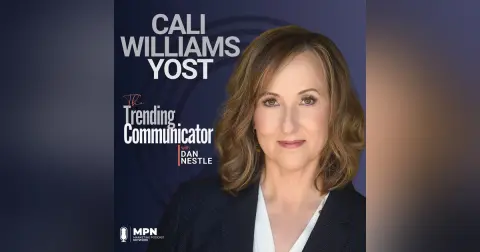

Cali Williams Yost, CEO and founder of Flex+Strategy Group, explains why companies treating AI as a software rollout are repeating the return-to-office mistake, and what a real work-model redesign looks like. She and Dan cover her four phases of change, where communicators fit, and how leaders can help the majority of employees who aren't AI front-runners.
Key Takeaways
- Cali Williams Yost emphasizes that implementing AI in the workplace requires a wholesale reimagining of work models rather than simply sending out return-to-office mandates or AI software licenses via email.
- According to PwC survey data, only 14% of employees are considered AI front-runners, leaving the vast majority in need of structured guidance to fit AI into their actual day-to-day jobs.
- Cali outlines a four-phase change management framework for AI transformation: assess, align, activate, and review and revise.
- Communications professionals play a vital role in supporting and driving organizational change, but communications alone cannot substitute for the foundational work model redesign.
- Organizations can bridge generational gaps by keeping pre-retirees on as domain-expertise mentors to help new graduates learn how to effectively work with AI.
When a company buys the licenses, posts the training videos, schedules a few lunch-and-learns, and then waits for productivity to show up, who is actually responsible for redesigning the jobs themselves? In a lot of organizations, the answer turns out to be the small group of employees who figure it out on their own, while everyone else tries the new tool once (maybe twice) and goes back to the way things were.
Cali Williams Yost, CEO and founder of Flex+Strategy Group, has seen this pattern before. She watched leaders try to rebuild their organizations after COVID with a return-to-office email, and she sees AI rollouts making the same move with a bigger price tag. PwC's latest workforce survey counts just 14% of employees as AI "front-runners," and Cali's concern is everyone else: the people who need someone to show them how AI fits the job they actually do.
Cali walks through her four phases of change (assess, align, activate, and review and revise), where communicators belong in each, and why communications can support a transformation but can't stand in for the work underneath it. She and Dan get into the jagged gap between what AI could do and what it's doing inside real companies, a proposal to keep pre-retirees on as domain-expertise mentors for new grads, and why leaders have such a hard time describing a change that's still in progress. Along the way, Cali tells the story of finding her own books in an AI training dataset, and how that discovery led to the walled-off AI system she and Dan built when she was his client, so she could take her body of work back.
Listen in and hear about...
- Why Cali compares today's AI rollouts to return-to-office mandates sent by email
- Her four phases for AI transformation: assess, align, activate, and review and revise
- The jagged gap between AI's theoretical potential and real-world use, and what it means for promises leaders already made
- Where communicators fit in each phase, and why comms can support change but can't carry it alone
- Keeping pre-retirees on as domain-expertise mentors for new grads learning to work with AI
- How Cali turned the discovery of her scraped books into a private AI system built on her own work
Notable Quotes from Cali Williams Yost
"I'm gonna steal back my stuff. If my stuff's being stolen, that's only a small portion of what I've created. What if there was a way for me to harness all my stuff safely and in my own space and harness that?" - Cali Williams Yost [06:35 → 07:19]
"We have got to grab those people and we have got to ask them before they walk out the door, say, hey, do you want to keep working for us for like two, three days a week in this capacity of mentor to these young people? Domain expertise mentor." - Cali Williams Yost [17:39 → 18:26]
"We are still running off of playbooks from 1987 in a 2026 world. The world of work has changed. We have to define new models." - Cali Williams Yost [19:50 → 20:46]
"You cannot reconstruct the parameters of a new work model, which is essentially what it is. It's the framework, it is the foundation. It is the architecture, Dan, within which your whole organization is going to operate within. You do not create that with an email." - Cali Williams Yost [28:41 → 29:34]
"Implementation of AI in the real world, outside of the lab is jagged, very jagged. And so we let that sort of IT technology story lead the story." - Cali Williams Yost [31:03 → 32:49]
"At each step of the way, communications is so key. But they're not leading the change. They're engaged in supporting the change and helping to drive it." - Cali Williams Yost [38:30 → 39:22]
"It really is a wholesale reimagining of the work model that we keep not wanting to do. Because this is what I keep hearing that takes a lot of time, that takes a lot of effort. And I'm like, but this, what we're doing right now takes way more time." - Cali Williams Yost [53:01 → 53:49]
"These are people who understand the way things have been done in the past can no longer guide the organization. Things have to change. They tend to be people who are willing to hold the space for change." - Cali Williams Yost [1:01:18 → 1:01:43]
Resources and Links
Dan Nestle
- The Trending Communicator | Website
- Communications Trends from Trending Communicators | Dan Nestle's Substack
- Dan Nestle | LinkedIn
- Lilypath | Website
- Inquisitive Communications | Website
Cali Williams Yost
- Flex+Strategy Group | Website
- Cali Williams Yost | LinkedIn
- Tweak It: Make What Matters to You Happen Every Day | Book
- Work+Life: Finding the Fit That's Right for You | Book
Research discussed in this episode
- What's Your Company's Emergency Remote-Work Plan? | Cali Williams Yost, Harvard Business Review, February 28, 2020
- Companies risk losing their most AI-savvy employees while leaving majority behind | PwC 2026 Global Workforce Hopes and Fears Survey
- Labor market impacts of AI: A new measure and early evidence | Anthropic, March 2026
- The Great Mismatch: How a Shrinking Workforce, AI, and Labor Reallocation Will Define the Next 15 Years | Indeed Hiring Lab, May 2026
Timestamps
0:00 Intro: why AI transformation is a work transformation
3:24 Cali joins, and how she and Dan first met
5:42 Finding her books in an AI training dataset
8:34 Building a walled-off AI system from her own body of work
10:57 PwC's 14% front-runners and the limits of lunch-and-learns
13:46 Who becomes the AI guide inside an organization?
16:14 Can front-runner know-how transfer to everyone else?
17:39 Pre-retirees as domain-expertise mentors for new grads
19:15 Why being digitally native doesn't translate to AI
24:34 Japan's shrinking workforce and middle managers walking out
26:33 Context, over-explaining, and why it helps with AI
28:22 Return-to-office by email: the mistake leaders made
29:59 Phase one: assess
31:03 The jagged gap between AI's potential and real use
33:09 Overpromised productivity and performative AI use
36:41 Phase two: align around one narrative
37:29 Agentic AI and the surprise token bill
40:57 Telling the stories of the people already succeeding
44:04 Phase three: activate, and why adults learn by doing
46:26 Phase four: review and revise
49:28 Rethinking how, when, and where work gets done
55:06 Why organizations struggle with change in the progressive tense
56:44 The three streams of AI innovation inside a company
1:01:04 The leader profile that makes transformation work
1:05:07 Ingenuity, displacement, and the new work nobody can see yet
1:07:32 Jagged adoption and a shrinking workforce
1:10:12 Work + life fit, not balance
1:10:50 Where to find Cali
About The Trending Communicator
The Trending Communicator is a podcast about the future of communications and marketing, hosted by Dan Nestle. Each episode is a conversation with a communicator, marketer, author, or technologist about how the work is changing and what that means for the people doing it. The show launched in 2020 as The Dan Nestle Show and has published more than 150 episodes.
About the Host
Dan Nestle (Daniel Nestle) is a communications strategist with more than 25 years of experience, including 16 years in Japan. He is co-founder and Chief Product & Intelligence Officer of Lilypath, the company behind the patent-pending Authority Intelligence™ platform, and founder and Chief Curiosity Officer of Inquisitive Communications, a strategic advisory practice. He received the 2022 Arthur W. Page Society Page Up Innovation Award, was named a PRWeek Dashboard 25 AI Pioneer in 2023 and 2024, and was named one of Propel's 100 Most Influential PR Tech Leaders Worldwide in 2025.
Connect with Dan
The Trending Communicator: https://trendingcommunicator.com
Substack: https://trendingcommunicator.substack.com
LinkedIn: https://linkedin.com/in/nestle
Lilypath: https://lilypath.com
Inquisitive Communications: https://be-inquisitive.com
Instagram: https://instagram.com/trendingcommunicator
Show notes for The Trending Communicator are co-created by Human Dan, Claude, and Fireflies.
Hosted by Simplecast, an AdsWizz company. See pcm.adswizz.com for information about our collection and use of personal data for advertising.
Frequently Asked Questions
Who is Cali Williams Yost and what does she discuss on The Trending Communicator?
Cali Williams Yost is the CEO and founder of the Flex+Strategy Group. On this episode with host Dan Nestle, she discusses how AI is fundamentally changing how, when, and where work gets done, and why organizations need a structured change framework rather than surface-level technology rollouts.
What are the four phases of AI transformation outlined by Cali Williams Yost?
Cali's four phases for successful AI transformation are assess, align, activate, and review and revise. These steps help organizations move beyond the jagged gap of theoretical AI potential into real-world productivity.
Why are traditional lunch-and-learns insufficient for AI adoption in the workplace?
Lunch-and-learns and software license purchases fail because they leave employees to figure out job redesign on their own, resulting in only a small fraction of workers successfully adopting the tools while the majority revert to old habits.