
 Apple Podcasts

 Spotify

 iHeartRadio

 Audible

 YouTube

 RSS Feed
Down with Fluff: Executive Storytelling in the AI Era - with Anuneha Mewawalla

I think it's fair to say that most of us in communications and marketing, at one point or another (and probably recently), have been accused of the most awful, terrible thing: committing fluff. It can happen anytime, but usually when we talk about the...
I think it's fair to say that most of us in communications and marketing, at one point or another (and probably recently), have been accused of the most awful, terrible thing: committing fluff. It can happen anytime, but usually when we talk about the mysterious arts of messaging, writing, brand identity, and almost anything creative. I think it's happened most often in my career when I've mentioned the most misunderstood five-letter word in our lexicon: story. I mean, I get it - when someone hears "story" they think about fairy tales, novels, movie plots, and so on. But a story is the Amazon Same-Day Delivery option for transmitting messages to another human being: it's efficient, fast, and dependable. It's about time for story - and the science of storytelling - to be permanently released from the fluff zone and given its due.
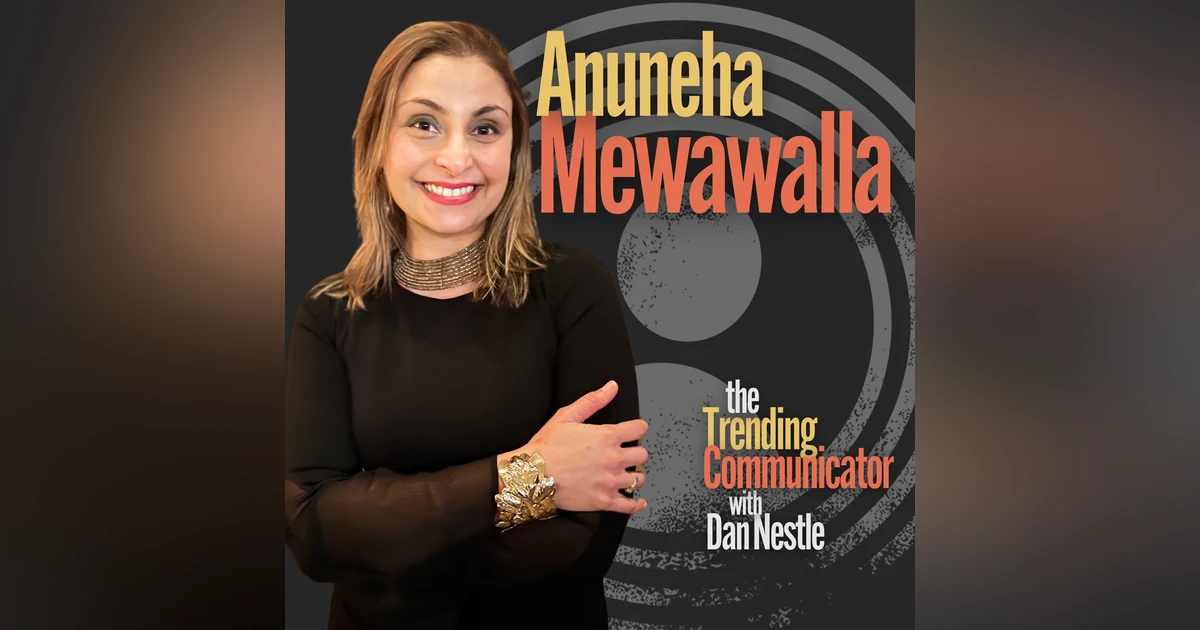
In this episode of The Trending Communicator, join host Dan Nestle as he welcomes former journalist, CCO, and now strategic communications advisor Anuneha Mewawalla, founder of Lexato Consulting and a leading expert in executive storytelling and AI integration. Anuneha shares her journey from a TV news anchor to a strategic communications leader, offering insights into the power of narrative in the corporate world. Together, they discuss why facts alone aren't enough to connect with audiences. All the elements we must communicate need to be delivered in a compelling, memorable way. That's why storytelling is increasingly important for executives, and why it's becoming a vital tool for leaders to connect with stakeholders and build trust.
Anuneha emphasizes the importance of authenticity and personal narratives in shaping a leader's brand. She shares compelling examples of how leaders can effectively invite stakeholders into their vision, fostering engagement and trust. The conversation also touches on the role of AI in enhancing storytelling through personalization, real-time adaptation, and content optimization.
Listeners will gain valuable insights into the future of executive storytelling, including the essential skills needed to thrive in a rapidly changing environment. From empathy and emotional intelligence to mastering AI tools and embracing multimodal storytelling, Anuneha outlines the key competencies for communicators of tomorrow.
Whether you're a seasoned professional or new to the field, this episode offers a wealth of knowledge on leveraging storytelling and AI to elevate your communication strategies. Don't miss this opportunity to learn from one of the industry's leading voices and discover how you can harness the power of narrative to drive meaningful connections and business success.
Listen in and hear about...
- The critical role of executive storytelling in building trust and conveying organizational vision.
- How authenticity and personal narratives enhance leadership communication.
- The impact of AI on executive storytelling, offering enhanced personalization and content optimization.
- Strategies for maintaining trust and credibility in a divided social landscape.
- The importance of a strong executive presence on LinkedIn for business visibility and engagement.
- Key skills for future storytellers, including empathy, AI mastery, and data-driven creativity.
- The evolving landscape of communication, emphasizing the balance between technology and human insight.
On the Essence of Storytelling: "I think my love affair with storytelling dates back to my time in the newsroom as a news reporter and as a television news anchor, bearing that responsibility to represent different sides of the story, to bring those stories, those stories that matter, to really be the one to sniff out, you know, stories in the most unlikely, unexpected places." — Anuneha Mewawalla [03:42 - 04:02]
On the Role of Storytelling in Leadership: "A story is not the facts of which it is composed or the points of which it is composed. A story is the composition." — Dan Nestle [05:25 - 05:53]
On Executive Storytelling: "Executive storytelling is absolutely foundational. It is not just one other tactic, one other channel. It is the strategic backbone that shapes how leaders communicate their vision, their values, their impact, and it's also how they are perceived." — Anuneha Mewawalla [05:54 - 06:15]
On Authentic Leadership: "What it comes down to is authenticity. I think it's the willingness to be personal. Because when you're personal, when you are willing to share a little bit more about that person, the values, the leadership values, the mindsets, the philosophies behind whoever your, whatever your title is, the likelihood that you come across as real and relatable is that much higher." — Anuneha Mewawalla [11:46 - 12:16]
On the Power of Personal Stories: "Working with the, you know, one of the C suite executives at a major tech company, you know, him being willing to share with the organization as part of all hands meetings, what are their top five leadership values. But really each of them was associated with a story. Either a story that was a struggle, a failure, or something that propelled them forward." — Anuneha Mewawalla [12:47 - 13:17]
On Engaging Employees: "When you get it right, when you get executive storytelling right, when they are, in fact, inviting stakeholders to join them in a journey to understand the why behind their sort of persuading you and, you know, getting you to understand why. There is, you know, there's. There's a joint purpose. There's a mutual purpose at stake here. Amazing things can happen." — Anuneha Mewawalla [16:22 - 16:53]
On the Importance of Authenticity: "Being authentic doesn't mean that you have to tell every single personal story all the time. It doesn't mean that you have to share everything, but it does mean that what you do tell has to be real." — Dan Nestle [25:24 - 25:55]
On Leadership Presence on LinkedIn: "A strong executive presence on LinkedIn is fundamentally important in today's day and age. And I think what the numbers are also telling us is that in our digital first world today, a leader's brand on LinkedIn, a leader's personal brand on LinkedIn has become just, you know, inextricably linked to their company's broader visibility and the company's broader brand." — Anuneha Mewawalla [29:17 - 32:14]
On AI and Executive Storytelling: "AI can deliver benefits in four key areas. When it comes to executive storytelling, I think it's certainly not replacing executive storytelling as we know it. It's amplifying it in these four ways." — Anuneha Mewawalla [41:15 - 42:18]
On the Future of Storytelling: "Empathy and EQ would be number one. Second would be mastery in working with AI tools. Three will be multimodal storytelling. Four would be data driven creativity. Five is going to be growth mindset." — Anuneha Mewawalla [55:06 - 58:01]
Resources and Links
Dan Nestle
Anuneha Mewawalla
Timestamped key moments from this episode (as generated by Fireflies.ai)
🎤 Executive Storytelling Importance (00:14 - 01:20)
- Communicators play a crucial role in preparing leaders to effectively convey their organization's story.
- Leaders must excel at storytelling to build trust and connect with audiences.
📖 Anuneha Mewawalla's Background (01:35 - 02:20)
- Anuneha Mewawalla has extensive experience in journalism and corporate communications.
- She founded Lexato Consulting, focusing on executive brand strategy and storytelling.
📊 Defining Storytelling (05:22 - 08:34)
- Storytelling is about creating meaningful connections through narrative, not just sharing facts.
- Effective executive storytelling invites stakeholders into the leader's worldview and builds trust.
💡 Authenticity in Leadership (11:01 - 14:32)
- Authenticity and personal storytelling are essential for leaders to connect with employees.
- Anuneha shared examples of leaders who effectively used personal narratives to enhance credibility and trust.
🌍 Navigating Social Issues (20:29 - 25:24)
- Leaders must balance authenticity with the need to address diverse social issues within their workforce.
- Staying grounded in company values is essential for effective communication during challenging times.
🔍 AI's Role in Storytelling (34:01 - 42:09)
- AI can enhance executive storytelling through personalization, adaptation, content optimization, and multimedia integration.
- AI should be viewed as a tool to amplify human storytelling, not replace it.
📈 Future Skills for Storytellers (55:02 - 58:01)
- Five essential skills for future storytellers include:
- Empathy and emotional intelligence
- Mastery of AI tools
- Multimodal storytelling capabilities
- Data-driven creativity
- Growth mindset to adapt to new technologies
🔑 Final Thoughts on AI and Storytelling (1:06:04 - 1:07:30)
- AI will transform communications, and professionals should embrace its potential to enhance storytelling.
- Urged colleagues to build an AI mindset and leverage technology for better communication outcomes.
Timestamps for your convenience (as generated by Flowsend.ai)
0:00 Intro
5:22 Defining Storytelling
11:45 Inviting Stakeholders
17:21 Leadership and Engagement
25:24 Navigating Social Issues
32:14 LinkedIn Presence
41:14 AI and Trust
49:46 Storytelling Frameworks
55:06 Future of Storytelling
1:02:17 AI and Storytelling
1:09:20 Closing Remarks
(Notes co-created by Human Dan and a variety of AI helpers, including Fireflies.ai and Flowsend.ai)
0:00 Dan Nestle: Welcome or welcome back to the trending Communicator. I'm your host, Dan Nestle. Have you ever wondered why some CEOs always seem to say the right things? Expressing nuanced views with confidence and clarity, even under pressure or in the middle of a crisis, while others struggle to string sentences together and are probably better kept out of the public eye? Look, maybe you know all this already, but one of the most important and impactful roles communicators play is to make sure that leaders are prepared and ready to be the authoritative voices of an organization. We keep them informed, we brief and we coach them, we write or we refine messaging, while at the same time we work to help them build trust with audiences and stakeholders every day, on social channels, in the media, at events, pretty much anywhere you see them, and so on. Of course, leaders are people. Some are great in front of a room, some are great writers and deep thinkers, and some just aren't. But if they're leading an organization, one thing they all need to be good at is telling a story, conveying ideas in ways that make sense, talking about their organizations in relatable ways, talking about them in. In their own stories, using their own experiences to build relationships and to build trust. We've talked about storytelling before on the show, but executive storytelling is kind of at a whole other level. And my guest today is one
1:33 of the leading practitioners in the field. A trusted thought partner to the C suites of high growth and Fortune 500 companies. Her background as a TV news anchor and comms leader gives her exceptional insight into the art and science of storytelling. After starting out as a journalist, she made her way into corporate comms, leading communications functions at the Page Society, Accenture and F5. Before founding Lexato Consulting, she's been helping her clients with executive brand strategy, leadership, communications, change and transformation communications and more. And now with the advent of AI, she's been at the forefront of AI adoption and enablement in the PR profession and in the spirit of transparency, is partnering with your humble narrator on a variety of AI training and enablement projects. I'm excited to get into the world of executive storytelling, how it's evolving and of course, what effect AI will have on all of this with my good friend, Ananeha Mevawala. Ananeha, it's good to see you.
2:34 Anuneha Mewawalla: Thanks for having me, Dan. I'm delighted to be here. Dan Nestle: I have to say it's been a wonderful pleasure to get to know you over the last year. But also, you are a trending communicator. It's why I've been working with you, it's why, you know, we get along so well. But also it's really why I wanted to have you on the show. Because, you know, storytelling is one of those things that we pop around. It's a term we throw around a lot. And, you know, there's a lot of different takes on it. And oftentimes when business leaders hear storytelling, you know, they don't. They don't hear value, they hear fluff. But we're here to tell you that that's not exactly right. And it has its own discipline and it has a lot of science behind it. And certain. It is a preferred method of maybe the only method of effective communication when we're talking about, you know, more complex subjects, for sure. So, you know, let's get into it a little bit. But before we start there, I just, you know, give us a few minutes if you, you know, if you want to walk us through the, you know, how did Ananeja get to where you are today? And why did you get so interested in storytelling? I kind of want to know.
3:42 Anuneha Mewawalla: I think my love affair with storytelling dates back to my time in the newsroom as a news reporter and as a television news anchor, bearing that responsibility to represent different sides of the story, to bring those stories, those stories that matter, to really be the one to sniff out, you know, stories in the most unlikely, unexpected places. And sometimes it's about finding the needle in the haystack. Stories worth telling, stories worth sharing, stories that inform, that are powerful, that can evoke emotion, that can inspire, that can change lives, that can cause change in our world, in our society. And I think that is where my passion for storytelling comes from. And I think that it translated really quite elegantly from journalism to strategic communications, to helping companies of all sizes, be it startups, high growth companies, or Fortune 500, because I think that's what separates companies today is how can you cut through the noise, how can you differentiate yourself in a very crowded marketplace with stories that are not just a listing of facts and data, stories that speak to both the heart and the mind? And so I think that brings me to
5:13 something that's so fundamental that I think we must address at the get go of our podcast and our time together is what is storytelling? Dan Nestle: You're getting way ahead of me. Getting. Anuneha Mewawalla: Well, not way ahead. Dan Nestle: You're getting right ahead of me. But you're absolutely. I was just going to say that I'm so glad that you pointed out that a string of facts and information itself unstructured or even just as a list is not a story, A story is not the facts of which it is composed or the points of which it is composed. A story is the composition. So, yes, please tell us what storytelling is in your mind. Like, what's your view on storytelling? And let's lay it out for our listeners.
5:54 Anuneha Mewawalla: As I see it, at its core, storytelling is the art of creating meaningful connection or meaningful connections through the power of narrative. And it's not about a simple recounting of facts or just sharing information. It is about tapping into the universal human desire, but purpose for emotion, for shared experience, for connection. And when you think about the communications toolkit, executive storytelling is absolutely foundational. It is not just one other tactic, one other channel. It is the strategic backbone that shapes how leaders communicate their vision, their values, their impact, and it's also how they are perceived. Now, executive storytelling is, and this is maybe one point of distinction from just storytelling per se is it's about inviting stakeholders into the leader's worldview. It's about disseminating. It's not just about disseminating the company line. I think that's really, really key to understand.
7:10 And the best executive storytellers that I have worked with understand that their personal narratives are intrinsically linked to their organization's broader brand and reputation. And so it's about getting behind the person behind the title. It's about revealing the humanity behind the title. What are the motivations, what are the struggles, the why that inspires people to follow and to come along on that leader's journey. If you think about the most influential leaders, you know, what makes their communication stand out, nine times out of 10, it's their ability to weave a compelling narrative that taps into our shared hopes, our fears, our aspirations. Incredible storytellers, incredible executive storytellers. They do not just inform us, they inspire us. That's one thing I want you to take away. And the power of executive storytelling, it's not just one additional tool in the communications PR toolkit. It is the glue that binds strategy to execution, vision to reality. And when done right, it can be that difference between creating superficial awareness or driving deep, lasting engagement with a
8:45 variety of stakeholders. Dan Nestle: So you've said so much there that I'm just, you know, I'm nodding my head like, well, of course it's such an ideal. It's a wave of magic wand. And we have a leader who can lead. You know, we have somebody who can, who can inspire others to follow or to kind of, you know, at least take a leap of faith or you know, accept the strategy that's being put forward, you know, be motivated to accomplish certain goals and tasks. I think we've all been there, we've all been in situations where you've had somebody that's inspired you, you've had a leader that's inspired you. And I suppose if we can, if we go back to those episodes in our life and in our professional life, I suspect very strongly that you're going to find these storytelling moments where they've woven in their own experience or set it up such that they're not just talking about, here are the things you need to do and here's why you have to do them. They're talking about, look, we have a greater mission here and a greater purpose here. Here's the situation. And that's, that's something that we should all kind of understand. But that's not all. You know, there are, there are forces arrayed around us.
10:07 That's why we need to do this. So there's a, there's a story, there's a, there's a flow. And almost like it's a, it's almost like the tasks and the goals or the medicine and the story is the sugar coated capsule that goes around it that allows us to swallow. In some ways. I don't want to like, demean the story itself into something that's extra or fluffy, but one thing you said that really, really stood out is this idea of inviting. You know, you said that effective storytelling, executive storytelling, that the whole goal of this is to invite stakeholders in. And I have to admit that I haven't heard it put that way until just now. And whenever that happens to me, I furiously start scribbling. When you think about that, inviting stakeholders to be on the journey with you. When we say stakeholders, we're talking about all of our audiences. We're talking about the people who buy products, who donate to your organization, who advocate for you, and also your employees, your coworkers, everybody. These are all different stakeholder groups inviting them in. Can you think of any examples from when you've worked with executives where there's somebody who has done a terrible job of being invitational, so to speak, versus an example of a very good inviter
11:41 or a trust builder that brings people in? Anuneha Mewawalla: Absolutely. I'm going to answer that question in two ways for the benefit of our listeners. I'll also kind of try to be a little bit like, what can we take away? How can we apply some of this to our own experiences and challenges and opportunities? And then I'll also Share an example. I think that what it comes down to is authenticity. I think it's the willingness to be personal. Because when you're personal, when you are willing to share a little bit more about that person, the values, the leadership values, the mindsets, the philosophies behind whoever your, whatever your title is, the likelihood that you come across as real and relatable is that much higher. And I think that's all very just inextricably linked to that idea of inviting people in. And so I've seen this on so many occasions, it's hard for me to decide which examples to share. But on one occasion, working with the, you know, one of the C suite executives at a major tech company, you know, him being willing to share with the organization as part of all hands meetings, what are their top five leadership values. But really each of them was associated with a story. Either a story that was
13:15 a struggle, a failure, or something that propelled them forward. But that was just, it was just remarkable what response that had and how it evoked a variety of reactions from employees in that they suddenly saw their leader in a different light. Here's someone who is just like us, who struggled, who succeeded, but he is willing to bring us in and be candid about it. And that was just such a tremendous driver of credibility, that transparency, that authenticity, but also of trust. They suddenly saw their leader in a way that they had never seen them before. I have so many other examples, but with another multibillion dollar tech company that I worked with, the CEO was on a transformation journey with a number of challenges that came along with it. Globally distributed workforce, multiple acquisitions in a short period of time, which led to an amalgamation of cultures and a whole lot more transformation ahead in terms of the strategic vision. Looking out, how are we to bring employees along on this journey? And that's something that I had the good fortune and the opportunity to work with him on. And I think that, you know, what we ended up doing was very,
14:45 very authentic in that we made the CEO part of the storytelling, a very central figure in the storytelling, talking in ways that were very personal and connected about the future strategy of the company, the priorities, the execution priorities of the company, the culture and the values of the company. Really sharing from a personal place, sharing employee stories, sharing the CEO's personal background and stories and why things and why this future scenario meant so much and why it could be such a game changer for the company in terms of competitive advantage it brought to us. And how he infused employees into all of the storytelling in a very Big way. And the results were just phenomenal in that we had over 70% of the company sort of participating in this CEO led very authentic storytelling, which was really driven by transformation storytelling.
15:51 And we had close to like almost 90% saying they were more committed and inspired about the future, which was just remarkable and inspiring on so many levels that when you get it right, when you get executive storytelling right, when they are, in fact, inviting stakeholders to join them in a journey to understand the why behind their sort of persuading you and, you know, getting you to understand why. There is, you know, there's. There's a. There's a joint purpose. There's a mutual purpose at stake here.
16:32 Amazing things can happen. And I think we've all kind of probably been exposed to a lot of really great research around employee engagement. So employee engagement is linked to higher performance, better customer success, lower turnover, absenteeism. And so I know I'm probably like, you know, this could be its own topic, and it's such a rich one, too, but I think that executives can play such a profound and influential role when it comes to engaging employees. And once employees are engaged, that can lead to such a phenomenal result in terms of company performance.
17:21 Dan Nestle: Oh, yeah. Our friend Ethan McCarty, who's been on the show twice, often talks about the multiplier effect of engaged employees on company productivity. And I think I'm quoting him, or at least I'm paraphrasing him properly on that one, or at least attributing it properly. You know, at least he's the guy I heard it from, let's put it that way. And there's no doubt that executive presence and executive, like the leadership qualities of the executive, the leadership qualities as conveyed to the employees is, I wouldn't say has an effect on that. I would say it's a precursor or a prerequisite for that.
18:07 Like, it has to happen for the employee community to really be engaged. Otherwise, the. I guess it does depend on how you define engagement, but for it to be positively engaged, obviously, if there's an issue with the CEO or with one of the leaders who is the face of the company to the employees, and they're failing at their storytelling, that causes disengagement or it causes the wrong kind of engagement. And, you know, it's. It's. It's a. It's a very critical skill and a. An important path to walk, I think rightly on. It's. It's. So in other words, it's kind of dangerous and risky. If you have somebody who can't be relatable and authentic and tell their stories at the helm and you know, you run these risks or these actual cases of, you know, oh yeah, I really, I really liked the company, but I just never really understood the vision or I, you know, I wanted to do a good job, but I couldn't. You know, like my, you know, I got the goals from my, from my manager, but I couldn't figure out how they fit in to the organization.
19:25 And you know, a good leader has to be empowered with the stories to make that relatable. And that's kind of where what really stood out to me here is this Authenticity, of course, but being realistic and being relatable is paramount now. It also brought to mind another question of mine and I was wondering how you're dealing with this, with your clients. You know, I mean, at the time of this recording, in fact, you know, we will be, this, this episode will be going live still when all this is fresh in people's minds. Right. We've just had a big election here in, in, in the United States and you know, we're not going to talk about that. It's fine. But what it does bring to mind is there are so many issues and so many social issues, so many, you know, causes, et cetera, in a fairly divided population. You know, your employee population oftentimes reflects the general population. And you know, and over the last several years, we've seen changes in the way that a lot of CEOs and a lot of leaders in general tell their stories and the stories they tell, in fact. So when you're talking about, I promise I'm going somewhere. When you talk about authenticity and you talk about relatability, I
20:58 get the sense that there was an over indexing on that for a little while where you had CEOs or leaders being what they. Well, I guess they were being inauthentic in a way because they're being. They're really trying their best to recognize the many different thoughts and opinions and traumas and joys of their employee audience. Trying to wrap it all into one story and one message, when in fact that's impossible. Right? The old adage that you can't please everybody, everyone. Maybe that's only part of the adage, but I think it holds true. It's impossible to please every single person. And I think if the storytelling is aimed at pleasing one part rather than the other part, you're going to run into issues. So my point is this. How do you stay authentic and relevant and in light of all These different social issues still maintain, still build trust and still build credibility and authority and belief in your vision, you know, when your employees might be thinking about other things.
22:22 Anuneha Mewawalla: It's a great question. I'll answer that in a few different ways. I think it's critical for us to ground ourselves in the context in which we are operating. Post pandemic, I think companies and employees have a new sort of contract that binds us, if you will, in that employees, their expectations of companies have evolved so vastly, so radically in that employees are hungry for what are the values, what are the purpose, what is the purpose of the company? The need to know that, but also the need for that to be somewhat aligned, for companies to be vocal, for leaders to be vocal about where they stand on a variety of social issues that we may be faced with. So I think that's important for us to recognize that that has evolved, that has changed, that that is a reality that we are going to be faced with const as we, as we sort of evaluate our communication strategy internally and vis a vis a variety of stakeholders. Secondly, I think it's become increasingly very, very complex for communicators to assess the path forward. Every
23:55 time something comes up in terms of what is our response going to be? Do we respond? Do we not respond? How do we respond? And I think that the way to think about it is really to ground yourself in the company's values. What is the North Star when it comes to the company's values? And I think that's fundamentally where it all comes from in terms of assessing how you respond, do you respond? And I think the other thing that I would say is really, really important is it's not just about words, it's about actions and behaviors. So you have to be able to back up and substantiate and support the words, whether, you know, if it's words that are coming from at the executive level with what is the company doing to actually stand for those causes or issues?
24:58 Because otherwise employees are going to just see right through. And so I think that every company's situation is different, every issue that comes at us is different. But I think that's sort of a rubric to consider in terms of how do you apply, how do you evaluate for your particular situation, your particular set of company values? Dan Nestle: Yeah, the CEO is in a tough spot, right? I mean, the CEO has to be the face and the voice of the company and really exemplify the company's values or define them in many cases. And being authentic doesn't mean that you have to Tell every single personal story all the time. It doesn't mean that you have to share everything, but it does mean that what you do tell has to be real. And what you do talk about has to align with the company's vision, your vision, the company's values and your organization's values and goals and culture.
26:09 And, you know, I think I've certainly seen, you know, more recently a, you know, more of a kind of worry or concern on the. On the. On the part of leaders and executives about going too far in one direction or leaning or, you know, do I need to talk about this? Or, you know, how do I tell the story without, you know, without essentially pissing off half the people? And I think if you have to ask that question, then you're probably just telling the wrong story. You know, I mean, it's. There shouldn't be any issue about talking about your company and talking about the great things you're doing and talking about your values and your vision, you know, taking it to whatever next step you want to, or you're connecting it to outside events or you're connecting it to things is that's where. That's where you need to have some. Some introspection and some contextual understanding, I think. So you know what to talk about. But the core of your message can be framed in a story, right? That is relatable regardless of what the externalities are, if you're doing it right. I think so. I didn't mean to go really down too far down that road, but I think it's important to understand that this is where the art comes in a little bit, and it's also where.
27:32 Or an understanding of the world around us is important as we construct stories and as we kind of coach and prepare our leaders to convey their visions. So it kind of makes me think about. Kind of makes me think about where, you know, where they should be focusing. If it's, you know, if it's not all about the. If you're. If you're not constructing your stories based on all these things around you? Like, where is it that they should be focusing? Mission, vision, values, whatever you want to call it. And, you know, maybe it's not always about the content. Maybe sometimes it's just about your leadership skill.
28:23 Right? So I guess what I. Where I wanted to go with that is how does that leadership presence trump some of that stuff? Like, how does leadership presence, you know, fit into this larger picture? And some. Some leaders simply don't have a lot of presence, but they can tell a good story. You know, where, where's the balance? You know, and now that I'm on, I keep adding more to the question on neha. I'm very sorry, but how does that leadership presence fit in? But, you know, let's kind of steer it towards something a little more practical here. Right. Where do we see leadership presence? We see it on LinkedIn all the time, for example. Right. And LinkedIn members get a little persnickety about some of the things that people say. Right. So how does that presence fit into this larger picture? And maybe we can kind of start to drive it toward what does it look like on LinkedIn, for example?
29:17 Anuneha Mewawalla: Yeah, I'm going to pull back the lens here and make it a little bit more macro level about leadership presence broadly. Right. So if you think about leadership presence on LinkedIn, that has today become a critical component of overall executive visibility and in many ways is driving business value in ways expected and unexpected. So let's take a minute and just ground ourselves in some numbers. LinkedIn today has over 900 million members in over 200 countries worldwide.
30:00 It is the largest professional networking platform. It's growing by nearly 60 million new members. Those were the numbers in 2022. And LinkedIn members are 50% more likely to buy from a company when the CEO is active on the platform. Profiles with like C Suite in the title in the heading get 8 times more profile views. On average, content posted by C Suite executives sees twice or two times higher engagement rates compared to content from other employees. 79% of buyers say top leadership influences their purchase decisions. And 79% of the global workforce is now on LinkedIn, making it a critical talent pool. So I think those numbers are telling us something. There's, there's a, there's a story in here which is that a strong executive presence on LinkedIn is fundamentally important in today's day and age. And I think what the numbers are also telling us is that in our digital first world today, a leader's brand on LinkedIn, a leader's personal brand on LinkedIn has become just, you know, inextricably linked to their company's broader visibility and the company's broader brand. I think that that's
31:38 pointing to a need for communicators to be actively proactively strategizing about their Leader's presence on LinkedIn, about managing that, about curating really thought provoking content engagement, really managing that sort of social content strategy. It's not something that we can. It's a huge missed opportunities for executives and for companies who are not Thoughtful and strategic about the opportunity here. Dan Nestle: Well, two questions for you. First of all, where's all that data come from and where can we find it? Was that. Is that available on LinkedIn or where does that specifically?
32:30 Anuneha Mewawalla: It's a number of different sources. A lot of it is LinkedIn themselves, but it's all very widely available. And I think it's just always really helpful. Right. Because we're talking about executive storytelling and executives love numbers. So it helps to kind of immediately drive home the need and the importance of paying attention to your executive presence on LinkedIn. But, you know, it also is kind of steering me to another topic that I'm curious to kind of ask you a little bit about, if we may take a few minutes. Dan Nestle: Go on. Anuneha Mewawalla: Yeah, I was just thinking about, you know, we've been talking about how to maintain trust. And, you know, we're also talking about a world where AI is just presenting incredible opportunities and incredible upside for communications. I think we're both very bullish on it. And of course, I think that the flip side, which, you know, we always like to see, we like to be balanced, we like to be informed in kind of seeing every opportunity and for what it. For what it brings.
33:42 And so, you know, I'd love to also hear a little bit of your perspective on, from an AI driven perspective, AI driven world, AI driven communications era that we are stepping into or actually in some ways already kind of straddling. How do we maintain trust in this era where there's so much synthetic content that's being created, we're dealing with, you know, deep fakes and whatnot. And I think that's somewhat, you know, that is pretty relevant in the context of what we're talking about. So I'm curious if you have some thoughts there.
34:24 Dan Nestle: Well, I don't mind flipping the script a little bit and you can interview me too, here. That's fine. Well, I mean, but it's an interesting point because it was something that was on my mind about executive storytelling in general. And you brought up a couple things that I think we can continue to kind of weave into this conversation. One of them being the personal. The leadership, sorry, the executive brand, meaning the personal brand of the executive as the company brand. And the idea that being active on LinkedIn, for example, is sort of like, it's almost a critical success factor for any executive who's out there.
35:13 So, you know, I was going to ask you just about the, you know, the kinds of storytelling that executives should practice or that their communicators should practice on LinkedIn specifically, but let's, let's back into that because I think trust has something to do with this. I think, I think the idea of, since you asked me, the idea of how do we build trust is part of this. You know, the way that you communicate on LinkedIn, obviously, you know, is if there's 900 million, you know, members, not all of them are your audience, but it's still a massive audience and you do have core audiences there. So the way that you're represented on LinkedIn is, is either a trust builder or trust killer. You know, it's, you can walk the middle, the middle road and not have any impression on anybody whatsoever, but what good does that do anyone? So the kind of content that you produce, the kinds of things you say have to be, and you, meaning the executive in this case, have to be their words, like it's gotta be theirs. It doesn't work when, you know, a comms person is writing on your behalf. It doesn't work when you are, you know, getting social media posts written
36:46 by an agency for you. I mean, it ultimately has to be in your voice. You know, that's not to say that a very, very skilled communicator can't get there, but in the end, the CEO or the leader who's, who's putting stuff out there on, on anything, but certainly on LinkedIn really has to have a final look at it and make sure that it is in there. It's something that they would say, right? So it goes to that authenticity and it goes to almost a, a validation that, oh, this is the person who, who says they are. Right, who they say they are. So this is part of this, you know, AI deepfakes, you know, you don't know if the content is real or not. Well, chances are you'll never really know as a casual observer or as a consumer of content, but one way that you can sort of prevent against that is to make sure that you can tell, you know, the authentic voice or like when somebody's being a real person, you know, investing the content with stories that make it real. So this is all, this is all. I think executive storytelling is so critical to this because when the executive has the right, has, has their own experiences and their own stories to pull in, it's far less likely for that content to be manufactured by some random bot or, you know, or a deep fake. So in many ways it
38:22 makes more sense for the leader, the CEO, to get even more personal with their stories, with the way that they provide context on LinkedIn, especially than they ever have before, with the caveat that personal on LinkedIn is not the same thing as personal on Facebook or Instagram or someplace else. Personal meaning it's your point of view. You do bring in your own experiences. You're not talking about necessarily taking the kids. Well, you could talk about taking the kids to the ball game, but you're not talking about necessarily spouting out about political views or talking about, you know, your hobby that nobody cares about, you know, unless it is absolutely germane to the story you're talking about. I think the CEO of LinkedIn recently said that he was questioning whether or not there should be more personal content on LinkedIn so that it resembles more of a Facebook feel. Of course, LinkedIn members do not like this, but he ended up saying it should be personal ish. It should be personal ish. And I kind of like that because that's, you know, that's what we're talking about here. A story that is, that is undoubtedly yours and yours alone. But it's not oversharing. It's not over revealing, you know, it's not, you know,
39:54 it's not telling the world things that you know are better kept between you and your family or between you and your friends on Linked, on Facebook or something like this. You know, I'm not saying that you should never share a personal experience because sometimes it really does make sense to do that. You want to show vulnerability, but, you know, not all the time and only when it makes perfect sense to do so. And you have to read, you got to be able to read. The room is sort of where that's got to go. All of this to say that I think the stories themselves and the power of the stories are really your first line of kind of bullshit detection and making sure that what you're looking at is real and not a deep fake. Technology is getting better. AI is getting better. And there's no question that you can use AI in great ways to enhance your executive profile, to create more content, to increase your volume, to increase your frequency, to get things done faster. But that doesn't mean you should trust everything to the AI. It means you should just use it as a boost or as a tool, as an enhancer to get you going.
41:15 Anuneha Mewawalla: Such a great segue too. Dan, to a very related topic on the topic of AI is how does AI intersect with executive storytelling that can it enhance or enable better executive storytelling? And I think you made some really pertinent, profound points for us to reflect on. And as I look at it from this new Vantage point. What I would say is in working with C suite leaders, I'm seeing that AI can deliver benefits in four key areas. When it comes to executive storytelling, I think it's certainly not replacing executive storytelling as we know it. It's amplifying it in these four ways. And I think, number one, it's enhanced personalization, because AI has the capability to help us understand audience segments more deeply, allowing executives and leaders to be able to tailor their narratives while staying authentic.
42:45 I think the number two would be in terms of adaptation, which could be pretty real time, could be pretty dynamic, in that AI can now help us analyze audience engagement and sentiment, and so it can allow for more dynamic storytelling. I think the third point I'd like to make is probably around content optimization, because AI can help in various stages of the content creation and refinement process, drafting of content, be it speeches or blogs or social or what have you. But it's also speeding up that process of improving consistency and accuracy. It can help execs refine messaging, refine their voice, align more with organizational goals, and ensure that, you know, all of their content and their various communication, different forms are staying, are reinforcing the same messages, the same organizational goals or values. I think the fourth one is around storytelling formats and the fact that AI is and will continue to make it easier to integrate a variety of multimedia elements, you know, but also to repurpose, if you
44:16 will, or content, mix the content in different formats, because as we know, audiences consume content in different ways. You can't communicate to everyone in the exact same way. One size does not fit all. And so that could be huge for executive storytelling, because look at the implications for resonance. Dan Nestle: You know, I am clearly bullish on podcasts, right? I mean, and if there's ever a medium that lends itself better to storytelling, I dare you to find it. Maybe video, I don't know. But having a conversation, the most natural human thing to do is sit around and tell stories to one another.
45:00 You know, some people bring up the old campfire analogy or the old campfire metaphor of, you know, that's where storytelling comes from. The way we would convey information through, you know, through stories that are sticky and memorable. You know, we had an oral tradition for so long, it had to be in the form of a story or else it could never be remembered. The campfire right now is maybe LinkedIn is the campfire. Maybe maybe a podcast is. But the point is that since the podcast or audio, and let's say even video content is a great way for executives to tell stories. You know, that's where I think there's a massive, tremendous power of AI to be able to take the executive's story, the message, and repurpose it and make it more accessible, more available to the audiences that matter.
45:56 Because not everybody's going to listen to a podcast. Not everybody's going to watch a video. The most important people to you might not ever see it. Your employees may never have a chance to see it or hear it or view it. You know, so being able to take pieces of content that you have or that you've done five years ago even, right, to take that and make it fresh and make it new, be able to kind of tailor it for different, different audiences and different channels, I think that's one of the extreme powers, benefits, powers whatever, of working with gen AI. And I think it's going to really kind of give a massive boost to good executive storytelling. I would even add also another thing to your fore here. I think research is another benefit for executive storytelling. And in this, in this very particular context, you know, we. Information, speaking from, from a position of knowledge, from a position of having information is foundational to any. Like any time you speak, anytime you write, anytime you communicate, and the more information you have at hand, the better story you can tell, the better you can weave facts into your stories. So, you know, I would always encourage communicators and the executives who need us to be, you know, using powers of AI to
47:32 really dramatically speed up your knowledge acquisition, you know, by helping you to, to absorb more reports, helping you to identify trends, helping you to encapsulate what experts are saying everywhere. There's a lot of tools out there that can help with that. So anyway, I think that this is all a massive boon to executive storytelling, any storytelling really, but executive storytelling. One thing you said that I wanted to ask you about in particular, is about formats. I love using AI for this purpose. But let me just throw it at you here, Ananeha, where we've heard a lot about telling a personal story or weaving in different parts of authenticity and values, et cetera. We haven't talked so much about how you do it. And again, I think you're totally right saying AI can help with this. But storytelling does follow relative. It follows a process. There's a beginning, there's a middle, there's an end. In every story there's something like this, and that's what makes it somewhat memorable. People have closure. People know if this happened and then this happened and, oh, this is how it was resolved. But that's a very basic, you know, kind of way of thinking about
49:02 it. We've talked about frameworks on this podcast, like the ABT framework, which is one of my favorites. Shout out to Park Howell and Randy Olsen on that one. The end. But therefore, framework for storytelling, it can be. Yeah, there's, there's other ways to kind of talk about that in different formats. What do you find to be the effective models, frameworks, et cetera, for storytelling that you can. That I think will remain effective into the future with or without AI. But if you have AI in your pocket, you can make them even better. Like what are the ones that you. What are your go tos?
49:46 Anuneha Mewawalla: Yeah, what a great question because when it comes to frameworks, I've seen every framework under the sun and I'll tell you what I tell my clients. Which is the best one is the one that fits. It's kind of like frameworks are like suits, you know. Yeah, whatever fits, that's the one for you. But having said that, I will say that there are certain frameworks that work particularly well in specific contexts and specific situations. So the ABT framework I think can be excellent for quarterly earnings calls or investor presentations where clarity and progression are crucial. The Hero's journey works brilliantly for turnaround stories, for innovation narratives, for transformation, for leadership transition narratives. The Problem Agitate Solve framework can work really well for product launches, for strategic shifts, or for major initiative announcements. I think really what I would underscore is that the key is matching the framework to both the message and also to the messengers or messengers natural style.
51:03 Dan Nestle: I am 100% in agreement. I love starting with. You can mix and match them and I love starting with an ABT a lot just to get my thoughts on paper. And I think that's the shorter ABT Problem Agitate Solve. These are really great for, as you said, for earnings reports, things like this. But I think it's also great for a compelling copy for the top of an offer or a webpage or something like this on the marketing side for sure. But I love plugging these things into AI and asking them to rewrite stories in these various frameworks and figuring out which ones fit best or which ones feel best for me and then I take them and rewrite them. But I think you're right, it's a very. The one that fits is the one that you should use. I totally agree. In fact, recently I was exposed to and I should have known this one a long time ago, but there's a, there's a, there's A Japanese framework called. I think it's called. I think that's what it's called.
52:20 Basically it's. It's a four instead of, you know, you. Most of our western style storytelling is in three parts, you know, beginning, middle, end, or, you know, problem or situation, problem solution or problem solution, you know, you know, talk, problem, agitate, solve or you know, and. But therefore, whatever. A play in three acts, right? The Japanese style has four. It starts with a kind of a setup and then there's a, you know, and a build up and then there's like a novel twist and then a kind of fourth act that brings everything together. And it doesn't always bring it together in a very pleasing or, or shall I say resolution oriented way. It's like sometimes it's just highly dramatic or it leaves you hanging a little bit, but it's. That four part does throw you for a loop sometimes. And I'm trying to figure out how to work that in sometimes to interesting storytelling activities.
53:24 But anyway, that's neither here nor there. I just think that there's so much out there that we can explore and play around with AI and experiment with. But look back to the topic at hand a little bit more with executive storytelling. We've come at it from a bunch of different angles and we've talked about AI and leadership a little bit recently on the show. There have been a few guests talking about the future of work, talking about leadership and influence. And it's become clear that there are a lot of, or become clearer actually in a very reassuring way that there are certain things that not only are probably not going to change as AI kind of gets more and more, you know, gets more and more prevalent, they're going to become more important as AI becomes more and more prevalent. Leadership skills like, you know, like empathy, like listening, like, you know, reading the room, that sort of thing. When we kind of narrow that down to executive storytelling, for example, like what do you think the future of this sort of practice is? And
54:54 storytelling like broadly, but certainly on the executive side, what's going to change and what do you think isn't going to change? What do you think we can double down on now and be safe? Anuneha Mewawalla: I'm going to give you five of the core pieces of skills, or let's just say if we had to say, what is the skill set of the storyteller of the future? What are those five things that are essential for storytellers of future? So I'm going to nail it down to, and I'll elaborate on it in A bit, but empathy and EQ would be number one. Second would be mastery in working with AI tools. Three will be multimodal storytelling.
55:45 Four would be data driven creativity. Five is going to be growth mindset. Let me expand on that a little bit. Empathy and eq. This is the ability to deeply understand and connect with human emotions, cultural nuances across global audiences. It's the fundamental human capacity to resonate with others experiences which is just. It remains irreplaceable. I think number two, I talked about mastery in working with AI and that is about AI human collaboration. I think in order for us to be effective, for us to be successful in how we harness AI, we have to understand what are AI superpowers and what are human superpowers and what is that magic, if you will, that exists in the middle and how are we going to unlock it.
56:46 And I think we have to be super aware of that. We also have to get better and better at understanding AI capabilities, Understanding AI capabilities specifically as they pertain to our function and broadly at a business level. I think that what I'm referring to here is also it's knowing when to use AI and when to rely on human intuition or what humans are best at. The number three skill set of the storyteller of the future is about multimodal storytelling. And this is about the ability to craft cohesive narratives across media formats. And it's going to keep evolving. But you know, text, audio, visual, ar, VR, what have you understanding how each medium's, how each medium is unique and what their unique capabilities are. How can they serve audiences in ways that connect better, that resonate better, that advance the story's purpose? I think that's going to be crucial.
58:01 Dan Nestle: Yeah. Before you go on, before you go on, that actually reminds me because something that I've been doing lately, I think that multimodal point shouldn't be underestimated. And it's a great point to bring up because as a communicator or as anybody who's telling a story now because of AI, you now have the tools to turn a written story into an audio file, into a video, but certainly add images and add more, more types of media or even tell the story in images. So there's. As a communicator, this is all in your hands. You don't have to be a designer, you don't have to be an audio technician or you don't have to have these other skills. It's all kind of at your fingertips, of course, how well it sounds and how good it gets done. Is a different story. But, but yeah, I totally agree that it's very important, I think, to take multimodality as a necessary kind of part of the brief. Okay, I'm going to tell this story. How should I tell it as an audio, Can I tell an audio format? Can I tell it? Can I use images? Can I do these things? And something to keep in mind as you go. Very sorry to interrupt.
59:26 I just thought that was a pretty, pretty. Anuneha Mewawalla: Not at all. And I think, you know what, I'll. Well, I'll. What I'd like to sort of add to the mix of themes that are emerging is that the goal isn't just to become AI first. It's. It's to become intelligence amplified. And the most successful communications teams will be the ones that have a, you know, careful balance between tech capability and human insight. And they won't just be great storytellers, they'll be AI fluent strategists who can leverage technology while maintaining an authentic human connection. And I think that that sort of is something that's underpinning a lot of what I'm saying. So it's across a lot of these skills that are going to be key for the storyteller of the future. And then the next point is around data driven creativity.
1:00:23 And it's again similar, right? Which is combine creative instincts with data literacy to understand audience engagement, optimize impact, identify emerging narrative patterns without losing the soul of the story. Right? I think that's where we come in. We have incredible capabilities at our fingertips. Now it's just how are we harnessing it and how are we blending human superpowers into it? And then the final skill is around growth mindset. It's the capacity to keep evolving with, with new technologies. I mean, AI is advancing at an exponential pace. You know, everything we know is being tested because there's new things that are emerging, new tools and new strategies. And so the mindset to continue to evolve with it, I think is going to be key, to be curious, to be critical thinkers, to have that capacity, cultivate that capacity to learn new tech, new platforms, while at the same time ensuring that our stories align with our company's objectives or our executives objectives or stakeholders objectives. And whether it's business, cultural, social impact goals, whatever
1:01:54 you have. So I think those are five, I'll just quickly recount it's empathy and eq, it's mastering working with AI. It's multimodal storytelling, data driven creativity and growth mindset. Those are the five essential skills of the storyteller of the future. Dan Nestle: I can't argue with any of it. I think it's all absolutely critically important. There's a foundational skill you got to have first. I think it's called writing. I think you have to be able to write, assuming you know how to write. That said, even then, though, you don't have to be a fantastic writer necessarily to be a fantastic storyteller. Storytelling is, again, as you've been talking about during our conversation here, and certainly as we've, I hope, come to understand, it's. It's about making those connections and building trust. And overall, it's that authenticity that invites belief, participation, trust, reputation, whatever it invites. It invites you to be part of the story.
1:03:14 There's a talent to that, but it's also learnable. And it's also something that can be, you know, that the word, where the words and where those images and everything that we use to tell the story, you know, kind of enforce that or enhance that or kind of get that out in the front. So, you know, putting it all together and you're creating something that's inviting and hopefully the executive that we are telling stories on behalf of or that is telling stories, him or herself, you know, building up their personal brand, which we didn't really get to because I really. I really wanted to. But get building up that personal brand, which does accrue almost 100% to the corporate brand. They also, I think, should not be comfortable outsourcing their storytelling 100% to anybody else. They have to have skin in the game. They have to be involved with this storytelling because it has to be them. It has to be authentic. And to your earlier point about deepfakes and trust, that's fundamental to trust in system, is for the actual person to be involved in what's going on. So these skills that you've mentioned, empathy, mastery of tools,
1:04:47 multimodal storytelling, et cetera, without a doubt, the executives themselves really have to be part of that process. They certainly need to know. They certainly have to be empathic and have a high EQ and the growth mindset that sandwich the more tactical points of AI tool storytelling and being data driven. But it is just. I think it's such an evolving landscape. But if you have these five things in your pocket, I think you'll be. Sounds to me like you'll be fine or I think you'll be fine. I agree with you on all of that.
1:05:30 I can't believe we've been speaking for so long. Let's. Let's kind of wind this down and just Give you the last word here, Anuneha, about. I mean, first of all, I'll give you two choices. First of all, is there anything that we didn't talk about that you wanted to have a couple of words, you know, you want to inform the audiences of or, you know, drop some wisdom or, and, or maybe it's the same thing. You know, is there something that you're concerned about or optimistic about when it comes to the future that you want to share with us today as a. Anuneha Mewawalla: Trending communicator, AI is going to turbocharge our field. It's going to reimagine communications as we know it, just as it is already reimagining business and society. And so I would just implore all my friends and colleagues in the field to not lose a minute and really capitalizing on its value, on educating yourselves and your teams on the capabilities, the use cases. Open your minds up to the fact that there could be so many more ways that we could be leveraging this to make our lives better, produce more, be more creative, but really transform the communications function to an intelligent, highly strategic, highly
1:07:01 proactive function. So I think that's what I would leave everyone with is just, you know, to encourage you and urge you to build an AI mindset and, you know, take the opportunity, every opportunity you can, to bring AI into the mix and to think about how it can uplift and elevate what you do in work and in life. Dan Nestle: I don't think I could have said it any better than that and certainly won't try. I think everyone out there now understands after listening to you for a little while, why I am so thrilled to be. To have the privilege to be working with you on a few projects. I mean, how exciting is it? Look everybody out there. I get to talk to Anaha all the time, so I'm always benefiting from the wisdom and certainly the perspective. And boy, your approach is so. It's so calm, straightforward, eloquent, but well informed. And I think that everybody out there today. I love the takeaways we're going to have from this episode and I can't wait to publish it.
1:08:22 Anybody out there wants to know more about Anuneha, check out her LinkedIn profile. I think there's only one person with the entirety of Anuneha, Me Wala in LinkedIn and her name will be spelled properly in the episode notes and on the show graphic. Look. Look her up on LinkedIn. Check out her company, which is lexadoconsulting.com that's L E x 80 consulting.com you can find her there. You know, search for her on the web. You'll find some articles she's written, some good stuff that that gives you some good insights into her thought leadership in AI especially. And I can't think of anybody else who I'd rather have working with me on things like executive storytelling and communications than Ananeha. So Ananeha, thank you so much for being on the show.
1:09:20 Anuneha Mewawalla: Such a pleasure. Dan, thank you so much again for having me. It is always delightful and super fun to chat with you on the future of communications. Dan Nestle: You got it. Thanks for taking the time to listen in on today's conversation. If you enjoyed it, please be sure to subscribe through the podcast player of your choice. Share with your friends and colleagues and leave me a review. Five stars would be preferred, but it's up to you. Do you have ideas for future guests or you want to be on the show? Let me know@danerendingcommunicator.com thanks again for listening to the trending Communicator.