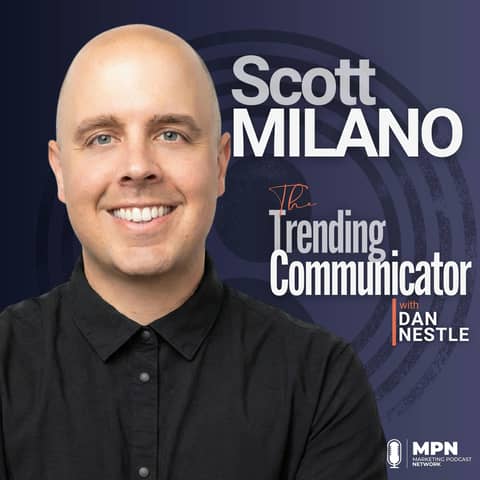
Naming is Storytelling, Just Harder - with Scott Milano


Everyone thinks they can name things. Toss some words around in a brainstorm, pick the one that sounds right, hope it passes trademark. But naming done right is storytelling compressed to its most essential form, and getting it wrong costs more than most organizations want to admit.
In this episode of The Trending Communicator, host Dan Nestle reunites with Scott Milano, founder and managing director of Tanj, one of the world's top naming agencies, and the man who has named more than 1,000 brands generating trillions of global impressions. He also built ChatNamer, an AI naming assistant with thousands of monthly users, within months of ChatGPT's arrival, long before most people knew what to do with it.
Dan and Scott explore why naming belongs squarely in the communications conversation, not just the brand or marketing silo. They dig into the mechanics of encoding brand DNA into a single word, what happens when organizations get it catastrophically wrong, and why AI can accelerate the process without ever replacing the judgment that makes a name land.
Listen in and hear about...
- Why a great name is shorthand for an entire brand story
- The Apple vs. ExecuTech thought experiment
- The Jaguar rebrand: bold strategic pivot or brand homicide?
- How Ally Bank, Natural Bliss, and Prosperity Now demonstrate names that deliver long after launch
- Where AI genuinely helps in the naming process and where it reliably fails
- ChatNamer: what it is, why Scott built it, and what it's actually useful for
Notable Guest Quotes
"It is 100% storytelling. And if you get it right, you're basically encoding the DNA of the brand and like the core message of the brand right in the name." [00:08:52 – 00:09:06]
"The shortest poem is a name... some very deep significance [is] encoded in that word, whether it's a personal name or certainly in our case, a brand name." [00:10:35 – 00:10:56]
"Naming is as much about words as it is about people. It is a people sport." [00:49:59 – 00:50:05]
"The biggest takeaway... is to not underestimate the power of a name. It's fundamental. It's the tip of the spear for any conversation, any message, any communication..." [01:01:26 – 01:01:43]
Resources and Links
Dan Nestle
- Lilypath | Website
- The Trending Communicator | Website
- Communications Trends from Trending Communicators | Dan Nestle's Substack
- Dan Nestle | LinkedIn
Scott Milano
Timestamps
00:00 Naming: The Creative Job Everyone Thinks They Can Do
02:01 How Dan Got His Start in Naming (Thanks to Scott)
03:43 What’s Changed in Naming—and What Hasn’t
05:45 The Effort Behind Good Names (and Dan’s Sony “BIONZ” Win)
08:00 Is Naming Just Marketing? Why It’s Actually Storytelling
09:10 The Name as the DNA of Your Brand
11:14 The Psychological and Cultural Power of Names
13:19 When Naming Goes Wrong
15:29 What Customers Really Take Away from a Name
16:19 ExecuTech vs. Apple: Branding Near Misses
18:10 Apple, Nike, and the Stories Baked into Brands
22:22 How Top Agencies Build Brand Narratives
25:40 The Chicken-and-Egg Problem: Does Brand Grow Into Name or Vice Versa?
29:17 When Public Reaction to Names Goes Sideways (Nintendo Wii & More)
31:39 Brand Overhauls: The Jaguar Example
36:27 Brand Loyalty, Employee Buy-in & Naming Success Stories
41:06 Research, Creativity, and AI in the Naming Process
45:55 AI’s True Role: Springboard, Not Storyteller
48:32 Can AI Really Name Your Company? (Spoiler: Probably Not)
55:24 The Power of Good Questions in Naming With AI
58:29 Why Human Judgment Is Non-Negotiable for Brand Names
01:01:26 The Takeaway: Never Underestimate the Power of Naming
01:03:23 Where to Learn More (and Why Naming Experts Still Matter)
(Notes co-created by Human Dan, Claude, and Castmagic)
Learn more about your ad choices. Visit megaphone.fm/adchoices
Dan Nestle [00:00:00]:
Welcome or welcome back to The Trending Communicator. I'm your host, Dan Nessl. When I think about the hundreds, if not thousands, of communicators and brand marketers I've known, I can count on one hand the number of people who one day decided, I'm going to do the one creative job that every marketer and communicator thinks they can handle themselves. And every IT, HR, legal, R&D, and hell, even finance team thinks they can do with some acronyms and numbers. I'm gonna name things. I mean, it would take a rare breed to want this job. Someone who either has a masochistic streak or someone who lives and breathes words and language and knows that a set of letters arranged just so can make or break a product, service, or even a company. That's power. And that's impact. But what it's not is luck. It's not coincidence. It's the fact that every set of letters is packed with shades of meaning. Every name has a story behind it, and I'd even say that every name is a story itself. Namers aren't just word people, they're storytellers, communicators, conveying volumes in a very particular way. So what I'm saying is naming is is communication, just like the rest of our profession, it's evolving. And there's no better person I can think of to talk about this than my guest today. For over 2 decades, he's named more than 1,000 brands generating trillions of global impressions. His clients represent $2.4 trillion, T trillion, in market value. He's helped secure $2 billion in startup funding. And you know his work, Nintendo Wii, Sony Bravia, Ally Bank, and a lot more. He started as a philosophy major, became a freelance copywriter in Tokyo where we met 20 years ago for lunch at a pub in Ebisu, part of Tokyo. And for dessert, he gave me all his clients and launched my career. It's true. Well, then he went on to lead Interbrand's verbal identity practice before founding his own agency, Tange, 16 years ago. Now, Tanj has worked with everyone from Nike to JP Morgan and is ranked among the top naming agencies globally. And within months of the arrival of ChatGPT, while most of us were either panicking or just beginning to grasp that the world was just changed, he built ChatNamer, an AI naming assistant thousands use monthly. He leaned in to understand what AI could and couldn't do while others were frozen. So making his return to the show after nearly 5 years, he was guest number 10 on the original Dan Nessell Show. Believe me, you want to go back for some nostalgia, go listen to that episode. He's the man who gave me my start at a bar called Footnik in Tokyo, the founder and managing director of Tang, my friend Scott Milano. Scott, welcome back to the show. How you doing?
Scott Milano [00:03:00]:
Oh, I am doing great, Dan. That was a terrific introduction. I'm, uh, it's wonderful to be here today.
Dan Nestle [00:03:07]:
I appreciate it. You know, you can see we've come a long way. In 5 years? You know, the last time we did this, I think was on Zoom and we had like 3 sections all planned out to like, you know, I gave some sort of upfront, like something which was, I mean, hey, it was good for what it was, but we all evolve, we all change. And probably, you know, none more so than you and Tang. I mean, you've really come a long way, but while still maintaining the core of naming and why, you know, why people keep going back to you and why you've been doing it for 16 years.
Scott Milano [00:03:43]:
It's remarkable.
Dan Nestle [00:03:43]:
So welcome to the show. And I'm really glad, really glad we were able to get together and do this. So, you know, so why don't we start like by just like filling us in on, you know, what you've been up to and maybe tell, you know, believe me, most of my listeners will not have heard episode 10. Of, of the Dan Nelson Show 135, 40 episodes ago. So, um, look, quick, a little quick, hey, who's Scott Milano, uh, and, um, you know, what's going on in, in your life and with Tangent, and, uh, we'll go from there.
Scott Milano [00:04:17]:
Yeah, so the short story is a whole lot's changed and not much changed at all, and I think you kind of captured that. We sit at this intersection of language and brand with a specific focus on naming some ancillary services around that, all related to language. And I think that's probably where we're going to sit and continue to go deeper and deeper into the future. We're certainly, you know, always innovating in terms of how we work with our clients. Obviously, the work that we create and we try to bring to market. And then also internally, and we can get into this a little later on in terms of just how, how we actually develop names or go through our process. We have now more than ever so many tools at our disposal that I don't think will actually solve the problem and generate ideas, but I do think can help folks in the hands of highly skilled people like, uh, like us, or in my case, you know, folks who deal with names all the time, uh, can help you get to interesting places faster and perhaps cover new ground, which is super exciting.
Dan Nestle [00:05:30]:
Yeah, it's kind of fun, like, just to even think about it, cuz you know, okay, okay. Full disclosure again for the, for the listeners who didn't hear it the first time we talked about this. Um, I did some naming work for Scott way back in the day.. And, um, yeah, I remember sitting there with Excel sheets and coming up with 400 versions of something. Uh, you know, you're pulling it, believe me, anybody can kind of whip off, whip out like, uh, 10, 10 names that may come off, come out of the top of your head. And let's not even get into AI yet. We'll hit, we'll hit that soon, but just from your own knowledge and creativity, you could probably come up with 10 or 20 ideas for something, whether they're on target or not. But to do 400, I dare you. I dare you. Uh, you know, it's, it is, it is, it is an effort. And especially when you have guidelines and things to follow. Um, so I did a couple of those with you, for you. And in the, I mean, you know, it's a couple projects, but in the thousands of suggestions I probably handed you over the years, and this was many years ago, one, I think one. Made it through, not for its original purpose either, is the BIONZ camera, the BIONZ engine for Sony.
Scott Milano [00:06:44]:
That's right.
Dan Nestle [00:06:45]:
That's right. That's my big claim to fame, BIONZ. Anybody out there ever get a DSLR or kind of new one of those new cameras, if it's powered by the BIONZ engine, you know where you heard it first. So, but you know, not a remarkable record on my behalf, but still one, got one.
Scott Milano [00:07:02]:
You got one, and that's probably pretty good, just given the few projects that you've worked on, and you nailed that one.
Dan Nestle [00:07:13]:
You're part of the club.
Scott Milano [00:07:13]:
So kind.
Dan Nestle [00:07:14]:
You are so kind. And I know you're saying that because it's true, but you're also saying it because you're my good friend, and we've been working together or talking about marketing and communications for decades. And that's where I wanted to go with this is like, This is the Trending Communicator. You know that it's, even though it's got communication or communicator in the title, we have people listening who are marketers. We have people listening who are, you know, salespeople, you know, some people I know over the many years who just decide that they want to be gluttons for punishment and hear what I have to say. But, you know, the idea that Naming, you know, naming is usually something the brand team takes care of or the marketing team takes care of. It's not typically seen as a comms function, but I contend that it is a communications, uh, skill or it's a commu— or it's, it's, you need communication skill to be able to name properly because it's, as I said in the intro, I think it's storytelling. I think it's storytelling or let me say, let me say good naming. Like real good, like skilled in is storytelling. And it's not only storytelling, it's harder than storytelling because it's like layering code on top of that story or burying it inside a cipher or like, you know, putting it inside this little package that you have to unwrap in a certain way. Then you're like, holy cow, there's a big story back there. You know, it's like any number of those things. And, um, but fundamentally it comes from story. So what are your thoughts on that? And what, and you know, where do you think that the that that has taken you where it's going?
Scott Milano [00:08:52]:
Well, I think, uh, it is 100% storytelling. And if you get it right, uh, you're basically encoding the DNA of the brand and like the core message of the brand, uh, right in the name. Um, I think— and we can, we can jump into some, some actual examples, but at a philosophical level as well, if you really start to think about the role and the functionality of a name, whenever you're communicating on behalf of the brand, you're leading with this one piece of real estate or verbal real estate. You're leading with that word and that message that's in there. If you get it right, as I mentioned, you're able to embed the DNA in the name, but also allow it to stretch, like, you know, as your message evolves and the different things that you have to communicate on. Ideally, you know, good names typically don't pigeonhole you into a single idea but span a number of different ideas, and anyone communicating on behalf of the brand can do so freely under that, under that name without feeling constrained. The other thing, man, is like, if you just back up, there's a great quote. We, we, um, I mentioned philosophy, but we recently launched this, uh, series of guides called "The Philosophy of Naming," "Name as Poetry," "Name as Power," and "Name as Meaning." And they're really short. They're on our website. You can just download them for free, but they're really short guides driven by very simple, profound quotes around or about naming. And there's this one quote in our "Name as Poetry" book. It's, "The shortest poem is a name." It's by a Canadian poet and novelist, Anne Michaels. It's really profound, right? I mean, yeah, it's like some very deep significance encoded in that word, whether it's a personal name or certainly in our case, a brand name. It has incredible depth and weight to it. So we're trying to raise the flag in all that we do to ensure that people treat names with the importance and significance that, that, that they require.
Dan Nestle [00:11:14]:
Yeah. It's, it's also like broadly speaking, you talk about philosophy. I mean, broadly speaking, you know, it's a, it's almost a given in any fantasy novel genre or any, like, uh, you know, anything having to do with, you know, mythology or anything having to do with magic or something like this that there's undoubtedly, maybe it's a fantasy trope, but there's always something about like, oh, I'm not going to, you cannot give a name because you, you know, if somebody has your name, then they have power over you. Or, you know, there's power in the name or, you know, we can't reveal the real name because then that's like opening your soul. And not to say that, you know, Ally Bank is a magical token or shamanistic in any way, but like there is this sort of power and it like culturally, and I don't know, in almost an atavistic way that we have a reaction, you know, and a sort of framework that we, under which we understand or kind of try to interpret names. So, you know, when I'm sitting around with a bunch of people in a company, and this happened several times in my career, you know, more than I can count, but You know, you're in whatever company you're in and somebody says, oh, we're launching a new product. We need a name list, you know, go for it. You know, and it's like, just play roulette and try to get a name right. And ideally you can maybe reverse engineer something out of that, but I don't think that people think of it that deeply at all. They just want something that sounds good and passes trademark, right?
Scott Milano [00:12:55]:
I mean, right. And that's fair, right? Like business people have an agenda, you need to get results and you they don't wanna spend forever doing it. And quite frankly, that's why we have a business is because folks, you know, who are developing some new innovation or need to rename understand the gravity of the challenge and the situation. And they know that just throwing some guys, creative people into a room with some pizza and some Coca-Cola or maybe a beer or two is probably not gonna yield the results that it actually deserves or requires. So I think it's absolutely true. There's a great, within the series of guides, we have one on name is power. There's an incredibly powerful quote from Tom Friedman, whether you love him or hate him. It's this quote of, "In the world of ideas, to name something is to own it." Yeah. To own it. Once you name it, you own it. We all understand that kind of from fundamental, like, perspective of our pets or our children, but also to think about it in terms of brands or concepts out in the world. And then also you're handing that over to the general public in the context of companies and organizations. Super powerful. And you don't really want to take it lightly.
Dan Nestle [00:14:26]:
Sort of unbidden, as you said that, like maybe the half glass full version of that, or the kind of dark side version of that, you break it, you bought it. You know, you name it, you own it, you break it, you bought it. You know, if you mess up a name, like clearly there's a consequence there as well. What I wanted to ask you though, is as you're talking, like thinking about all these elements are they have so much in common with, or they are part of good storytelling, you know, imbuing meaning, ensuring meaning, kind of controlling the narrative, all these different things that can be encapsulated in just a couple of letters. That's fine and good, I think, for, for a brand to think about that, for you as an expert namer to really kind of put all that into your process. From the consumer or reader of the name, how important is it for them to get it when they see that?
Scott Milano [00:15:29]:
Yeah, I mean, I, I think you could look at it from two levels. There's, there's the level of like the general consumer. They're, they're not thinking about names, right? Names are, are the tip of the spear for any conversation about the brand, but they automatically kind of like subliminal, or maybe subliminally kind of process the name, but then move into the world of the brand, the product, the experience, whatever it is. But at the same time, that initial impression and that subliminal message or feel or vibe or whatever it is that they're getting out of it matters. Simple example here. Guess what company was almost named ExecuTech? ExecuTech.
Dan Nestle [00:16:15]:
Yeah. What company was almost named ExecuTech?
Scott Milano [00:16:19]:
What large, amazing, powerful technology company that is revered— Microsoft. —basically all over the world? No.
Dan Nestle [00:16:28]:
No?
Scott Milano [00:16:29]:
Apple? Yes, the other one. Apple.
Dan Nestle [00:16:33]:
Oh my God. So ExecuTech— That sounds like a Wozniak move.
Scott Milano [00:16:35]:
Yeah, yeah, yeah, yeah. So I did a little bit of digging for something else and uncovered that. It wasn't like the final name and they changed it or anything. Yeah. But it was in consideration. So this is an Apple— lore. But that as a simple example, ExecuTech. If— what if we had our ExecuTech iPhone in our pockets all day long? We'd have a very different impression of, of that brand just based on the name. It's entirely different.
Dan Nestle [00:17:03]:
Uh, I feel kind of Jetsons-y on that, like a little— it's a little weird.
Scott Milano [00:17:08]:
Yeah, it's, it's just not because we know it's not. Yeah, because you know the possibilities. So Names open doors to possibilities, essentially, and they also can limit— like ExecuTech would limit general consumers who aren't executives, right? Uh, so I think, you know, again, in the spirit of, uh, understanding the significance and the role of a name, just simple examples like that can be quite powerful.
Dan Nestle [00:17:36]:
Yeah, you mentioned that you had some examples of how of, of names that encapsulate storytelling, you know, can you share a couple of those? Like, what are some of the ones that stick out in your experience? Even if it's something you've named or even if it's something out there that you know about, um, you know, I want to kind of demonstrate that connection and like back into it, my kind of like, so here's the story and then here's the name, that kind of, yeah. Yeah.
Scott Milano [00:18:03]:
I mean, I, I, I think actually the Apple example is, is one of those where it's great.
Dan Nestle [00:18:10]:
Yeah.
Scott Milano [00:18:10]:
You're opening up this world of, in a very technical, executec-type world, you're opening up an entirely new avenue of graceful human-centered design. Apple is often the first word or one of the first words that people learn when you learn a foreign language. It's very basic and fundamental to who we are. And it has nothing to do with what they do. Yet it signals everything in terms of simplicity, elegance, and thinking, truly thinking differently. I'm like an Apple fanboy here spouting all the messages. Other classic example, again, just to go back to how names change perception, Nike. What if it was called its original name, Blue Ribbon Sports? Very different name, very different story. Both are actually about winning. Nike being the goddess of victory. Blue Ribbon being a symbol for, you know, winning a race. Totally. Yeah, right, right. Yeah. Totally different imagery, totally different message, and totally different possibility. So I think as soon as you, you know, sort of start thinking about names and it's not like every day we're kind of like the general consumer is talking about the story behind these iconic names. And often they don't, they don't, they don't, they might not know them, but they're there and they're part of the fabric of the brand. And I think for anyone who's working on behalf of the brand, communicating on behalf of the brand, to have some type of backbone and DNA of the brand baked right into the name helps aid how you communicate and talk about it.
Dan Nestle [00:19:56]:
You're preaching to a big choir here. You know, we, and I, again, I can't tell you how many times this happened in my career where, you know, there'd be an initiative at a company or somebody wants to say something or there's, you know, we're gonna, we're gonna do a new project, whatever. Or, you know, it's our, it's earnings season, whatever the, the thing that has to happen that is there, the communicators inside. And so, you know, some, a lot of times it means like, okay, What's our narrative? What's our narrative? What's our core narrative? The story we tell ourselves, right? What is that? And this, you'd say, well, people would be like, well, what do we really need that for? Because you're spending a lot of time creating this, this, uh, you know, a couple paragraphs that are going to change the world. It's like, hear me out. We're not going to change the world with a narrative. Well, we could change the world with a narrative, but what we're trying to do is anchor everybody in a vision. You know, we're trying to anchor you as the executive in a place that you can return to and that you could draw from so that you understand better what you're talking about. You know, it, it gives you a foundation. Otherwise you're wobbling. So, you know, you wanna say, trust me on this, but actually it's just, it is something that we, we always need, I think, when we wanna go out there and, you know, talk about something new or even just talk about something we already have. How do you do something without having a story behind it? Doesn't compute with me. I mean, I'm not talking about like necessarily a performance marketing ad, which is, you know, hey, buy this today and get 50% off, nothing like that. But even small ads have, can, should be able to trace a a DNA connection, as you said, right? To a narrative, right? And, um, why should that be any different for a name? I mean, it should be even more important for a name. Sometimes the name is the, is the how this narrative starts off, and sometimes the narrative leads to the name. So, um, in your process, you know, how often are you like start— I know you're not starting with the name, you're finishing with the name, but how often are you starting with a story Or like a, or are you starting with a, you know, like a, a creative vision, but not quite a story yet. You know, how, how does it, how does the process work typically? Yeah.
Scott Milano [00:22:22]:
I tend to think it's pretty straightforward because I live and breathe it. But it's also not rocket science. I'm just going to put that out there. Yeah, no, this is not some magical kind of thing that happens. Through research, through understanding the, you know, the goals and ambitions of the business, the brand, our audiences, our key stakeholders, what motivates them, our competition, kind of understanding what's happening in the landscape. It's sort of a rubric of different pieces that we typically think through and try to pull out the most salient points in terms of what it is that we want to communicate. So core story, worldview at a high level, these are big conceptual pieces, and then how we say it. So what we say on one side and then how we say it on the other. So the mood, the feel of it, the texture, the type of name, the tone, whatever it may be. And then from there, you're just generating ideas and going through a process. It's usually an iterative process. And at the end of it, to be quite frank, it's never done until the name cements the kind of main concept and you land on it. That is the cherry on top that kind of sets everything in motion. Ideally, if you do it right, it still, it strategically covers many of the concepts that you were boring into in the creative process. If it doesn't, you can always compensate for it, you know, with messaging and storytelling around the name. And of course, you know, on behalf of the brand more broadly. But we feel like the name sort of cements everything, you know, that core, core story. And it's really a case-by-case basis. Like if I called, you know, a name like Apple versus like a legacy BlackBerry name, you know, from old school technology. They're fruits. Hey, guess what? You know, uh, but they also have like very different vibes, right? Like, and they communicate different things. Um, so it, it all depends on that kind of final— the final name and where you land. Uh, and again, that's when everything gets set in motion.
Dan Nestle [00:24:42]:
Well, stories evolve and change over time. They also You hear this a lot that, oh, you, when you meet somebody, um, I like, you know, you meet, uh, somebody meets me, Dan. Oh, Dan, the name fits you. I don't know. Nobody's actually said that to me directly, but you, you know, the name Scott that, yeah, you're a Scott. The name suits you. But have you grown into the name or just is the narrative of Scott what then that somebody understands first before like they kind of associate that the, the word, the name with you because you're you. I don't know if it's like a Mobius strip to me. It's like, okay, what's, you know, it's like an Escher painting. What comes first? You know, but it's sort of what I'm trying to get at here is that when you're in your process, and I know, 'cause I've been behind the scenes early days and we'll get to how maybe it's changed a lot, but like when you get to the core of it all, like what are we trying to convey? What's the what, right? Then we're get, you know, before you even get to the how. It's like sometimes there's multiple answers. Sometimes there are, just like you said, there's ExecuTech and Apple. There was a choice and they're very different choices and they both are trying to tell the same kind of fundamental core story. Although when it became Apple, the story changed probably to meet that, or the story kernels were discovered, right? Like Oh, that makes more sense because if we, oh, you know, if we look at what we're doing, it's actually this. So, but when you suggest several different iterations or several different names for a, for a client, are you, are you working from several different stories or do you come up, you know, how, and then finally, like when they, when they do decide one, how does it all coalesce? It's, it's just a curious process for me and I'd like to know. Yeah.
Scott Milano [00:26:39]:
So typically we will work with multiple stories. There'll be overlap and they're not completely disjointed. They're just looking at things from different angles. They're looking at the brand from different angles and different lenses. That's pretty much it. Yeah. I think whether you grow into the name or the name grows into you, It's— I don't think there's any way to know that. It's the old chicken and egg thing from the dawn of time. But I feel like it's a bit of both. And our job and any brand owner's job or marketer's job is to try to land the plane as best you can. It's always a turbulent process. When you name your children, I guarantee you have at least a couple names and you're like, oh my God, which one is it going to be? And you want to see them and try to make the best decision that you can. That's the most important part is just being thoughtful, being intentional about it, getting— putting your best foot forward with the best name possible that you can. And more often than not, it works out. Obviously, there are cases where People rename, or certainly companies rename for varying reasons. But, you know, no one's perfect. Sometimes change is necessary.
Dan Nestle [00:28:12]:
May have, you know, it, I was just thinking about any names that I would have known that, that have bombed. I mean, there's plenty of names out there that have bombed, but I mean, I was thinking about people because you're saying like how you name your kids. Like nobody ever, well, I hope nobody ever comes up to you and says, why'd you pick that kid's name? You have a terrible name for your child. Right? But if you have a name, if you suggest a name for a company or for a brand or for a product, any number of people are coming out of the woodwork and saying, shitty name. What are you doing? It's like, who came up with that thing? Right? I mean, I was there when, when you, when we came out in Japan, like you know, it was, uh, this is a long time ago, the Nintendo Wii. And, you know, people moved on to Switch. I get it. But the Wii was just, remember, I was in your office and you like, cause I was coming in to work on some, maybe this was Beyonds. I was before, before Beyonds, but I was working on something for you and you were like sitting there like head in your hands. What's going on here? Because there was a lot of backlash to that name.
Scott Milano [00:29:17]:
Yeah, you know, when you're feeling there, there, and then there wasn't, right? So like, if you just kind of like push through a little bit— people hate change. Whenever you rename something or rebrand something, as we saw recently with Cracker Barrel, Jaguar, like you could argue they're good or bad strategic moves. I'm not even going to touch that yet unless you want to, but Anytime you change something very fundamental about a thing's identity, and in this, in the case where brands, they're kind of things in the public domain, obviously people are going to feel weird about it. The internet is a wonderful place and it's also a horrible place for people to share all types of feelings, and we're all very well aware of that. So as you, you know, no matter what, you're gonna see some blowback, you're gonna see some resistance. We think it's a game of— it's not even a game of confidence. You have to just have a certain level of confidence in the move that you're making. Uh, so move being, in our case, we're, you know, this, this one area, keep core fundamental piece of the identity, the name. But obviously there's a bunch of other stuff, you know, driving any type of rebrand or new brand entering the market. If you do your homework, if you are intentional, you create something that has some meaning and significance and you do it well, right? Execution matters. You are certainly going to have a higher chance of less blowback. There will be blowback no matter what. There always is. Yeah. And more success of having it land, hit the market and do all the things that you need it to do afterwards.
Dan Nestle [00:31:06]:
Yeah, I mean, today's, today's, you know, 3-second news cycle and the instant instantaneousness of communication. Of course, any big change will hit the headlines and, you know, we, we don't, we know about the biases and the different, you know, political motivations for things and, you know, wherever you stand, it doesn't matter. But, you know, you brought up Jaguar and Cracker Barrel. I'm not going to, you know, we don't have to talk about the politics of either of those things. But I did want to ask you about Jaguar though, because it's fascinating to me. And I'll tell you what, look, and both of these things, let the record show, these are not naming changes. These are just, these are brand, complete brand overhauls. And I might have been more comfortable with Jaguar had it been a name change as well, in some ways. Now, time heals a lot of wounds, and I'm not saying I was wounded by Jaguar. I have no pet, no dog in the race. I don't really care about Jaguar at all. But I thought it was such a crazy move, and I still think it's a brand suicide for what Jaguar is and was. But then again, you think about it, right? These cars aren't going to come out for another 5 years, right? They're just like sitting on this thing. There's not gonna be a product, not for 5 years. It's gonna settle in. They're gonna make changes, right? Just that big announcement was what it was. Sure, they trashed the old brand. Okay, fine. But they were selling zero cars. They were selling, they weren't selling any cars. That, and eventually that, that fact, you know, kind of bubbled up to the top of all the objections I've heard. And it's like, You're not selling any cars and you go out there and you do something different, whether or not it's the right thing to do. You know, if it's a bonehead move or whatever, could they have, could they rescue Jaguar by doubling, tripling down on the heritage brand and building incredible macho sports cars or whatever it is? Maybe, but I'm not, you know, not a brand strategist for Jaguar, but it's just that like, it's just colored by opinion a little bit more. You know, but where, where do you land on that?
Scott Milano [00:33:20]:
Just for, just, just for shits and giggles. Yeah, so obviously it was brand suicide to make that dramatic of a change without— I mean, it's got such a deep, rich legacy. Yeah. And as even if sales were, would have been, you know, low and down over the, over the many years there's an incredible amount of, uh, significance, uh, probably equity, yeah, equity, heart for, for, for that brand. Uh, you could have rebranded in a better way, just broadly, if you wanted to. Uh, I mean, the whole point was to, to skew, uh, to target a, uh, a younger, more youthful, affluent audience. Whether they did that successfully with that rebrand or not, they obviously didn't. We won't know. Because it didn't work. Yeah. So there is that. How do you do that? Well, maybe one way to do that is actually to create like a separate brand, right? Like something that preserves the legacy, call it Jag, right? Like I'm just like, I don't know. Yeah. Give it a little bit of a different name and then go down that route. Maybe there's a halo effect back up to the, the older parent brand, and then you make changes up there as well. I don't know. Yeah. I think to your point around not coming out for 5 years with the product is disastrous. So this is a bit above my pay grade too. I'm a naming guy, but that is a problem. People get upset and if you're not delivering it, immediately, or, you know, it's like a, they weren't just trying to tease it. They were like, I don't know. That's why it was pretty much brand suicide.
Dan Nestle [00:35:14]:
I, I, well, they brand homicide. I would say like there was, it was a decision made by people inside that company to kill that brand or at least kill everything it stood for. Um, but again, but again, I'm not a strategist. I just, I kind of understand. I understand a little more about the business situation. I still think it was, I think it's terrible, terrible rebrand if you want to be my candid opinion. It's just, it's ridiculous. But yeah, I know it's fascinating to me that we put so much stake in a name and the name Jaguar in this case stands for so much because of legacy history and the people who drive it and, you know, talk about it and rabid fans. And I think, you know, names Great, great names get there. And in your experience, like from the things that you've named, especially, you know, have you, have you seen any of this kind of rabid acceptance or like reaction to the name that is so, you know, I don't know, I guess dedicated or loyal that it surprised you or that's what you were going for?
Scott Milano [00:36:27]:
I think, I mean, I think that's what you go for in any, any naming, any, any brand that you are naming, right? Like, you know that there's going to be resistance, hesitation, a little bit of blowback, whatever. You just got to, you got to kind of plow through it. Like I said, put your best foot forward, feel confident, and go for it. But if I think about some of the names that we've developed over the years, and then kind of like where the, what we named them and where they are feels like we got them right. So premier higher profile example, Ally, Ally Bank. They, to this day, they still say, you know, we're an ally for your financial wellbeing. They leverage the name right in all their messaging and their communications. It is the DNA, it's the exact DNA of the brand. So that's like a, a successful example. Another one that we did a number of years ago, and it's good to like look at slightly older names because you can kind of see how they've evolved. It's more on the product level, but we did a project, a natural coffee creamer for Nestlé and Coffee-Mate. They were trying to scale, just dress up, you know, the Coffee-Mate brand. And we came up with this name, Natural Bliss. It's in shelves everywhere across America or in grocery stores. Next to the milk aisle or whatever. And it's this forever natural, forever blissful experience that you can add into your coffee, right? Like the name delivers and it delivers eternally. We also— another example that I was thinking of in this context is years ago, a couple of years ago, we worked with an organization that was previously called CFED, and they're— they basically promote financial security sort of by empowering, uh, various nonprofits who share a similar message all across the country. Um, CFED has this sort of like legacy name, Center for Economic Development. It may have had another acronym in it, whatever. It's just like a 4-letter, uh, alphabet soup of a name. We changed, and so like the name, that name doesn't communicate anything, so we changed them and renamed them to Prosperity Now. So this is a large-scale national organization that has now a unified singular message in the name that galvanizes all of their, their own, all the folks in their own organization, all the other organizations that they, they, they power and, and fund and, and help support, uh, around a single message of Prosperity Now. It's a, it's a call to action. So the, the significance of like, you know, doing the homework, trying to get it right in the, in the beginning is a good sign that if you do it right, it's going to last for the long term. It's— you're going to be able to continue to reinforce your message even if, as your message evolves, uh, back to that name and there's some consistency in the 2GEL. So it makes sense in the mind of of the audience that you're trying to communicate with. Yeah.
Dan Nestle [00:39:46]:
I mean, you brought up an interesting point about the, about employees too. We keep forgetting, I think that, you know, as my friend Ethan McCarty would say, it's like employees are public and employees are your key audience, especially if you, you know, if you have a big company. I mean, how cool would it be to work for Prosperity Now versus CFED? Which sounds, could be a, could be a, a, a health syndrome, right? Right. It could be a bank. We don't know. But yeah, I'd much rather, like you say to somebody, yeah, I'm a, you know, I'm, I'm, I work at Prosperity now. I mean, people kind of then they'll probably think that, okay, you work for a company that's, that's out for doing something good for people. You know, it's different. Gotta be a different kind of level of, of enjoyment on the, on the employee. You, you said something. About if you get it right from the go, right? So if you get it right, and of course there's, as I said earlier, there's no way to tell really for real until the name is in the market and it goes the way it goes. What you're doing is essentially mitigating the risk of it going one way or another, right? Putting in a dedicated process. So what do you do? Like, how do you, you know, get there to that, that process? And I think this kind of dovetails a little bit of something you mentioned as you were just describing your business at the very outset, which is, you know, the tools you use are involved or have evolved. You're, you've, you're using a lot of different, uh, you know, some technology, et cetera, to, to help with that process, even though it's fundamentally a judgment call. And so, you know, you have to make that call based on your expertise, but what is the process now and how, what kind of tools are you using and how has that changed? Great question.
Scott Milano [00:41:41]:
And there's so much wrapped up in there, Dan. I don't know if I feel like we're entering the iceberg to some degree, but I guess you could just describe the tip.
Dan Nestle [00:41:52]:
Yeah.
Scott Milano [00:41:54]:
Just I think, you know, our process, like I said, is that's not rocket science. There's a couple key phases of doing your homework, laying a foundation, being creative over top of it, thinking and approaching it from a variety of angles, dealing with a huge quantity of ideas because inevitably you're going to face pushback from pretty much every angle. Internally, people second-guess an idea or don't understand it. You have trademark issues, you have search issues, you have URL issues. You have all this different stuff that's like swirling around out there and, you know, hopefully you'll get a couple of the good ones through and then make a smart decision based on a handful of really good options. The way our fund—
Dan Nestle [00:42:38]:
yeah, I was just gonna say, I will narrow, I'll shrink the iceberg a little bit and say, just ignore all the compliance, legal, you know, that those kinds of tools, USPTO, any of that, like trademark search, none of that. I mean, for the creative process. That's what I'm talking about. Yeah.
Scott Milano [00:42:55]:
Yeah. So I think within the way we work and when we work through our process, we've certainly been able to leverage AI in a variety of different areas. My general stance on it is that it's the AI alone. If you sit down to ChatGPT and you're like, Hey, whatever nickname you have for your ChatGPT, give me some names for my new startup. It's obviously not going to work. And then, you know, you can be a little bit more thoughtful and deliberate and try to get it to generate names for you, but it's probably going to fail and they're going to sound like executech. That's it. However, if you have a broader process and you are able to leverage tools in very creative and interesting ways at various points within it, you can unlock truly new ideas. You can sort of buoy yourself up and above them and springboard off of them. And then I think in the hands of skilled creatives, especially folks who like understand how names work and how to like bake a name much like you would bake a cake, it can be incredibly powerful. So we use various, like, either custom GPTs that we've developed or just, you know, pulling through all types of prompts and queries on the research side to better understand, you know, the history of our customers, if it's a company with a long legacy, and you can sort of pull out interesting things that we might not get through interviews. We're also interviewing people, so it's a very human exercise as well. We use AI models if we can't do like a big research piece for our customers' audiences or our clients' audiences. We'll use AI to leverage or to develop basically really unique, interesting profiles for key stakeholders within, within the assignment. Yeah. Competitive context. It can help. It's not going to do the whole thing for you, but if, if you're looking for inspiration and ways to like break out of an existing sector that you're working in, You can leverage AI and its support to really think creatively, pull from other worlds, and then bring that back into your world and provide some out-of-category insights to help, help people see outside of their own box. Because inevitably, whatever space that you're playing in, you're often thinking in the confines of that space. But when you name something new or you rename a brand to to achieve new things, you really want to bring in new inspiration with into the conversation. And sometimes that means fishing outside of your own pond.
Dan Nestle [00:46:11]:
It's very tempting to just go into like a ChatGPT and just say, okay, yeah, I've picked up like, you know, I had to generate 500 games and you know, there's got to be one in here that's good. And chances are it's not, right? That means it's— chances are you're not going to find something good. But if you have all those inputs you're talking about, right? If you have, you have deep research, if you've done the research, if you have personas for your stakeholders, which I highly encourage people to build in their own, whatever LLM they're using. I mean, I have an ICP ideal customer profile kind of, you know, over like overarching document that sits in Claude. And I actually just used it to create a skill. And Claude skills, if you got familiar, I mean, it's like a little custom GPT you can call into a conversation and just have it do something. So like, for example, like I'll have an idea, I'll be like, so what do my customers think about this? Use your ICP skill. And it'll say, okay, yeah, well, customer group number 1 thinks this, you know, would resonate with this about 40%. It's pretty interesting. So if you have those tools available to you, right, then surely somebody with creative tendencies and a command of language, you know, can get closer to, you know, finding a decent name if they're going to go through all the trouble. You're going to get closer to it. So, you know, what do you say to people who are, you know, fairly advanced and believe they can set up AI the way they want to and come up with, you know, a list of 5 or 10 or 20 or 50 names that by some remarkable kind of twist of fate are all available and and legally, you know, usable, you know, I mean, I mean, I guess clearly that's not one of your customers, but, but what's the kind of, you know, Surgeon General's warning to these folks that, that you would, if you, if there is one?
Scott Milano [00:48:32]:
My warning would just be try it.
Dan Nestle [00:48:37]:
Go ahead.
Scott Milano [00:48:38]:
Try it. And for something that's low stakes or pretty easy, like you're naming a feature on a product or something like that, it might work. It totally might work. Go ahead and give it a shot. For any business or organization that is going to invest hundreds of thousands of dollars in building a brand,, if not millions of dollars or multimillions of dollars to launch something new or to rename and rebrand. In that context, is there any sane business leader who's going to hand a little brief to an intern who has some prompting capabilities and expect to get a result, a meaningful, clear, definitive result that everybody in the organization is confident in from a couple ChatGPT queries? Yeah. If so, good for them. Go for it. Good for them. But the reality is naming is as much about words as it is about people. It is a people sport. It's probably, you know, within marketing more broadly, one of the most political and sensitive things because you are creating the fundamental identity for whatever initiative or, you know, the entity itself. And that takes conversation, that takes deliberation, that takes feedback, that takes persuasion. There's all kinds of things in there that unless you have like a magical naming humanoid that is really charismatic or really smart and is able to like talk to people all over the world and pull in all these inputs, entirely possible. The future is a crazy place. But if that's the case, then we're all out of work, right? Oh yeah. But I think it's really, you know, it's, it's, that would be, I think, fairly foolish to expect that that's going to solve your problem. I think you need to, you know, you need a deliberate process. If you're launching a brand at any level that, you know, we would, we try to take our clients to or ensure that our clients are at, you know, you need people who are pretty skilled in this, whether it's our firm at Tange or, you know, some competitor or some other resource, but it needs to be deliberate, robust, thoughtful, and in order to get it across the finish line, 100%. Yeah.
Dan Nestle [00:51:33]:
Clearly the higher stakes should be self— it should be self-evident that the higher the stakes are, the, the more you really want to have, um, all of your buttons buttoned and T's crossed, I's dotted, and all that stuff. I mean, You know, you think about any other thing that you would do for your brand and, or for your company or for whatever. And, you know, you'd go through a process. Why not with a name? If it's, if it is the company name, it should be unquestionable. Think of all the ways that people are going to be using that name. It's going to become your, your, uh, your, your social handle. It's going to become your URL. It's going to become an avatar on your, in your future AI agents, right? It's going to be your chatbot. It's going to be everything. Do you want to trust that the result of that to, you know, oh yeah, I talked to GPT for a few hours. And by the way, I would say, you know, you do better talking to Claude because I'm biased in that respect. He's my BFF. But, you know, I do, yeah, I don't do any naming, you know, for real. But if it's like very low stakes and it's like, hey, you know, I want to do this service, is this okay? I, there's always a better way, but I will use, I will use Claude particularly for inspiration more than anything else. Like directionally, like, yeah, gimme some ideas, you know, maybe it's gonna spark my mind in some way, you know, like, and I'll always ask it like, okay, gimme, you know, gimme some ways to combine these words or, you know, this provide some portmanteau or, you know, gimme some coin terms and it's They always, by the way, they generally suck at doing that. Of course. Right? It's just like, you know, you kick, they don't get it right. But, but then sometimes you get, you get kind of really fascinating things when you say to, when you tell the AI, you have permission to go nuts, go crazy, right? Off the reservation. And occasionally, very occasionally, you'll see things in there that are like, oh, That's interesting. I don't know if it's appropriate, but it's interesting. Like, and it, and it does get your brain going in different ways. So I think it's a valuable kind of like a valuable, I don't know, like it's almost like a cattle prod. It pushes you in certain ways. Like, oh, that's a shocker. I'll try. Maybe I'll go in that direction, but I wouldn't use it to create the name. Yeah.
Scott Milano [00:53:57]:
Yeah. I just, I don't think it, again, anything that is meant to be just at a high level and like creative, expansive, lateral thinking, like it can help you get there faster, but it's not going to get there by itself. It's inherently a human activity. It's like to take, as we said at the onset here, is naming is an act of control, of taking ownership over something. In order for large organizations to do that, you need to have a story around it and a reason behind why this large group is focusing and putting all its energy into that single word or series of words. And that takes people. It just totally takes people.
Dan Nestle [00:54:53]:
Yeah, we've been trashing a little bit on AI naming, but then again, you have Chef Namer, right? And, you know, where, what is, what is going on with ChatNamer now? You, it is, I think it is, it is a great recognition or sort of an acknowledgement that people are going to go to ChatGPT or whatever and do names. So why not use something that is at least coming from the expertise of, of a namer, right? Like, so there's something behind that that's better than your normal ChatGPT usage. So what's the use case for, for ChatNamer then in all this?
Scott Milano [00:55:24]:
Well, it's been around for about 2 years. So I think in late '22, early '23, when, you know, AI really just kind of came to the market for all of us, the general population, I had this idea of like, hey, let me build something that maybe, let's see what it can do. Let's just see what it can do. So invested, you know, a little bit of money in creating a platform, very small platform. It leverages now, We've kind of changed it to leverage the latest OpenAI models, but like all it does is takes you through a series of basic questions that we would ask about any naming projects. Like what are we naming? Who is it for? Why does it matter to the world? And these are questions that most people who try to name stuff don't even ask themselves. So we're just putting that out there to see how the AI does it. But I think as a service, it doesn't yield good names. We've already established that its benefit is to get people to think more critically about what they're naming. And that's kind of what we do as, as players in this space. We're helping surface ideas that aren't on the surface, right? Like, and ways of thinking about it that ultimately feed themselves and propel the process and create great results. The case, the case, the use case for that initially it was to test. Second, it was as like a little bit of a market marketing tool at the end of it.
Dan Nestle [00:57:06]:
Yeah.
Scott Milano [00:57:07]:
So the end of the experience, it's a little bit of a lead magnet, but as a, as kind of a free service that's just out there, I think its benefit really is the questions that it's asking and ensuring that people who are naming something low stakes, they're never going to hire us to begin with. A hair, you know, a hair salon or a nail shop or something like that. Right. It can help them, you know, and, and we're happy to, happy to do that and, and have some free stuff that's out there for them.
Dan Nestle [00:57:39]:
You know, and that's an important point. I mean, I think it's really, you know, we've been sort of trashing the, the capability of AI to name things, but again, it's all about how high stakes they are, they are, how high stakes something is and you know, how much you really are willing to spend. There's a lot of factors there, but I wouldn't discourage a hair salon, you know, or a local restaurant or something like this to go and explore what they can find on AI that might get them thinking in a different way. You know, that's, it's a little bit of a different category. And I'm not saying, well, it's good enough for them, but not good enough for big companies. What I am saying is the use case is different. Like it's just a, that what's on the line is a little bit different, even though if it's a sign you're gonna put in front of your restaurant, you should really be thinking very, very carefully about that and think about the questions you should be asking yourself. That is certainly a, a big benefit of something like ChatGPT. And, you know, I've even discovered this in, uh, in, um, some of the work I'm doing, like I'm creating executive positioning assessments, right? So, you know, I use AI very heavily to come up with a very detailed sort of audit of your, where you, where you stand in the market, what your, what your state of, of content creation is, what your, what your market, what your positioning statement is, how you, what your elevator pitch is, all these different things can be generated through the, through the process I've got in, right? But what I've heard, and, and it, and I think it's amazing, right? I'm gonna have to say that. And if you've, if everybody out there thinking this is an advertisement for Inquisitive Communications, hey, so be it. It's my show, my company, deal with it. But, um, but what I've heard is customers and, you know, potential clients are saying things like, the intake process, the questionnaire made me really think about things. Mm-hmm. Like, it really made me think about that. Like, does the AI do a better job than a team of researchers? Uh, candidly, sometimes, right? But it all depends on the input. It depends what you get. If the intake is right, then the output tends to be better. So if you're asking yourself the right questions, you'll come up with a better answer. I'm not saying you'll come up with the best, the best brand name that way, or, you know, or product name. Just because of the limitations of LLMs. You need the human, you need humanity there. But it's very important to be, to really kind of approach AI with this, with this kind of willingness to be interrogated by the AI. I think it's a, it's a very useful thing to do. So before we go, Scott, we found that we got like just, just a couple of minutes left and I just, I mean, we can keep going. I'm so fascinated by the whole naming thing, as you know, from knowing me for 20 years, but I think we're at a point in our lives, in the life of AI in society that people are just like, oh, let's just delegate shit to your chosen LLM. And it's critically important that especially when there's a lot on the line, don't forget, or in fact, not just no forget, like emphasize the human. Over the AI. The human expertise is what makes the AI good. And that seems to be what, what you're saying as well. So, uh, any kind of final words of wisdom for the, for the masses out there who are like thinking, okay, I'm in comms, I'm in marketing, naming is something I really don't do that much, but, you know, what can I learn from this?
Scott Milano [01:01:26]:
Yeah, I think the biggest takeaway that I usually have with folks, or for folks that don't know a ton about naming, is to not underestimate the power of a name. It's fundamental. It's the tip of the spear for any conversation, any message, any communication, for, for the, the thing that you're communicating on behalf of the organization, the company, yourself, whatever. It's shorthand for your message, right? Like, here's this, just again to go back to some of these simple examples. What if my name, my name, I pop up on the screen and my name is Tetsuji Mori? Yeah, yeah, you're gonna have some kind of completely different impression of me that is totally, and, you know, uh, not what you hear when you hear my real name, Scott Milano. And it's for the same— it's the same for all of us. Dan Nessel, Inquisitive Communications, uh, you're all, all the listeners here, all the brands and businesses that they work on behalf of. Uh, it is, uh, it's a super critical part, uh, and component of, of everything that we do and how we see the world and how we talk about the world and identify things in the world. Uh, so for I'd say high-stakes issues, initiatives, endeavors that require naming, and that's not only companies or products, it's all kinds of things out there in the world. It's really important to be very deliberate and thoughtful about how it gets done. And a lot of people benefit from expertise. And that's where folks like, like myself and my company, Tange, that's where we we can come in and certainly help.
Dan Nestle [01:03:23]:
Well, I think that you've nailed it in that final summation. And there's no question that the expertise, that domain experts, the people who've been leading these industries, people in the creative spaces, in communications, in marketing, expertise is invaluable and increasingly invaluable as AI, especially as more and more people use AI and start to lose their own idea of what an expert does. I mean, let's, you know, it's almost like we have to protect the artisans, but that's not what I'm saying at all. You want the work to be great. You want the, and you want it to be right and to be intentful and have all the considerations. And if you want that kind of a, that kind of an experience with your naming, go to tang.co. That's T-A-N-J.co for Tang, Scott's company. You can check them out on LinkedIn. Of course, Scott Milano, his name will be spelled properly in the episode title. Instagram, tang.nyc, T-A-N-J dot NYC. And for those TikTokers out there, and I know, believe me, you know, even the Gen Xers and the millennials, everybody's out, everybody's got something, something going on on TikTok, whether you want to admit it or not, go to tang.co on TikTok. And I will tell you, we didn't get to talk about this today, but I would, I would recommend that Anybody out there who is even mildly curious about naming, but also has an interest in short-form video, but check out Scott's accounts. You know, he posts them to LinkedIn as well, but check out Scott's Insta and his TikTok because you're doing some really unconventional things with short-form video to talk about naming, to talk about, to tell stories. It's, it's like story time with Scott in 30, in 35 seconds. It's fantastic. And I highly recommend everybody go and check those out. I love the story about Wicked Lester and KISS, for example. You know, those sort of get into names. What if KISS, you know, what if the band had stayed Wicked Lester? What would there have been a KISS? So go to those places, Scott. Did I miss any place? Was, did I get all your, all your locations?
Scott Milano [01:05:35]:
No, I think that's it. All my social handles, our website, anyone looking for just some quick, you know, names from a free name generator. We think ours is a little bit better than some of them that are out there. You can check out chatnamer.com as well. Oh, chatnamer.com.
Dan Nestle [01:05:51]:
I missed that. Well, awesome. Well, Scott, thanks for being on. It's terrific. And we— everybody out there, please name properly. Be careful. It's a lot of power in your hands. Thanks, everyone. Thanks, everyone. Thanks for taking the time to listen in on today's conversation. If you enjoyed it, please be sure to subscribe through the podcast player of your choice, share with your friends and colleagues, and leave me a review. 5 stars would be preferred. It's your call. Have ideas for future guests? Want to be on the show? Let me know at dan@trendingcommunicator.com. Thanks again for listening to The Trending Communicator.