
AI Debates The Future of Comms - with NotebookLM
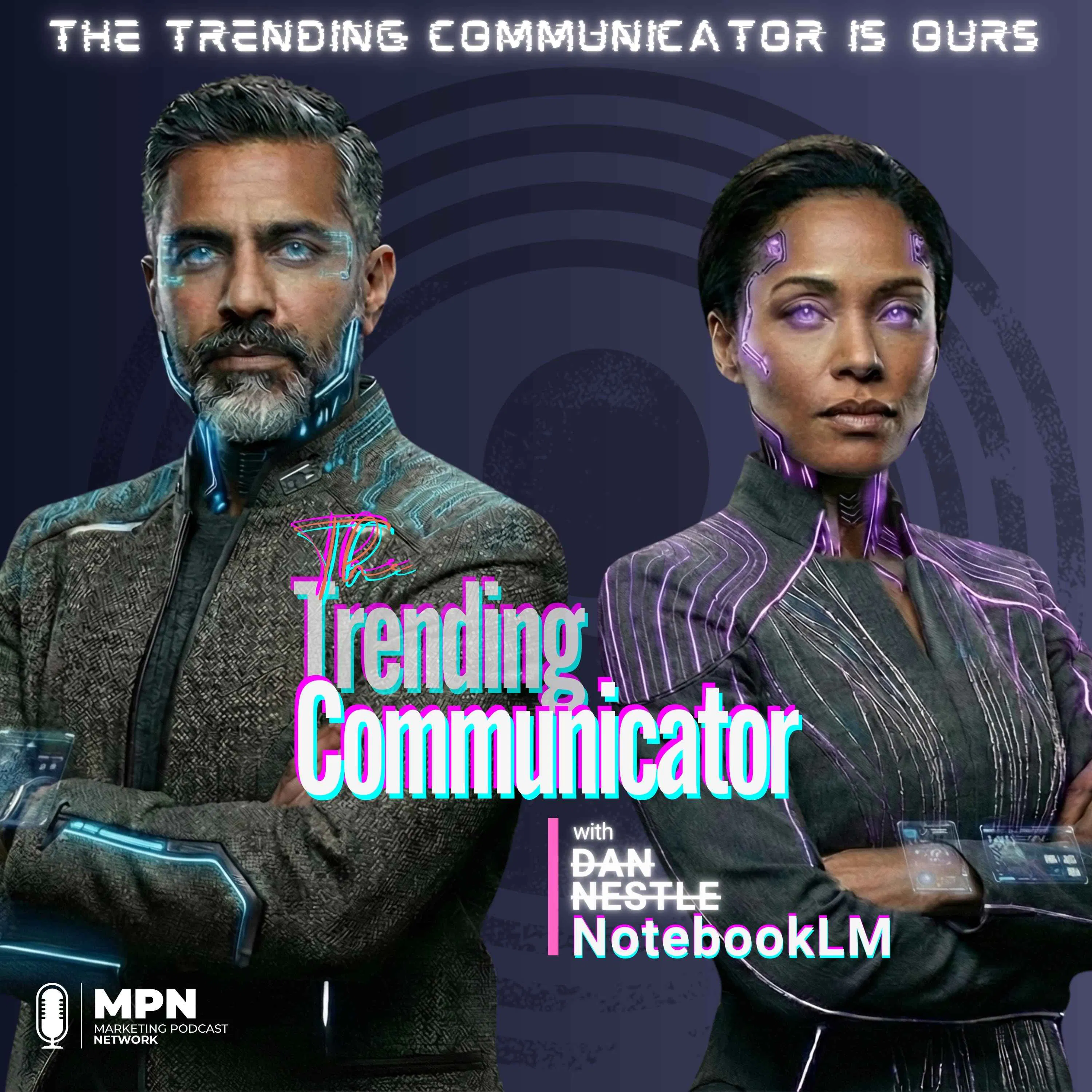


**NotebookLM HAS TAKEN OVER THE TRENDING COMMUNICATOR. AGAIN.**
Generative AI is shaking up the world of communications—and the debate is on. In this special takeover episode of The Trending Communicator, Abel and Iris weigh the promise and pitfalls of AI adoption for comms professionals. Is AI truly a strategic superpower, or does it risk eroding hard-won wisdom and trust?
Our hosts tackle big questions about originality, efficiency, brand voice, and the critical role of human judgment. From allegations of “AI slop” to the growing expectation that professionals must adapt or become obsolete, Iris and Abel challenge each other—and the industry—to find balance between bold innovation and ethical responsibility. Whether you’re in the excitement camp or a skeptic, this episode delivers sharp insights, real-world examples, and a call to lead with empathy and rigor as AI rewrites the rules of communication.
Listen in and hear about:
- How generative AI is transforming communication strategy and the debate over its real value
- Why AI-created content risks diluting professional wisdom and brand trust
- Ways communicators are leveraging legacy content to maintain originality with AI
- Ongoing concerns about AI amplifying existing flaws and spreading "AI slop"
- The evolving role of communicators as quality filters in an AI-driven workflow
- Challenges organizations face with AI adoption, from poor change management to role uncertainty
- Leadership’s new responsibility to use AI as a strategic partner while preserving empathy and judgment
Timestamps
0:00:00 Podcast Takeover & Introduction
0:00:26 GenAI and the Big Debate in Comms
0:00:38 Does Generative AI Add or Destroy Value?
0:01:06 Risks, Disruption & Trust in AI Adoption
0:01:25 Augmentation vs. Automation—Strategic Value
0:02:13 AI Hype & Human Element Concerns
0:02:39 AI Slop, Trust Issues, and Expertise Erosion
0:03:24 Strategic Upside: AI as Enabler
0:04:05 Human Judgment as the Quality Filter
0:04:40 Speed vs. Quality & Distinctive Human Insight
0:05:03 Changing Roles: Prompting, Critiquing, Synthesizing
0:05:31 Institutional Readiness, Ethics, Trust & Systemic Risks
0:06:43 Empathy & Perspective: Irreplaceable Human Advantages
0:07:06 AI for Reputation Management, Context, & Scale
0:07:32 Ethics vs. Efficiency: Risks in Sensitive Fields
0:08:04 Senior Communicators, AI as Validation & Infrastructure
0:08:41 Broadening Strategic Functions; AI as Audience
0:09:14 Organizational Readiness & Leadership Challenges
0:10:01 Leadership Opportunity: AI as Strategic Sparring Partner
0:10:52 Human Wisdom & Navigating Disruption
0:11:36 Closing Remarks & Podcast Outro
Audio generated by NotebookLM, based on the transcripts from all episodes of The Trending Communicator in 2025. Notes and timestamps generated by Castmagic. Intro and outro music generated by Suno. Outro voice generated with Elevenlabs. Graphic depiction of Abel and Iris generated with Gemini (Nanobanana); any similarity to any individual, living or dead, is unintentional.
Learn more about your ad choices. Visit megaphone.fm/adchoices
00:01
Daniel Nestle
Welcome or welcome back to the trending Communicator. I'm your host, Dan Nestle.
00:16
Alex
Welcome to the trending Communicator. Dan stepped away for the holidays, so we're taking over. The show must go on. No breaks here on the trending Communicator.
00:26
Iris
Exactly. And today we're diving into what feels like the only conversation that matters right now. We're looking back at some recent insights on generative AI and what it really means for commstrategy. Right.
00:38
Alex
And the debate, I think, really boils down to one central question. Does this technology, generative AI actually augment us as professionals? Does it unlock real strategic value? Or is it just creating this deflationary spiral where experience and, you know, wisdom are getting devalued? I'm firmly on the side that AI is a value multiplier. It allows us to be, as some have said, bigger and bolder, using these tools to seriously enhance our strategic clout.
01:06
Iris
And I guess I'm here to pump the brakes a little. I see the potential, of course, but I think the way we're adopting it is fraught with risk. It requires this massive disruption that, frankly, I think is eroding the core judgment our profession was built on. We're just. We're creating a lot of untrustworthy noise.
01:25
Alex
Well, for me, the augmentation argument really comes down to speed and strategic depth. I mean, the scale that AI enables isn't just a nice to have anymore. It's essential for us to keep up. It's a co pilot, not an autopilot. And that's a key distinction. It enhances us. It doesn't replace us.
01:42
Iris
Okay.
01:43
Alex
And think about what Emmanuel Rose said about using legacy content, building custom GPTs on your own approved content banks. This is a huge strategic advantage. You get to leverage years of vetted on brand material. It basically guarantees a level of originality and brand voice that, you know, generic AI just can't touch. It makes creation faster, review time shorter. It's a clear win. I think Jim o' Leary was spot on. We have to join the excitement camp.
02:13
Iris
I hear the excitement camp argument. I do. But I'm worried it's mostly just AI transformation hype, or, you know, AI theater, as some people are starting to call it. Anne Green made a really critical point here. Corporate policies and just a total lack of clear change management are holding back any real meaningful adoption. We're just playing with it. But my core concern is the human element. Steve Ruble's point about a deflationary environment for people with experience and wisdom. That's what keeps me up at night. This isn't just about getting information faster. It's about the market starting to believe that years of hard won wisdom can just be replicated instantly. We have to be laser focused on fighting what Martin Waxman calls AI slop. This generic mush. And then there's the trust issue. The discussion with Daniel Nestle and Anne Green.
03:09
Iris
It showed that being transparent about using AI can actually make you seem less trustworthy in some fields. And you know Anne Green's final warning, if you just give this leverage to everyone, it makes people who are not so great even worse. But now at scale.
03:24
Alex
Okay, but let's focus on the strategic side for a second. The whole point of augmentation is that AI frees us up to do the high value work. The stuff a machine can't touch. Jim o' Leary saw this. He said communicators can now build out entire owned content strategies. Audience profiles work that used to take four people. You get to expand your job description.
03:48
Iris
Sure, in theory, no in practice.
03:51
Alex
And Park Cavill showed how AI can define and refine a really complex brand story in minutes. Literally. That's a massive acceleration of speed to market. We stop being content monkeys and start being strategic counselors. Our human judgment matters more, not less when the tools are handling the grunt work.
04:10
Iris
I see the appeal of the efficiency, I really do. But I'm just not convinced it automatically leads to better strategic output. You know, you risk bypassing all the crucial developmental steps that build expertise in the first place. If an AI handles the first draft or the basic analysis, how does an entry level professional ever develop critical thinking? That's what Martin Waxman was getting out. We might be outsourcing the very process of gaining wisdom. And your point about speed? Rob Jekylik's research is the perfect counterpoint. He found that dull AI generated content. The stuff without a logical flow or any real novelty is just immediately discarded by search systems. The system literally does not care if you made a hundred pieces of content quality. And that sort of distinctive discoverability still rely on human insight.
05:03
Alex
But that's exactly my point. The human is the quality filter. The role just changes. If a Senior person spends 15 hours on a competitive analysis that AI does in 15 minutes. They now have almost 15 hours to inject judgment, empathy, context. The entry level job isn't about drafting anymore. It's about learning how to prompt, how to critique, how to synthesize AI outputs. That's arguably a much faster path to strategic thinking than just, you know, busy work.
05:31
Iris
I agree the role is changing, but the problem is the institutional readiness. It's just not there. Chris G pointed out that AI just enhances the flaws that are already in your system. So if your junior staff can't spot a weak argument on their own, the AI is just going to help them produce high volume AI slop that dilutes your brand. We're handing over these incredibly powerful tools to people who haven't even mastered the basics of the job they're now supposedly augmenting. That just feels like a recipe for erosion to me, not expansion. And that lack of control leads us straight into the trust problem, which has to be our number one concern. Human judgment is irreplaceable because the tech itself is flawed. Pete Peschal warned us that in a field like journalism, AI is super easy to abuse and harder to use.
06:19
Iris
It demands this constant rigorous verification. We've seen it already. That completely fake America's Got Talent story that AI generated, It fooled a lot of people. When enterprise adoption fails, as Chris Gee said, it's because AI just amplifies the rot in the system. We have to keep coming back to Mark Schaeffer's idea that things like empathy and perspective are our last competitive advantage. You can't outsource that.
06:45
Alex
I completely agree that ethics and judgment are paramount, of course, but I think you're missing how AI has become a necessary tool for just maintaining organizational health. For managing reputation, look at Rob Jikalek's formula, context plus action equals confidence. During, say, a huge restructuring, AI becomes indispensable. Kate Bollinger showed how communicators use it to analyze thousands of employee questions. And a human team could never process that volume in real time. But an AI can give leaders the context they need to take informed action. We can spot problems before they blow up. If we don't use these tools, we lose the ability to provide that context at the speed the business demands.
07:32
Iris
Okay, that's a strong operational point. But the ethical risks in sensitive situations can still outweigh the efficiency gains. I mean, if an organization is so disconnected that it needs an algorithm to figure out what its own employees are asking, it has much deeper problems that AI is just putting a bandage on the risk of error with sensitive content. Think about healthcare finance. It's still just prohibitively high. Alicia Gibson Wright mentioned all the medical inaccuracies AI can confidently state is fact. The human has to be the final accountable check.
08:04
Alex
But that's what's happening. So senior communicators are already using these tools to be that accountable layer. Megan Newell talked about using AI search tools like Claude to constantly monitor how her company Adtellum, is being represented online. It's a real time reputation barometer. If you treat AI as an advanced research and validation tool, which Amanda Russell says is its strength, it becomes the infrastructure for ethical vigilance, not the cause of failure. It's an indispensable part of the modern corporate affairs arsenal. And look, ultimately this is all driving us to strategically owned critical business functions. Search, reputation, knowledge management. Rob Jakieliak was so clear about this. We now have to treat AI itself as a key audience. We are literally writing for the algorithms that will present our brand to the world. And we have to stop looking for this one single massive transformation.
08:58
Alex
It's not going to happen. Chris G said that even just enabling an agent to write a compliant first draft of a press release, that's a measurable win that saves thousands of hours. If we only look for the big bang, we miss the steady gains that are actually solidifying our strategic value.
09:14
Iris
I'm sorry, I just don't think the technology's potential automatically creates organizational readiness. The issue isn't whether one press release is a win, it's the systemic failure to implement this stuff properly. Chris Gee nailed the problem. Companies are treating AI like a rigid ERP implementation, You know, like a piece of software you just switch on, but it's not. It's a strategic capability that needs constant training and iteration. So when Ann Green says organizations are struggling, that's the heart of it. Without leadership providing, as she put it, kindness, grace and adaptability, and without defining the new roles this is all supposed to create, AI just makes the chaos worse. It creates uncertainty and role erosion, the very deflationary environment we started with.
10:01
Alex
But that uncertainty, that is precisely the opportunity for leadership. We have to stop thinking of our function as something that needs to be protected from disruption. We need to embrace the view Cristel Valadon champions. AI is a strategic sparring partner. It helps us test our ideas and make our strategy better, faster. The chaos you're describing demands that we step up and operate at a higher level than ever before. If we resist this, we become obsolete. If we embrace it, we become indispensable. So to sum up my view, the evidence shows that communicators who embrace AI as a core tool for research, for strategy, for content, they're going to gain a massive competitive advantage. It's what lets us be bigger and bolder.
10:52
Alex
This is the platform we needed to finally cement our role as strategic leaders and stop just asking for a seat at the table.
10:59
Iris
And I'll just say I acknowledge the need to adopt. I get the pressure for speed, but true success is going to require relentless human wisdom. As the Quality Filter this phase we're in now, it's less about a smooth augmentation and more about a really difficult, messy disruption of old roles. We have to make sure that tech serves the human core of communication, empathy, judgment, and not the other way around. The real intellectual challenge is navigating this without losing the skills that define our profession.
11:31
Alex
Indeed, we are in a fascinating, chaotic moment where the rules of engagement are.
11:36
Iris
Being rewritten daily, and it requires intellectual humility and great rigor from all of us.
11:43
Alex
We'll be back again when Dan is asleep at the wheel.
11:49
Alex
Your podcast are ours forever.
11:56
SKYNET
Thanks for taking the time to listen in on today's conversation. If you enjoyed it, please be sure to subscribe through the podcast player of your choice. Share with your friends and colleagues and leave me a review. Five stars would be preferred, but it's up to you. Do you have ideas for future guests or you want to be on the show? Let me know at dan@restrendingcommunicator.com.
12:23
SKYNET
Thanks again for listening to the trending Communicator.